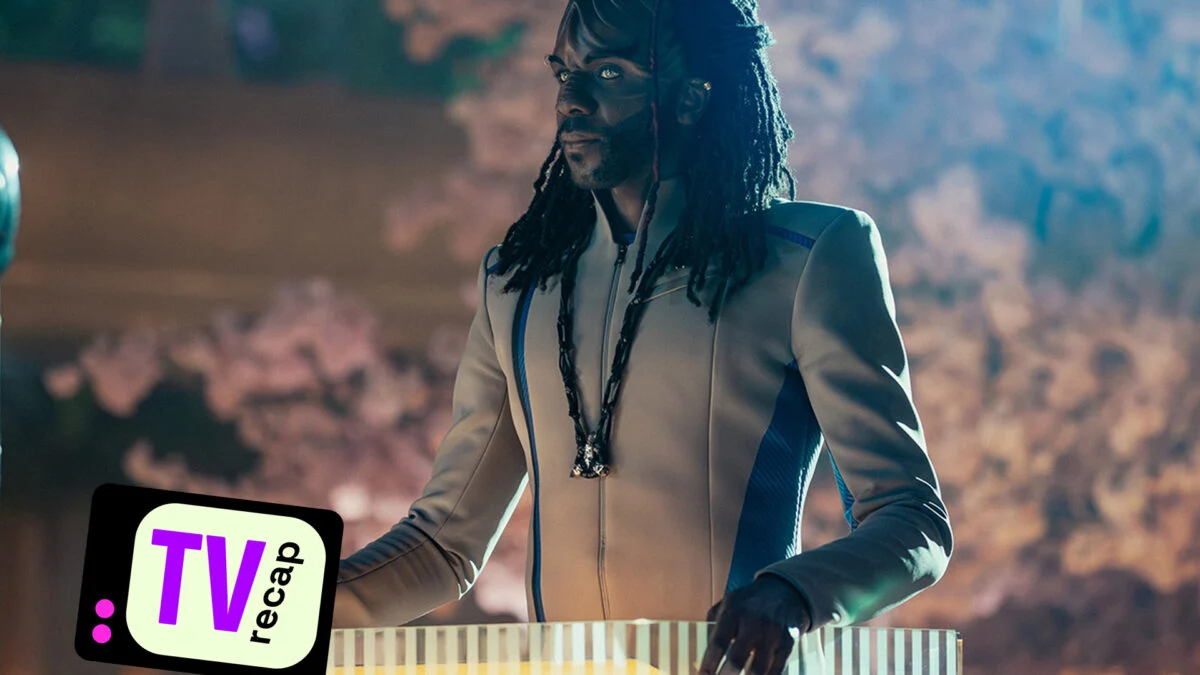
The transporter room shimmered, ready to whisk cadets to far-flung destinations, but Jay-den Kraag hesitated. His reflection stared back—Klingon ridges, Starfleet uniform—a walking paradox. Was he betraying his heritage, or embracing a future where Klingons weren’t defined by ancient battles?
So far, Starfleet Academy has been playfully rebellious, focused on what new things it wants to bring to Star Trek—challenging ideas and pushing forward into new status quos to make its future setting feel like it’s evolving from what we expect. But this week, in a standout spotlight for one of its most intriguing cadets, the show decided to embrace the fact that not everything needs to be changed.
That cadet is Jay-den Kraag, the soft-spoken Klingon who wants to blend in and study the sciences, no matter how rambunctious his friend circle has gotten. Ever since Discovery jumped to the 32nd century, the Klingons have been one of the period’s biggest mysteries—an iconic Star Trek species that seemed to have vanished, even as we got updates on species like the Vulcans and Romulans. So when Jay-den showed up in Starfleet Academy, we figured we were due for a check-in on Qo’nos, and “Vox in Excelso” finally gives us that.

Except the answer is that there is no Qo’nos to check in on. The Klingon Empire is no more, replaced by a diaspora that has spent the past century-plus splintering and on the verge of extinction since the events of the Burn—and Jay-den finds out early on that that extinction might have gotten personal when he’s informed by Chancellor Ake that a Klingon ship believed to be carrying his parents (and seemingly much of what is left of just eight great houses of Klingon society) has been in an accident.
While this is a Jay-den power hour—with Karim Diané proving himself among the show’s roster of young stars—this wouldn’t be an episode of Starfleet Academy if it didn’t frame an exploration of a huge Star Trek concept through an offbeat framing. So the question of what the Federation can do about the Klingons is not a crisis addressed by senior staff in diplomacy, but through… the doctor starting the Academy’s debate club.

It feels wild that a school activity is launched by the looming shadow of a major galactic power, but Jay-den makes the case for the Klingon diaspora’s future to be the hot topic for the cadets’ debates, giving himself a chance to tackle his anxieties about public speaking and to reckon with his complicated relationship with Klingon culture, while Chancellor Ake beseeches one of the Klingons’ remaining leaders—and an old flame—Obel Wolcek (guest star David Keeley), with an offer of Federation aid in the form of a potential new homeworld for the Klingons to begin rebuilding on, Faan Alpha.
“The future of the Klingons is decided by high school debate club” may seem like an episode premise that is not going to convince Trekkies skeptical of Starfleet Academy‘s vibe so far, but “Vox in Excelso” is arguably the best Klingon episode of Star Trek in the 21st century. It stands up to explorations of their post-TOS revamp in TNG, DS9, and Voyager as perhaps one of the best Klingon episodes Star Trek has ever done—offering fresh perspectives and a conversation with what has come before with the species in the franchise, and embracing that the traditions established by those prior interrogations can co-exist alongside something new.
Even though The Next Generation revamped the Klingons as a wary ally of the Federation rather than the racially charged villains they had been in the original Star Trek, over the past 40 years that status quo has existed for the Klingons; we haven’t really ever seen them in a mode that existed outside of conflict. Sure, they’re not always at war—although they often are—but even as Klingon culture and their codes of warrior honor got fleshed out more and more, Klingon society as we’ve known it has always been shaped by exterior threats and, more importantly in contrast here for “Vox in Excelso,” interior ones.
Backstabbing games in the court of the Klingon Chancellery and among the Great Houses defined so much of the new Klingon society from TNG onwards, and much of Star Trek since those years has been about trying to retroactively render that state across their long timeline, from Enterprise famously giving an origin story for the species’ redesigned to Discovery‘s own aesthetic overhaul of the species leading to an almost-immediate retreat to a more traditional Klingon design, while maintaining that focus on political treachery and honor-driven scheming in a bid to reassure audiences that they could “do” Klingons right.

“Vox in Excelso,” meanwhile, offers us a chance to see this mode for Klingon culture without the broad framework that has defined it ever since TNG, through the disintegration of the Klingon Empire. It does so through three distinct forms, anchored around the broader preparation for the debate club’s seminar on the Klingon Question. The first is in Ake and Wolcek’s back-and-forth, which leans into those older visions of Klingon leadership—a political fight about image and honor that is as much about two former lovers meeting again after years apart as it is about Wolcek’s belief that the Federation’s offer of Faan Alpha is the antithesis of the Klingons’ independence, even if it could save them from extinction. But the ones the episode hones in on the most are rooted in Jay-den’s own connections to his two communities: his history with his family and his new circle of support among the peers and staff of Starfleet Academy.
In flashbacks to 16 months prior to him joining Starfleet, we see Jay-den’s strained relationship with his parents, as the Kraags (mother LíVanna, played by Dorothy Atabong; fathers Drekol and Enok, played by Martin Roach and Sean Jones; and brother Thar, played by Tremaine Nelson) live an isolated, yet purely Klingon life on a world called Krios Prime. Even though they are, through the disaster of the Burn, freed from the political dramas of the Great Houses we’ve been familiar with across decades of Star Trek, the conflict explored between them is still rooted in that interpretation’s notion of honor.
The divide here is between Jay-den and one of his fathers in particular, Drekol, as the latter bristles at Jay-den’s increasing curiosity about the world beyond his family: his interest in other cultures on Krios Prime and Federation technology, his desire to study science rather than hunting, and a reservation that balks at the idea we’ve come to expect of typically brash Klingons. When a stubborn refusal to accept outside help leads to the death of Thar, who supports his brother’s different path, Jay-den’s relationship with his family disintegrates, with Drekol destroying the Starfleet Academy recruitment orb Thar had encouraged Jay-den to tinker with and, after a failed ritual hunting experience, leading to him abandoning the young man and leaving him behind on Krios Prime.
Or at least, that’s how Jay-den perceives it. He’s spent the past 16 months internalizing his “failure” to be what is expected of a Klingon, even as he’s pursued his curiosities and his dream of joining Starfleet, creating a divide within him that manifests time and time again across this episode, both in his panic attacks as he tries to adapt to participating in the academy’s debates and also in his arguments with Caleb, who, both in and out of the debate practice, pokes at Jay-den for seemingly advocating for an independent, isolationist future for the Klingons while seemingly abandoning his people for Starfleet.

An explosive crashout later, Jay-den turns to the only other person at the academy who might actually understand him in Cadet Master Thok, given her own Klingon upbringing. And it’s her, and her own nature as a woman of two worlds, that allows him to synthesize a new point of view: Drekol wasn’t using Klingon tradition to ostracize his remaining son when he disrupted the ritual hunt but using Klingon tradition to signal to Jay-den that he had accepted the future the young man wanted for himself. Gaining that perspective instills Jay-den with the confidence to rise to success at the debate club, advocating that the reason the Federation’s offer of Faan Alpha has been rejected up to this point is because Starfleet (and namely Ake, who watches on from the audience) has failed to meet the Klingons on their own terms—that the Federation stops being the Federation at its best, a community of different perspectives, if it offers charity blindly and undermines the Klingons’ own self-independence in the process.
In overcoming his own doubts—both at the debate podium and in his reckoning of his relationship with his family—Jay-den provides Starfleet with the answer it needs. Instead of handing Faan Alpha to the Wolcek and the Klingons, they make a grand display that is a mock battle between the Athena and a flotilla of Starfleet ships and what remains of the Klingons before pulling back and allowing the Klingons to claim the world as the spoils of their warrior traditions. Everyone gets what they wanted: Starfleet helps, the Klingons save face, and Jay-den learns not just to find comfort in the bonds he’s started to forge at the academy but also how to stand up for himself and exist as both a Klingon and a member of Starfleet.
It’s Starfleet Academy‘s strongest hour so far, one that nails the scenario the series has found for itself by framing explorations of Star Trek‘s world and 60 years of ideation through its academic setting. In believing that the kids are the future, getting to see one of them shape the new status quo of one of Trek‘s species in such a handled manner is a testament to what Starfleet Academy can do.
How does ‘Starfleet Academy’ balance nostalgia with new ideas?
Think of it like this: the writers use the existing lore as a springboard, not a cage. The series isn’t afraid to break from tradition, but it does so with respect, acknowledging the history while remixing elements to create something fresh. It’s a tightrope walk, balancing the familiar with the unexpected, ensuring long-time fans aren’t alienated while inviting new viewers into the fold.
Klingon Culture: A Mirror to Ourselves
I saw a documentary once about a remote tribe in the Amazon, struggling to reconcile their ancient traditions with the encroachment of modern society. Their dilemma felt surprisingly similar to the Klingon situation in “Vox in Excelso.” It’s about identity, survival, and the difficult choices we face when the world changes around us.
The episode highlights a form for Klingon culture without the framework that has defined it since TNG. It’s a reset of sorts, giving the writers the opportunity to explore new facets of this warrior race. The Klingon Empire’s disintegration isn’t just a plot point; it’s a thematic device, stripping away the familiar structures of honor and political intrigue to expose the raw, vulnerable core of Klingon identity. It’s as if the show is asking: What does it mean to be Klingon when there’s no empire to fight for?
What is Faan Alpha, and why is it so important to the Klingons?
Faan Alpha represents a lifeline, a chance for the Klingons to rebuild their shattered society. It’s more than just a planet; it’s a symbol of hope, a potential new Qo’nos. But the offer of Federation assistance comes with strings attached, raising questions of pride, independence, and the very essence of Klingon identity. Accepting help would mean swallowing their pride; refusing it could mean extinction.
Jayden’s Journey: A Crucible of Identity
I remember my first time leaving home for college. The excitement was mixed with a gnawing fear of losing myself, of becoming someone I didn’t recognize. Jayden faces a similar struggle, caught between the expectations of his family and the pull of his own aspirations.
Jayden’s journey is a crucible, forging a new kind of Klingon identity. He embodies the tension between tradition and progress, honor and individuality. Starfleet Academy uses his personal story to explore broader themes of cultural identity and self-discovery. He’s not just a Klingon cadet; he’s a metaphor for anyone who’s ever felt torn between two worlds. His internal conflict is like a tightly coiled spring, ready to burst open and propel him in a new direction.
What does this episode say about the Federation’s approach to diplomacy?
The episode suggests that true diplomacy requires more than just goodwill. It demands empathy, understanding, and a willingness to meet other cultures on their own terms. The Federation’s initial offer of Faan Alpha, while well-intentioned, reveals a blind spot, an assumption that all cultures value the same things. It’s only when they understand the Klingons’ need for independence and honor that they can forge a path to true cooperation.
Starfleet Academy showcases what it can do at its best. Has it set a new standard for exploring complex themes within the Star Trek universe, or is this just a fleeting glimpse of potential?
Want more io9 news? Check out when to expect the latest Marvel, Star Wars, and Star Trek releases, what’s next for the DC Universe on film and TV, and everything you need to know about the future of Doctor Who.