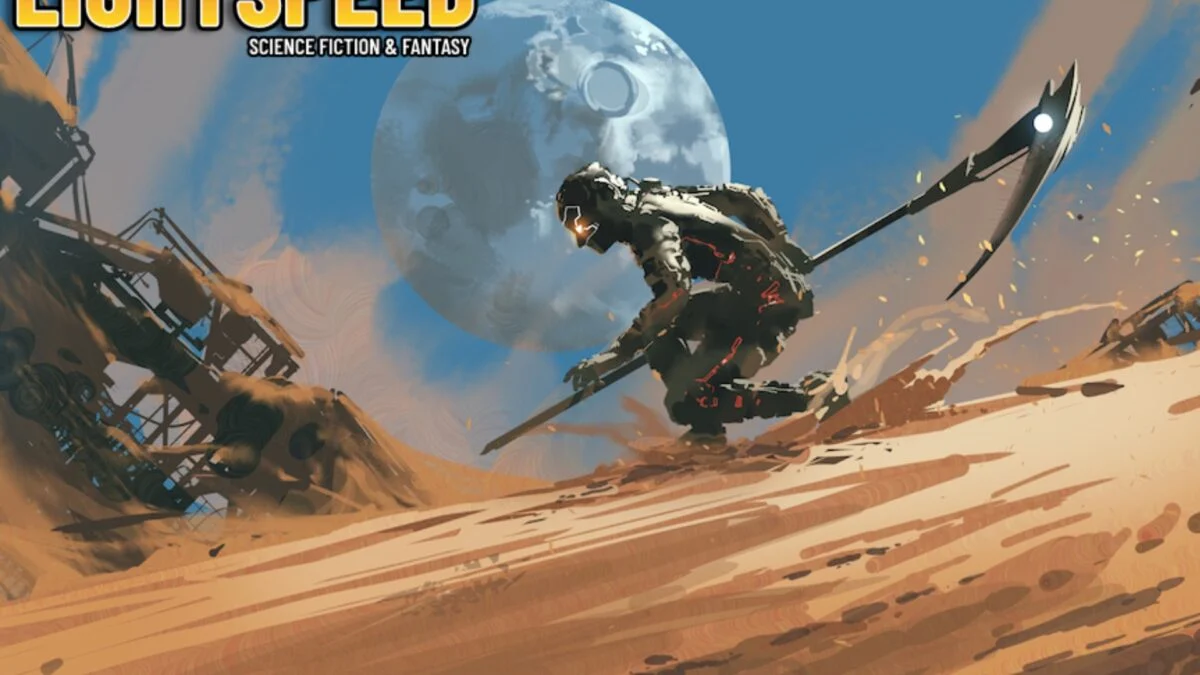
The Singapore Strait, 2237 AD. A watchtower sentinel stares at her console, half-listening to the monsoon hammer the metal roof, the other half dreading the inevitable ping from her ex. Wei Jie’s digital persistence was becoming a kind of torture, a relentless drip of hope in a world running dry. Was this the kind of slow-motion doom everyone felt before the end?
Death Echoes Overlapping
By Megan Chee
The scent of rain on hot asphalt always brings me back to my childhood, growing up in Kuala Lumpur. It’s a primal memory, a sudden rush of cool air amid stifling humidity. In Megan Chee’s “Death Echoes Overlapping,” a similar sense of place anchors a story that spans galaxies and eons, exploring the echoes of destruction and the strange connections that bind seemingly disparate lives.
The story opens with the necropolis station of Tau Andromeda, a civilization fueled by harvested “death echoes.” Keepers tend to the dead, channeling their energy to power a megacivilization. To them, death isn’t a tragedy but a gift, a return on the investment of life.
But golden ages fade. Tau Andromeda crumbles, its planets reclaimed by nature, the necropolis station left silent in space.
Then, across the vast expanse of the cosmos, three planets meet sudden, violent ends. These civilizations, unaware of each other’s existence, are destroyed by a gamma-ray burst, a weapon of mass destruction, and self-replicating nanobacteria.
Their death echoes ripple outward, overlapping and reverberating through space and time. This is where Chee’s story truly begins, a symphony of cosmic grief echoing across dimensions.
• • •
On Earth, in 2237 AD, Esther monitors the seas from her watchtower in the Singapore Floating Archipelago. Wars rage elsewhere, but her corner of Southeast Asia is quietly succumbing to the rising ocean.
Her ex, Wei Jie, still texts, clinging to a future she sees as impossible. “Can we talk?” he asks. She deflects, her patience worn thin by his obliviousness. She sees the end coming, accepts it, even embraces it. Everything returns to the sea, eventually.
• • •
On the planet Autura, the Collective morphs into the Farmer, a being composed of trillions of insectoid Units. The Farmer’s life is simple: plough the land, plant the seeds, harvest the fruit. Satisfaction comes from repetitive motion, from unity with the Collective.
Unit XJ7832, a single cell in the Farmer’s brain, experiences this contentment. Born in the swamp of the Mother’s Embrace, it joins its siblings in a single, unified purpose.
• • •
On the gas giant Lalesh, the Wisps ride the supersonic winds. These beings, made of thin, weblike tissue, absorb energy from the storms. They are artists, poets, scientists, communicating through intricate patterns of movement.
One Wisp, however, is alone. A shred in its body makes its flight erratic, unable to join the flocks. The Lonely Wisp dances through the storms, creating beauty that no one else will ever see.
• • •
The death echoes of Earth, Autura, and Lalesh converge, creating a strange, alien awareness in the final days of each world. Their people dream strange dreams.
What Happens When Different Realities Collide in Dreams?
Esther dreams of being buried alive in a sea of bugs, becoming one of them, a small scuttling thing in a massive throng. The horror gives way to a strange sense of order, a realization that she is part of a thinking thing, a collective soul.
She wakes up in tears, remembering the terror and the beauty of their synchronized movement. Wei Jie is at her door, drawn by her screams. For the first time in a long time, she questions her contempt, wondering if they are all just small, scurrying creatures, playing their assigned roles.
Wei Jie shares his own strange dream, a vision of flying in a cold wind, understanding the flapping animals around him. Esther, surprised by a note of wistfulness in her voice, wishes she had dreamed the same.
• • •
Unit XJ7832 experiences a moment of individual consciousness, separate from the Collective. It sees the world through its own eyes, not the eyes of the many. But the Collective calls, and it is absorbed back into the whole.
Until now. Unit XJ7832 finds itself alone, shivering in a small room. It flexes its hands, marveling at their solidity, their singularity. Instinct drives it to explore, to witness the other Characters, each living a solitary existence.
It steps out into the night, drawn to the ocean. It wants to jump in, to feel the cool water against its skin. But it awakens back in the Collective, the moment of individuality lost in the seamless flow of Units.
• • •
The Lonely Wisp finds itself on solid ground, in a field of orange grass and crystalline sculptures. It is now the Artist, a being made of insectoid Units. Its many hands shape the crystal structures, creating beauty for its own sake.
Can Art Exist Without An Audience?
As the sun sets, the sky turns vibrant hues, reflected in the sculptures’ translucence. There is no one else to witness this beauty, but the Artist knows that eventually, others will come, and the sculptures will stand as an embodiment of its luminous mind.
• • •
Esther is flying, dancing in the frigid wind. She begs to stay there forever, to be this forever. Is this heaven, she wonders, this eternal dance in the cold?
• • •
Esther awakens to an alarm. A doomsday weapon has been detonated. Wei Jie takes her hand, calm and serene. “Let’s go outside,” he says. “I don’t want to die down there in the dark, packed like sardines.”
The sky is red. The horizon is aglow. Esther wails, realizing she doesn’t want to die. Wei Jie holds her, comforting her. “Maybe we’ll end up there, after this,” he says. “Let’s meet again in the windy place.”
Everything lights up in scarlet.
• • •
A swarm of nanobacteria is devouring Autura. Unit XJ7832, part of the Physician’s eye, watches as everything falls apart. For a moment, it feels afraid, not just as the Physician, but as itself. And then it feels nothing at all.
• • •
The Lonely Wisp is composing a new poem when the gamma-ray burst hits. It has no idea it’s coming.
• • •
The death echoes of the three planets ripple outward, sweeping over the Tau Andromeda system. On the necropolis station, empty thuribles glow with energy. Clockwork machines groan into motion. Stagnant fountains begin to flow.
For a moment, the necropolis space station lives. Then, with a sigh, the death echoes fade, leaving it still and silent once again.
About the Author
Megan Chee is a Singaporean author who has lived in Taiwan, Hong Kong, and the United States, and is currently based in Singapore. Her debut science-fantasy novel “The Archaeology of Falling Worlds” will be published in early 2027 by Daphne Press (UK) and Bindery Books (US). Her short fiction has appeared in Clarkesworld Magazine, Uncanny Magazine, Strange Horizons, Lightspeed Magazine, and other venues. Her work has been translated into Chinese in Science Fiction World, and has been featured in The Year’s Best Fantasy anthology (Pyr Books). Her short story “The God of Minor Troubles” was narrated by Wil Wheaton on Season 1 of his audiobook podcast It’s Storytime with Wil Wheaton. You can find her online at meganchee.carrd.co, @meganflchee on X and Bluesky, and @megancheewrites on Instagram and TikTok.

Please visit Lightspeed Magazine to read more great science fiction and fantasy. This story first appeared in the February 2026 issue, which also features short fiction by Alexander Weinstein, Phoenix Alexander, Audrey Zhou, Rukman Ragas, Deborah L. Davitt, Modupeoluwa Shelle, Susan Palwick, and more. You can wait for this month’s contents to be serialized online, or you can buy the whole issue right now in convenient ebook format for just $4.99 (approximately €4.65), or subscribe to the ebook edition here.
Want more Movies & TV news? Check out when to expect the latest Marvel, Star Wars, and Star Trek releases, what’s next for the DC Universe on film and TV, and everything you need to know about the future of Doctor Who.