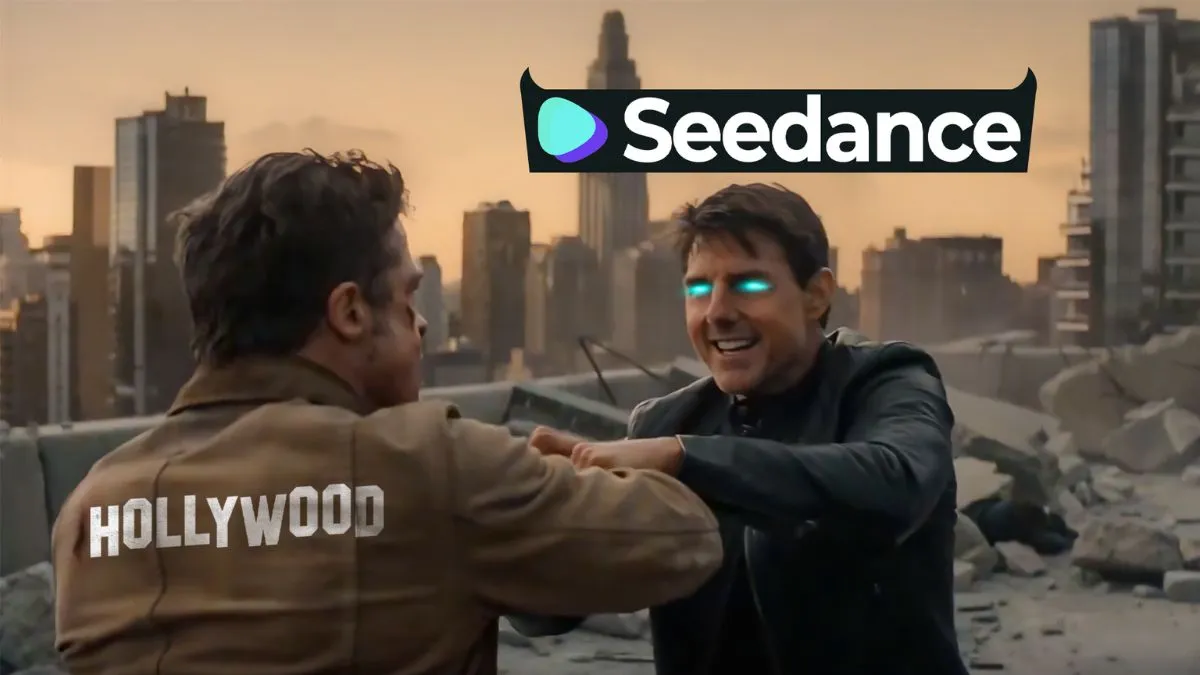
Imagine scrolling through your feed and stumbling upon a video that sets your heart racing: Brad Pitt and Tom Cruise, locked in an epic rooftop battle, their every move so lifelike it feels as if you’ve just watched a scene from an action blockbuster. The shock isn’t just from the visual quality; it’s the unsettling realization that what you’ve seen isn’t real, but a fabrication birthed from the depths of artificial intelligence. This chilling creation is the handiwork of Seedance 2.0, a revolutionary model developed by ByteDance, and it poses an unprecedented challenge to the very fabric of Hollywood.
The brilliance of the Pitt-Cruise video dazzles the eye, yet it masks a more sinister threat lurking beneath its surface. Let’s explore why this development isn’t merely impressive—it’s terrifying.
Hollywood Just Met Its Greatest Threat
Breaking: China’s Seedance 2.0 is INSANE.
SPOILER: Hollywood is now officially behind.
10 Wild examples:
1. Jeffrey Epstein knew too much pic.twitter.com/EG7eABzXzu
— Future Stacked (@FutureStacked) February 11, 2026
Once you catch a glimpse of that video, it’s hard to shake off the realization of its hyper-realism. From cinematic lighting to fluid movements, the whole experience is designed to mesmerize. The most alarming aspect? No cameras rolled, no stunt teams were engaged, and most shockingly, no actors gave their consent. All it took was a prompt to Seedance 2.0, and voilà—a new reality emerges. This is a seismic shift for Hollywood, a disruption that threatens to redefine star power.
For decades, the allure of the silver screen has rested on the shoulders of iconic stars. The global box office thrives on the connection between actors and their fans, relying on the real emotions they bring to life. But what happens when a software can replicate that magic—facial expressions, vocal nuances, emotional depth? This could fracture the very foundation of cinema, eroding the influence that stars currently wield and casting a shadow over everyone involved in the film industry.
Movie Industry Could Face the Music Soon
Every technological advance in Hollywood should be approached with caution, and Seedance 2.0 is no different. If a single software can reproduce performances at a fraction of the cost, what incentive do studios have to invest in costly contracts or hire human talent? Why employ makeup artists, set designers, or even visual effects teams when a few clicks could generate stunning visuals? This could lead to a long-term economic fallout, imperiling cherished filming locations worldwide as studios pivot toward digital recreations.
While Hollywood has navigated technological revolutions before, these required human involvement. Seedance 2.0 seeks to minimize that need, making it a formidable adversary for all whose livelihoods depend on the film industry.
Seedance 2.0 Throws Consent out of the Window
The Motion Picture Association of America (MPAA) and Disney have filed a lawsuit against ByteDance over the Seedance 2.0 project, alleging “massive copyright infringement.”
Watch this video, and you’ll understand the real reason for Hollywood’s panic: survival. In the past,… pic.twitter.com/5UZXcYzEY9
— China pulse (@Eng_china5) February 15, 2026
A critical issue with this AI innovation is its blatant disregard for consent. The Brad Pitt and Tom Cruise video serves as a troubling example; neither actor approved the use of their likeness, yet someone monetized it without permission. This opens a Pandora’s box of ethical dilemmas. Celebrities may eventually seek legal safeguards, but the chilling aspect is that this incident has only begun to scratch the surface of what could be happening unnoticed across the internet.
In a stark response, Disney and SAG-AFTRA have vocally challenged ByteDance for compromising copyright and misusing intellectual property. While ByteDance has promised to implement oversight to prevent future infringements, Hollywood recognizes that legal recourse can’t fully address the threat posed by AI.
Shockwaves Beyond Hollywood
While the immediate impact looms large over Hollywood, the potential misuse of technology like Seedance 2.0 extends far beyond. Imagine fabricated footage crafted for harassment, propaganda, or damaging reputations. The grim narrative has already been explored in the 2025 film G20, which depicted how AI-driven videos could manipulate public sentiment and sway global events. What might have seemed like fiction now feels like an eerie reality.
Envision a world where every piece of evidence—be it a leaked video or a supposed eyewitness account—can be contested as artificial, where perception loses its grip on reality. With technology capable of imitating life so flawlessly, what happens when the line between truth and falsehood blurs? The ramifications stretch far beyond entertainment, posing a significant risk to democratic processes and journalistic integrity.
The sheer power of Seedance 2.0 is not merely in its creations; it lies in the uncertainty it ushers in. The AI-generated battle between Hollywood titans may seem like harmless fun, but as history shows, the ability to distort reality has far-reaching consequences. Who’s to say what will remain true in an era where reality can be artfully crafted to deceive the masses?