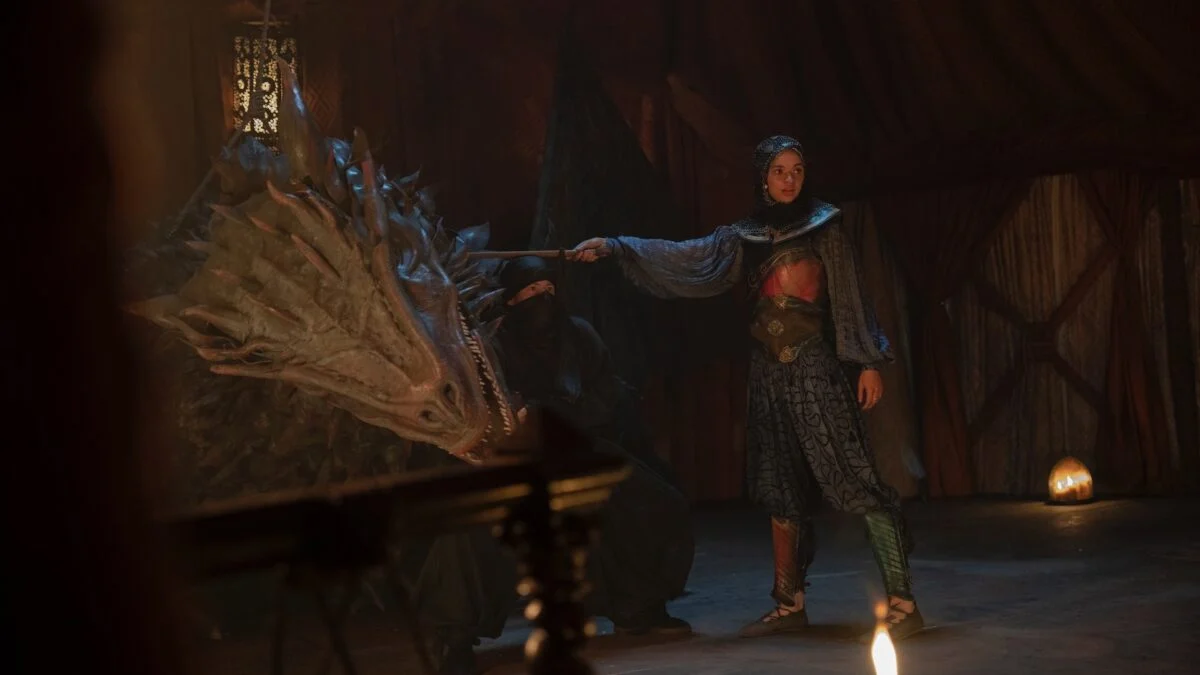
I remember the moment Tanselle walked into that tavern scene and the set fell into a different rhythm. A few comments online cracked like cold glass; applause and bile arrived in the same breath. You felt the choice testing the audience’s comfort with change.
I’ll be direct with you: targeted negativity is rarely about a single performance. It’s about what a casting choice exposes in a fandom — the parts that prefer sameness. I watched Tanzyn Crawford answer that pressure with a single, steady sentence: “I’m employed—and I’m following my dreams.”
On the set, energy shifted the moment Tanselle appeared — what that quiet revealed
On filming days, people notice small things: a pause, a look, a rearranged blocking. That pause became a story off-screen when clips and photos hit social feeds.
Tanzyn Crawford says the pushback included race-based negativity. She described the intimidation of stepping into a world people love and guard closely. You can hear the relief in her words when she adds that George R.R. Martin told her, “You’re exactly what I pictured [for Tanselle].” That citation from the author reframes the moment from controversy to fidelity to source material.
On social feeds, a handful of posts swelled into louder threads — what kind of backlash appeared?
On Reddit and other platforms, threads sprouted fast. Some commenters complained Tanselle didn’t match their mental image; others reacted to wider changes in casting across the franchise.
Did A Knight of the Seven Kingdoms face racist backlash?
Yes, there were examples. Crawford herself acknowledged receiving race-related negativity. The pattern echoes other entries in the broader universe: Steve Toussaint, who plays Lord Corlys in House of the Dragon, told Men’s Health that some viewers accept dragons and violet eyes but balk at a wealthy Black character. The conversation spilled into outlets like Wonderland and the Hollywood Reporter, and fans debated casting choices on Reddit threads about actors such as Bertie Carvel and his portrayal of Baelor Targaryen.
At a reading, a respected voice nodded — why that matters for an actor
At private readings and early screenings, authors and producers witness a performance in context. George R.R. Martin’s approval carried weight for Crawford.
When the creator of the world you entered says you match his vision, you gain more than a line on a résumé. You get a shield against reductive critiques. I’ve seen projects survive far worse friction when an authoritative figure quotes the text and points to the actor as the embodiment of a role.
How did Tanzyn Crawford respond to casting criticism?
She kept it simple and forward-facing: she acknowledged negativity, then pointed to the fact she’s working and pursuing her craft. Her posture is both defiant and practical — a refusal to let internet noise define her career.
On fan boards, debates over appearance are recurring — what the pattern tells us
On forums, commenters argue about ethnicity, height, hair color, and lineage as if wardrobe alone defines a character. The Baelor casting dust-up — where Bertie Carvel’s darker hair prompted remarks about Dornish ancestry — is a clear example.
These disputes are partly about ownership. Fans feel entitled to guard imagined details; when a show alters the visible markers, some react as though a promise has been broken. Casting then becomes a lightning rod: you get praise, you get anger, and everything in between. It landed like a pebble in a still pond, sending rings outward.
For Crawford, the role offered depth beyond looks. She described Tanselle as “a softer outlet” in a series that’s otherwise very masculine and brutal, a character with private passions and agency — not a mere accessory to Dunk (played by Peter Claffey).
On the industry side, creators and outlets shape the story — who amplified the voices?
On publication pages and in interviews, platforms like Men’s Health, Wonderland, and the Hollywood Reporter curated the conversation. I follow those outlets because they set how the debate circulates.
Actors get filtered through these lenses. When respected voices—Martin, critics, showrunners—voice approval, it changes the angle of the conversation from “Did they get the casting wrong?” to “Why did that reaction surprise us?” Casting choices are a lighthouse, carving out a safe patch in a storm of expectations.
Want more io9 news? Check out when to expect the latest Marvel, Star Wars, and Star Trek releases, what’s next for the DC Universe on film and TV, and everything you need to know about the future of Doctor Who.
I’ll ask you directly: if a creator accepts an actor and the performance stands on its own, should the loudest comments on a forum decide who belongs in a story?