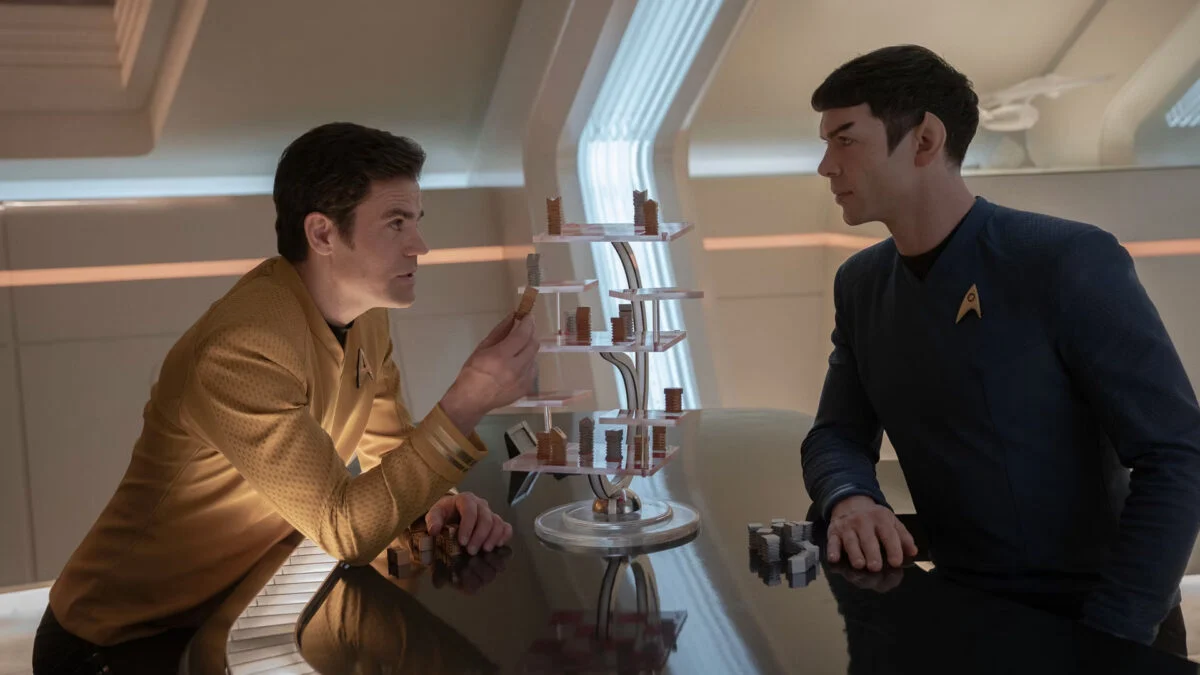
The soundstage is quiet. A corridor of matte-black doors sits under dim house lights, and someone has left a script on a folding table. You can almost hear a captain’s orders that have not yet been given.
I’ve followed long-shot pitches before, and I’ll tell you plainly: you should care about this one. You’re reading about Star Trek: Year One because it matters for the future of the USS Enterprise and because the people who built Strange New Worlds have put their cards on the table for Paramount—now it’s the studio’s move.
A warehouse humming with lights — the Strange New Worlds sets still sit in Mississauga
I remember the first time I stepped onto a soundstage: the smell of paint and the precise disorder of cables. That image is useful now because the physical stakes are real—Henry Alonso Meyers told TrekMovie that the sets on the CBS stages in Mississauga, Ontario, have not been torn down.
That detail turns a creative pitch into a logistical question. If the sets stay, a new series can hit the ground faster; if they go, rebuilding eats time and budget. I’m watching the same hinge you are: studio choice versus production momentum.
Is Star Trek: Year One happening?
You want the short truth: it’s a pitch on a desk at Paramount, not a filmed order. Meyers confirmed the team behind Strange New Worlds formally presented Year One to the studio, and Akiva Goldsman has been one of the loudest advocates. That’s meaningful—Goldsman’s name carries weight at the studios and with collaborators.
But a pitch does not equal production. You can be optimistic—the fifth season of Strange New Worlds is set up to hand off into a Kirk-era story, with new actors cast as McCoy and Sulu—but studio slates, corporate strategy, and the availability of creative talent all play gatekeeper roles.
A coffee cup cooling on a writer’s desk — the pitch sits on someone else’s watch
There’s a practical rhythm to television: writers finish, editors finish, then the studio decides whether to greenlight more. Meyers’ line—“it’s out of our hands”—is not resignation; it’s a direct observation of how power works in this industry. You can see the pitch, but you don’t control the greenlight.
Paramount is juggling its Star Trek strategy right now: two more seasons of Strange New Worlds, at least one more of Starfleet Academy, and a fresh movie effort with John Francis Daley and Jonathan Goldstein—the duo behind Dungeons & Dragons: Honor Among Thieves. The decision timer feels like a chess clock—every minute spent is a minute where options narrow.
Will the Strange New Worlds sets be destroyed?
Studio budgets and stage availability drive those choices. Meyers’ comment that “our sets have not been destroyed yet” is the clearest signal you’ll get without an official memo: the physical option remains. Holding a set is costly, but demolishing and rebuilding can cost more in time and creative energy.
If you care about continuity—or about saving weeks of production—this matters. I’d watch Paramount+ messaging and union activity in Mississauga; both will hint at the studio’s inclination to keep the doors closed or to clear the stage.
A calendar circled in red — the 60th anniversary breathes urgency into the pitch
I’ve seen anniversaries tilt studio decisions before: milestones make executives hungry for headlines. The Star Trek 60th offers a marketing drumbeat that could propel Year One from idea to announcement.
The cast and crew have leverage. When Picard wrapped, its team pushed for a follow-up called Legacy and found the studio unpersuaded; that memory tempers expectations. Still, a prequel tied to Kirk’s early command is a clean narrative hook—familiar enough to draw legacy viewers, new enough to justify fresh creative investment.
What does this mean for Star Trek on Paramount+?
Paramount has a brand problem and a content balancing act. Greenlighting Year One would signal a commitment to serialized, legacy-linked storytelling while keeping production efficiencies—like existing sets—on their side. Passing would push the franchise toward different forms, like new films from Daley and Goldstein or more anthology-style projects.
You should watch for three signs: official orders from Paramount, statements from Akiva Goldsman and Henry Alonso Meyers, and whether the Mississauga stages remain leased. Those three signals will tell you which path the franchise chooses.
I’ll close with a question I would ask if I were sitting across from the studio execs: do you want the next decade of Star Trek built on standing stages and a ready crew, or will you gamble on starting over and hoping the audience waits?
Want more io9 news? Check out when to expect the latest Marvel, Star Wars, and Star Trek releases, what’s next for the DC Universe on film and TV, and everything you need to know about the future of Doctor Who.