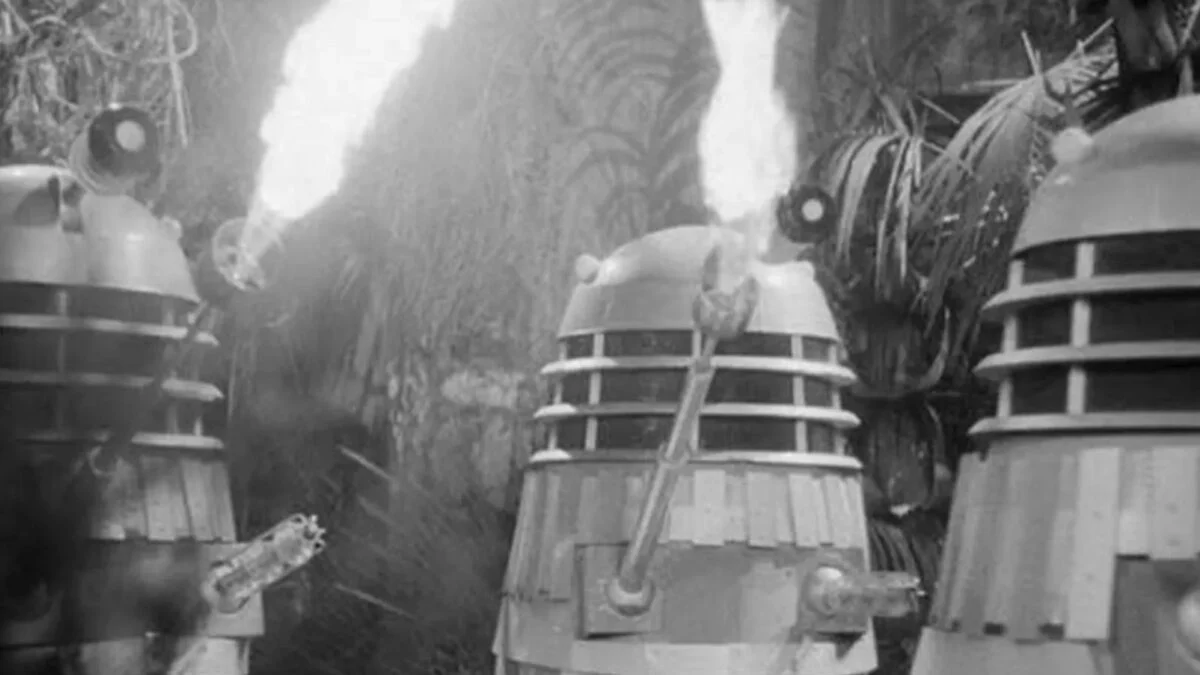
I was standing in a dim room full of cardboard boxes when someone said the words that stop you: “There might be film in here.” You could feel the silence tighten—like old tape about to snap—because for decades whole Doctor Who stories have lived only in memory. For fans and historians, a single reel is a small quarrel won against time.
A charity volunteer in Leicester opened a box and found film reels, and what followed felt impossible.
I’ve covered recoveries before, and you learn to read the room: excitement, disbelief, a quick calculation of provenance. The BBC has confirmed that two episodes from 1965’s The Daleks’ Master Plan—the first and third installments, titled The Nightmare Begins and Devil’s Planet—have been reclaimed from a posthumous collection donated to the Leicester-based charity Film is Fabulous!
Those reels are the first classic-era finds returned to the BBC archive since a cache surfaced in Nigeria in October 2013. For fans who treat missing episodes like lost artifacts, this is more than nostalgia; it’s restoration of story and context for the first Doctor, Steven, Katarina, and the short-lived Space Agent Sara Kingdom.
A production office memo from 1965 reads differently when you hold the surviving footage in your hands.
Watching recovered episodes is how the past stops being rumor. I sat with clips and listened as Peter Purves—the actor who played Steven Taylor—saw his younger self again. The BBC arranged a private screening for him before the public release; his reaction was raw and immediate. “I’m astonished these two wonderful episodes have finally turned up,” Purves told the BBC. “So many of my episodes are missing—it’s heartbreaking to me.”
How many Doctor Who episodes are missing?
Numbers in this story shift like quicksand: early on, more than 150 classic episodes were unaccounted for; over decades, collectors and broadcasters returned many. Today roughly a hundred episodes from the 1963–1989 era are still missing, though that total changes when reels surface at places like Film is Fabulous! or in overseas archives.
A shipping crate labeled with a donor’s name tells you more than the paperwork ever will.
Why do certain stories vanish? In the 1960s the BBC routinely cleared tape to reuse it; formal archiving rules wouldn’t arrive until 1981. The Daleks’ Master Plan was ordered wiped and, unlike other serials, wasn’t widely sold overseas—partly because its violence alarmed censors in New Zealand and Australia. That refusal to export turned this twelve-part epic into a needle in a haystack.
This serial is especially thorny: five episodes survive, seven remain missing, and among those lost is The Feast of Steven, notable as the series’ first Christmas Day broadcast. The story kills several regulars—Bret, Katarina, and Sara—so it was shut out of markets that might otherwise have preserved copies.
Where were the recovered episodes found?
They came from a posthumous donation of hundreds of film reels to Film is Fabulous!, a Leicester charity that preserves and shares cinema history. That cache joined a scattershot trail of discoveries—from Nigerian TV storerooms to private attics—that have slowly chipped away at the missing catalog.
A fan watching an old Dalek story for the first time feels both relief and a fresh ache.
For you, the recovery matters because it restores scenes and performances that shaped the show’s DNA. For scholars, it fills gaps in continuity and design. For industry figures—actors like Nicholas Courtney, who returned to prominence as Brigadier Lethbridge-Stewart—these episodes map early careers and production choices. The discovery is like a missing puzzle piece found under a couch: small, grubby, but essential to the whole image.
When will the recovered episodes stream on BBC iPlayer?
The restored versions of The Nightmare Begins and Devil’s Planet will be available on BBC iPlayer on April 4, joining the three surviving episodes of the serial already on the platform. The BBC’s restoration pipeline and iPlayer make these artifacts suddenly accessible to a global audience—where before they lived in bootlegs and memory.
A restoration engineer wipes a tear and tightens a sprocket, and the room hums with purpose.
Restoration is practical work: film cleaning, frame matching, and careful digital repair. The BBC, working with archivists and specialists, treats every frame as evidence. You should know that recovery doesn’t always mean pristine playback—colors fade, sound needs reconstruction—but the narrative integrity returns. For fans, that’s what matters: seeing Sara Kingdom’s arc and the Daleks’ scheming in full motion again.
For decades vintage Doctor Who has been a scavenger hunt across continents and charity basements, and every find rewrites a little of what we thought we knew. Some stories will probably never surface, a dropped stitch in the tapestry of television history; others will continue to appear where you least expect them.
Want more io9 news? Check out when to expect the latest Marvel, Star Wars, and Star Trek releases, what’s next for the DC Universe on film and TV, and everything you need to know about the future of Doctor Who.
So what will the next discovery teach us about how we value our cultural past—should private collections and small charities be treated as front-line archives or as curiosities to be plundered by nostalgia?