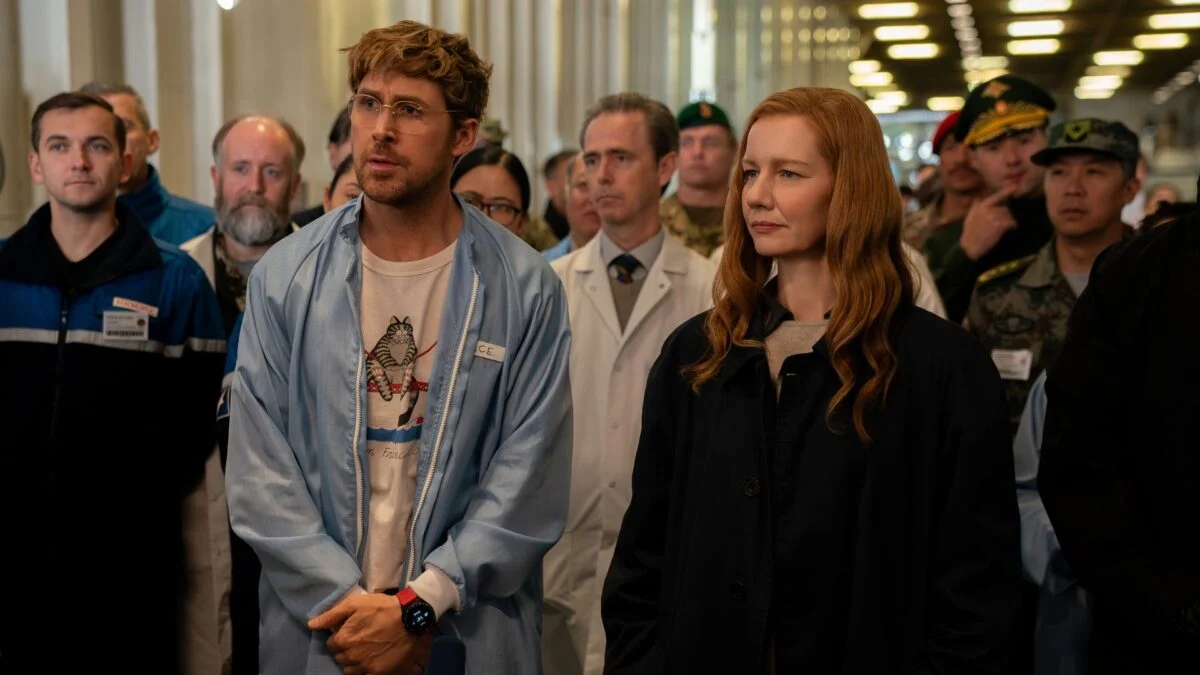
I watched the final cut and paused the frame. On a small boat, Stratt watches a message as the world chills around her. A tiny tattoo on her neck turned a tidy ending into a whisper of something larger.
I’m going to walk you through what Lord and Miller folded into Project Hail Mary’s last breath — the detail you probably missed, why Andy Weir planted it, and how that single mark rewrites Stratt’s arc from public villain to fugitive survivor. You’ll get my read, the source-context, and the rumor trail from Slashfilm to io9 and back again.

On a boat in a freezing world — the film shows Earth briefly, and that moment carries weight
The theatrical ending gives you closure: Grace and Rocky find the cure for astrophage, and Grace stays with Rocky to save both species. But the post-cut Earth shot is a compact data point. Directors Phil Lord and Chris Miller squeezed a line of backstory into a single frame: Sandra Hüller’s Stratt bears a tattoo that hints at a harsher life after the mission left.
I tracked the director quotes from Slashfilm and the thread on io9: Lord says the tattoo reads as a shorthand for “life without parole.” Andy Weir supplied that beat. It’s a micro-narrative that tells you more than a line of dialogue could.
What happens at the end of Project Hail Mary?
In both Andy Weir’s novel and Lord & Miller’s film, the arc resolves: the astrophage problem is solved, Rocky and Ryland Grace survive, and life on Earth is buying time. The movie adds one late-life detail — Stratt’s tattoo — which implies the public response on Earth was violent and legal, not simply grateful.
At a film edit bench — a tiny visual cue became a political cipher
Filmmaking is selective: you keep what explains character with minimal screentime. That neck tattoo performs heavy lifting. Lord explained that after Grace leaves, governments fracture, and Stratt is prosecuted. The tattoo reads as verdict and exile. It turns her from technocrat to scapegoat, and then, possibly, to escapee.
That change answers questions the book left off-camera. Weir’s Stratt in the novel authorizes extreme measures on Earth — attempting controlled destruction of empty regions to conserve energy and life. The movie doesn’t show those policies, but the tattoo implies Stratt took the fall for decisions the public found intolerable. The brand-name reporting (Slashfilm) and outlets like io9 helped spread the director’s intention to audiences hungry for that extra layer.
Does Stratt go to prison in Project Hail Mary?
Short answer: the film implies she was sentenced. Lord said Andy Weir imagined Stratt going to a French prison for life, and the directors wanted that history to breathe in the final scene. It’s subtle: the tattoo’s “V” with a strike-through is shorthand for life without parole, and Lord suggests she later escapes and keeps working to save the planet. That criminal arc never needed a courtroom scene — a visual tag does the work.
In conversation with the source material — the film stays faithful but edits tone
Readers of the novel know Andy Weir built a clinical, problem-solver story around Grace. Lord and Miller respected those beats. But cinema rewards economy: one image can seed a mystery that pages would have occupied. I treat that tattoo as an editorial choice that shifts Stratt’s moral balance without rewriting the core plot.
If you’ve seen the film and read the book, the exchange happens like this: the movie preserves the rescue and the geology of the cure; it trims political exposition. The tattoo reintroduces politics as subtext. It’s subtle and effective — landed like a pebble that rippled across decades.
Directors and authors are tools of storytelling: Weir’s plotting, Lord & Miller’s pacing, Sandra Hüller’s performance and Ryan Gosling’s name-power in marketing all signal authority. Festivals, IMDb pages, and Rotten Tomatoes scores frame how viewers approach that last scene. The tattoo becomes a deliberate nudge for anyone reading between images.
Is the movie different from the book?
Yes and no. The major beats and the ending match the novel. Differences live in atmosphere and implication. The tattoo is a film-only flourish that asks you to read Stratt’s life after the Hail Mary mission. You can watch the movie as a faithful adaptation and still walk away with new questions about who pays for survival.
The tattoo also opens a private-colony subplot on the offscreen timeline: Did Stratt burn fields to save people? Was she tried for crimes meant to save humanity? Directors hinted she was convicted, then escaped by way of contacts. That’s a thriller hook smuggled into a sci-fi rescue story.
I want you to notice how small gestures change what you assume about a character. That tattoo shifts Stratt from a stern administrator to a survivor in hiding, a public enemy who kept working. The film’s economy makes the act more chilling, not less.
The detail is a reminder that adaptations are conversations — between author, director, actor, and audience. When Slashfilm runs an interview, when io9 posts a breakdown, those channels are how these quiet choices get amplified into cultural lore.
The tattoo reads like a wanted poster — a compact signal about guilt and exile. Would you have let a leader make those hard calls if you thought your life was worth preserving at any cost?