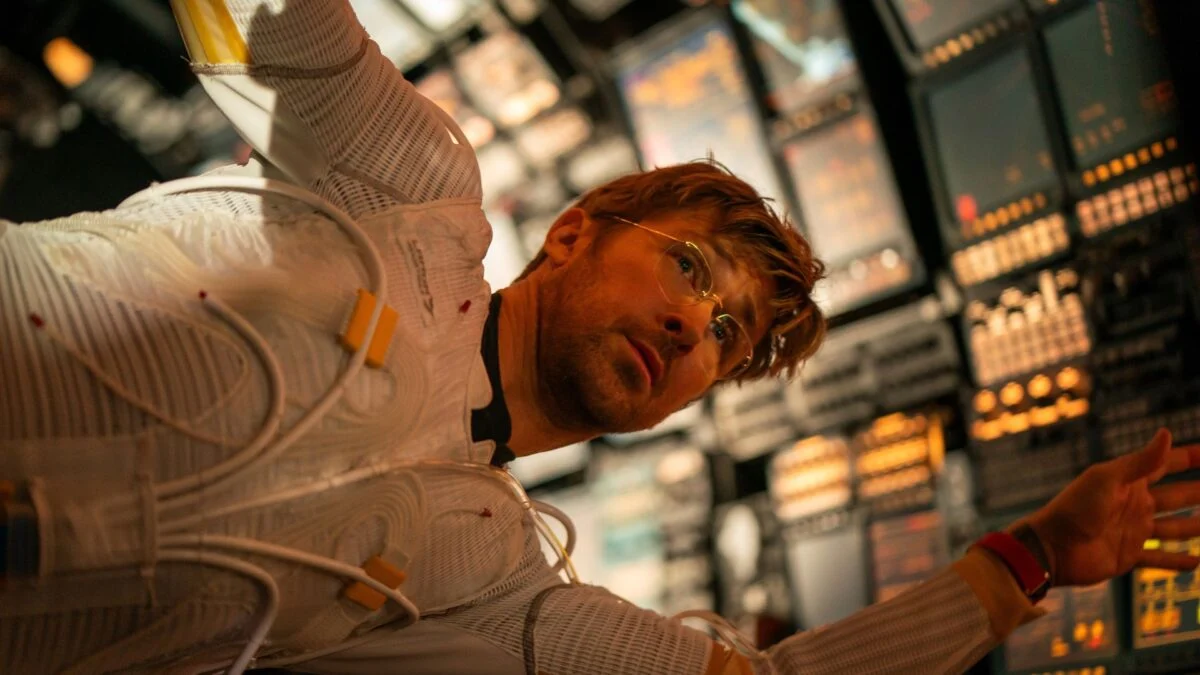
I remember the instant I read Andy Weir’s line about Ryland Grace’s “coma-resistant” gene and paused. The explanation felt neat on the page and fragile under the microscope. When the film premiered, I watched the same scene and realized the movie had quietly fixed something I’d always wondered about.

In a newsroom you learn the moment a storytelling shortcut will bother readers.
Here’s the skinny: Andy Weir’s original book gives Ryland Grace a rare gene that makes him unusually tolerant of long-term comas, and that genetic quirk is why he’s sent on the Hail Mary. It’s tidy, but I always felt the explanation read like an afterthought—a patch to get a protagonist into an impossible scenario.
How is the Project Hail Mary movie different from the book?
In the film, Drew Goddard and directors Phil Lord and Christopher Miller strip away the gene subplot. Ryland ends up on the ship because of what he knows, who he is, and bad timing: he’s the last qualified person left after a fatal accident kills the team he was training. There’s no invented genetic property, just human competence, loneliness, and urgency.
I’ve sat through dozens of adaptations where small changes make the whole story hum better.
Weir told Polygon he liked the rewrite because it removed a piece of contrived science. I agree. The movie’s choice makes the premise feel earned: Gosling’s Ryland isn’t chosen by fate or a convenient gene—he’s chosen because of expertise and circumstance. That turns a plot device into character fuel.
Did Andy Weir like the movie changes?
Yes. I heard him praise the film team—Goddard, Lord, Miller—for finding a way to preserve immediacy without the “little made-up side science” he’d invented for the book. He said it always felt a bit forced on the page, and the screenplay solved it by leaning on motive and logistics instead of genetics.
On set and in the editing room, filmmakers are forced to ask one blunt question: will this land on screen?
That bluntness is what improved Project Hail Mary. Instead of explaining away why someone can survive an extended coma, the movie shows you a man whose life circumstances and training make him the only practical choice. It’s cleaner, and it respects audience intelligence—no technobabble to hold attention, just human stakes.
Why was Ryland Grace chosen for the mission in the movie?
Because he had the right knowledge and happened to survive the pre-launch catastrophe. He had no close family waiting at home, a particular scientific skill set, and the grim timing that left him as the only viable candidate. It’s a chain of human reasons, not a genetic one.
Film audiences respond to plausibility the same way you react to a sloppy edit.
When a story trusts the viewer and trims the excess, the emotional beats land harder. The movie’s fix is like a sleight-of-hand trick that reveals competence instead of contrivance; it feels as precise as a Swiss watch. That’s why Weir called the change an improvement.
I’ve worked with writers and filmmakers who over-explain because they fear the audience will miss something; the Hail Mary team did the opposite. They removed an apologetic detail and forced the plot to be honest about who Ryland is and why he goes. That honesty matters when you’re selling a single human alone against cosmic stakes.
You can argue that the book permits more speculative flourishes—Weir’s comfort with plausible nonsense is part of his voice—but the film’s edit narrows focus and amplifies emotion. For a movie led by Ryan Gosling and shaped by Drew Goddard and the directing duo of Phil Lord and Christopher Miller, that tightening was the right call.
Want more io9 news? Check out when to expect the latest Marvel, Star Wars, and Star Trek releases, what’s next for the DC Universe on film and TV, and everything you need to know about the future of Doctor Who.
So tell me—which version says more about how you want science fiction to treat its heroes?