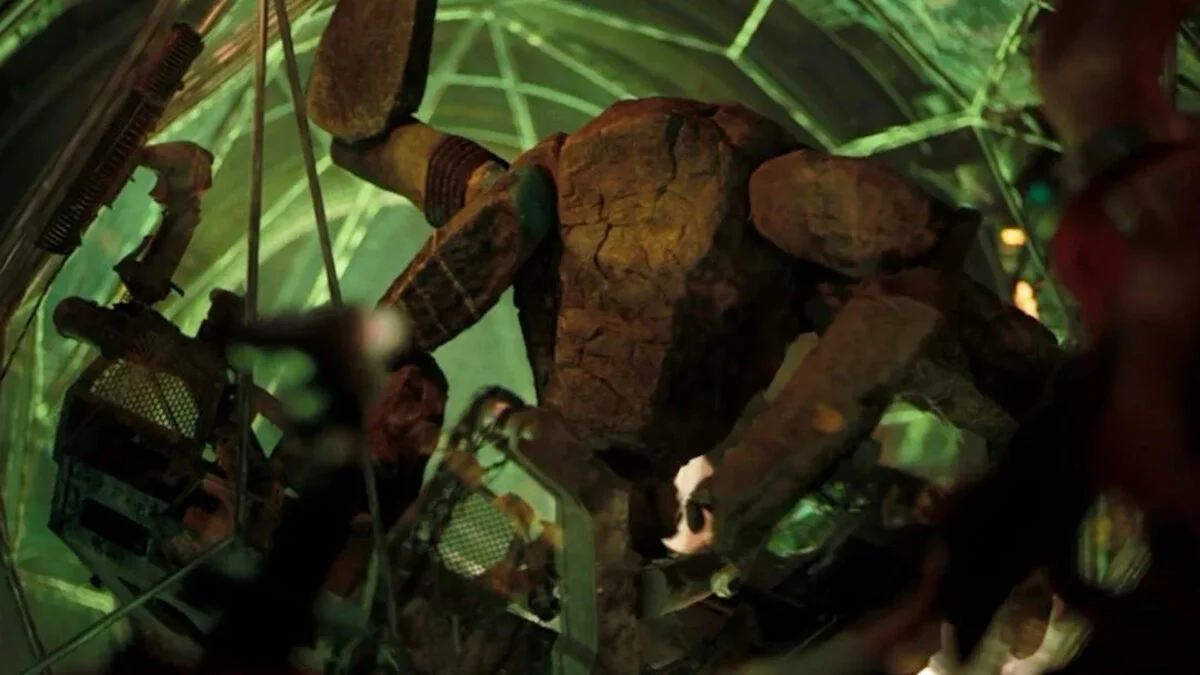
I was leaning over a table of thumbnails when a plastic eye blinked for the first time under a lamp. You felt it too—the room sharpened into a set piece, and the joke about “an alien rock” stopped landing. Suddenly a creature made of barnacles and knuckled fingers carried the weight of half the film.
I’m Kris Anka and Jesús Alonso Iglesias’s unofficial tour guide here: I followed their sketches from BlueSky posts to the puppet stage, traced choices Phil Lord and Chris Miller debated, and checked Andy Weir’s descriptions against the designs. You’ll see how asymmetry, silhouette, and a handful of tactile decisions turned a concept into a co-lead, and why some designs stayed on the page while others walked (or crawled) onto set.
Sketches and asymmetry: where Rocky’s silhouette began
A coffee-stained page marked “2C” sat next to a stack of thumbnails.
The art brief was short and stubborn: make Rocky readable at a glance but unfamiliar enough that your brain keeps trying to classify him. Kris Anka pushed asymmetry and texture to trigger curiosity—barnacles as rank markers in design 2C, spidery limbs in 1E and 1G, and patterned growths in 2D that read as culture without dialogue. The sketches respected Andy Weir’s scale—“smaller than a human, about the size of a Labrador”—while exploring what “rock skin” could be: 2A, 1E, 1F, and 1I hold closest to the book’s “weird, brownish-black rock” line.
The sketches on the table were a watchmaker’s bench of ideas.
How was Rocky created for Project Hail Mary?
You should know the answer is not a single technique but a chain of small, smart decisions. Lord and Miller favored practical puppetry early on; the art team’s job became proving the creature could sell emotion without relying solely on CGI. Anka’s concept work informed the puppet’s silhouette, finger construction, and where to add tactile details that read on camera. Jesús Alonso Iglesias and others supplied alternate anatomies—rounder heads, hole-riddled faces, and leg configurations that suggested different ecologies and habits.
Puppetry and body acting: making a rock feel alive
The shop smelled of silicone and coffee the day the puppet first moved.
After the puppet chassis existed, Anka returned to refine how Rocky expressed himself. He explored body acting: shifting weights, moving small stones, and tuning vocal clicks that would register as personality. The team treated fingers and extremities as expressive tools rather than engineering problems—how a hand can cradle a Rubik’s Cube or curl in anger matters onscreen. When Rocky moved, his gestures were carved music.
Why did the filmmakers choose practical puppets instead of CGI?
Because practical presence sells chemistry. Phil Lord and Chris Miller were betting that an object you can light, touch, and frame will generate subtler, more believable reactions from human co-stars. Practical puppets force constraint—and constraints force inventiveness. The team could layer CGI over a physical performance later, but the emotional beats were first negotiated in hands-on sessions with Anka, Iglesias, and the puppet crew.
Alternate takes: how other artists imagined Rocky
On Jesús Alonso Iglesias’s feed, a round head full of holes stared straight at the camera.
Iglesias pushed a design with a porous, almost coral-like skull and long, utilitarian legs—choices that suggested different movement and sleeping patterns. His Rocky used human-like hands for dexterity (Rubik’s Cube included) and posed in sleep states that felt alien and intimate. Iglesias called it one of his toughest challenges; he learned more about character design in the process than in most commissions combined. Those alternate concepts are what you flip through in an art book and then argue about at a holiday party.
Who designed Rocky and where can I see more art?
Kris Anka and Jesús Alonso Iglesias are two names you’ll see first; Phil Lord and Chris Miller steered the production choices; Andy Weir’s prose set the baseline. Follow them on Instagram and BlueSky to watch concept threads and test footage appear in real time. I’m hoping for an official art book timed to the film’s physical release—perfect for collectors and anyone who wants to see every dead-end and discovery that led to the puppet you met on screen.
The design choices—barnacles as insignia, asymmetry as readable character, and hands that could perform delicate tasks—turned a clever idea into a partner. If an art book drops this holiday season, it will be a field guide to the compromises, the near-misses, and the one or two strokes that made Rocky feel like a friend rather than an effect. Which Rocky would you have trusted to save humanity?