She is on her knees, palms pressed to cold linoleum, while June names what she has done. The words land like a verdict and Lydia stays—listening, shamed, defiant. Minutes later she rises and makes a choice that refuses a tidy ending.
I watched Ann Dowd describe that moment at a recent press day, and I want you to hold that shape in your head as you meet Lydia again in The Testaments. You remember the Red Center, the punishments, the rows of women taught to obey—what you might not expect is how survival carved a different path through the same bones of power.
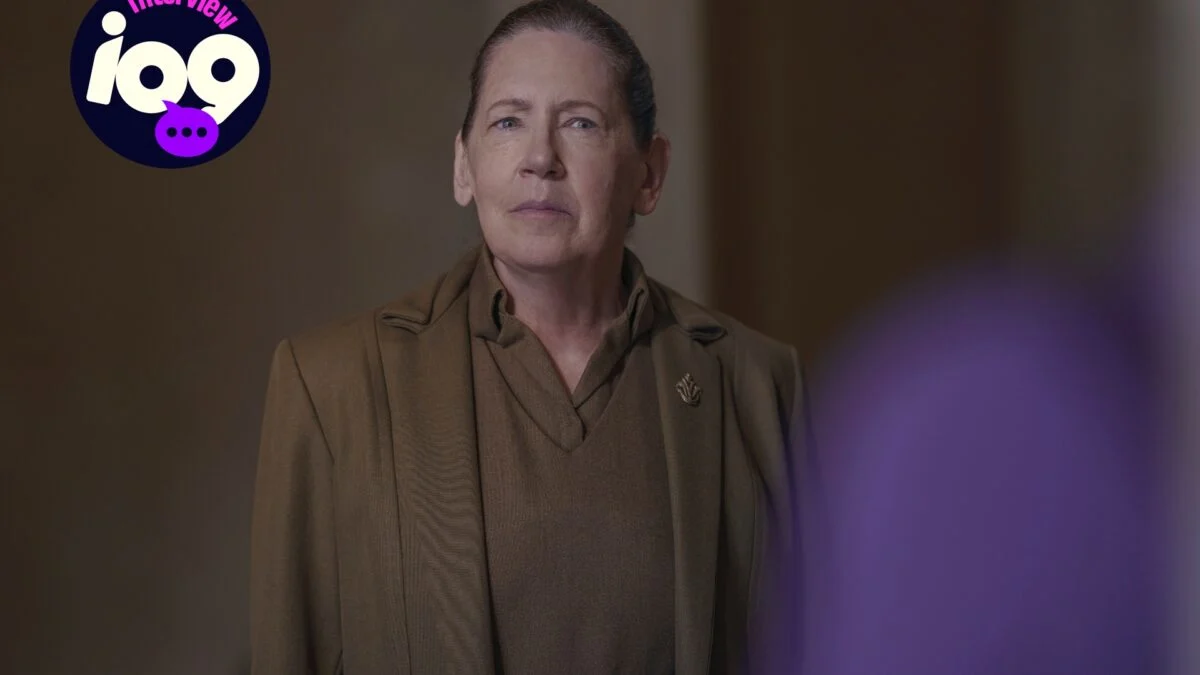
At a press day in Los Angeles, Dowd described Lydia’s reckoning before she described the school
I asked Ann Dowd how a woman who ran the Red Center ends up with a statue and an academy named after her. She answered in a way that made the sins and the survival feel contiguous, not opposites. What she told me was less apology and more a construction of a new moral architecture.
Dowd said Lydia was “brought to her knees in remorse” at the end of The Handmaid’s Tale—and that moment mattered. She chose to “sit with the shame” and then to decide where to place her remaining energy. That choice births the Aunt Lydia School for Commander’s daughters: a project that preserves command and teaches homemaking, but is also, in Dowd’s reading, a map of who Lydia is now.
Who is Aunt Lydia in The Testaments?
You can view her as the same enforcer in a new uniform, or as someone who has rearranged loyalties. Dowd frames Lydia as someone who, having been exposed and humiliated, asks herself what matters. She lands on a fierce, almost maternal devotion to girls—albeit girls chosen from the top of Gilead’s hierarchy: commanders’ daughters and the Pearl Girls.
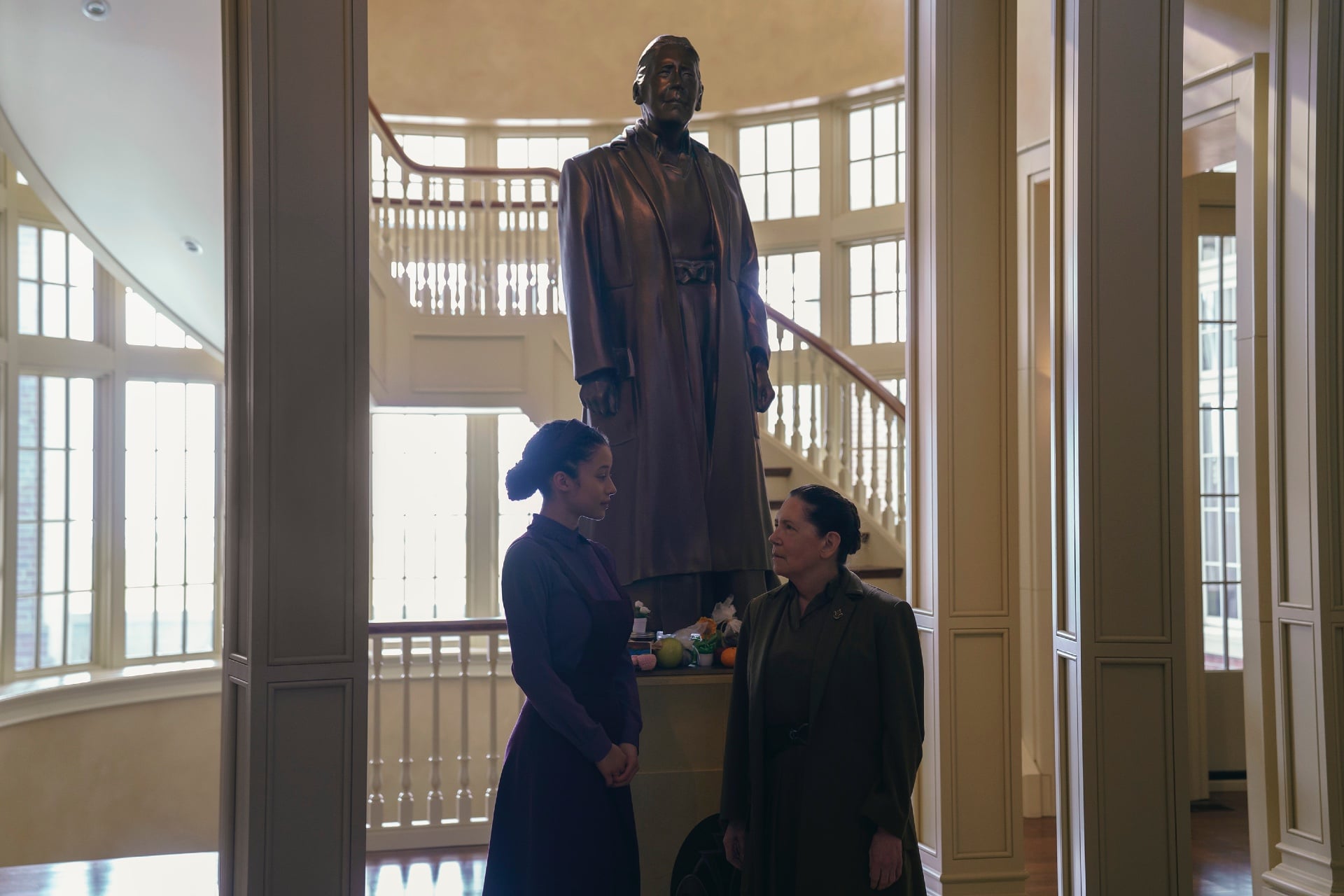
On set, the statue of Lydia is treated like an altar; in the real world fans left tokens at its base
That small ritual—students leaving tokens—says something about power masquerading as reverence. It also says you can be loved by the system you once enforced.
Dowd believes Lydia is “a gentler soul” in this new life, someone who examined her complicity and made other choices. She still runs an apparatus that enshrines Gilead’s values, but the internal weather has changed. Think of Lydia not as a single villain from season one, but as a layered figure whose remorse becomes a new form of authority—like a lighthouse with its glass cracked.
Has Aunt Lydia been redeemed?
Redemption is a sticky label. You and I both know audiences want absolutes: guilty or forgiven. Dowd resists that binary. Lydia’s kneeling is an acceptance of truth; her school is a refusal to disappear. Dowd’s language—”sit with the shame”—reads as accountability if not full atonement. You’re watching someone reassign love and control; that’s not forgiveness so much as reconfiguration.
At io9’s press event, I heard how the series ties back to Margaret Atwood’s book while widening the lens
The Testaments moves the camera to corridors we only saw in outline before, and it connects to the original through consequence rather than repetition.
Margaret Atwood’s material is the skeleton; Hulu and the creative team add flesh and argument. Ann Dowd, an Emmy winner for her work earlier in the franchise, brings nuance to Lydia’s continuity. What you’ll see across the rollout—first three episodes on April 8 on Hulu and Hulu on Disney+, then weekly—are choices that complicate villainy and attempt to explain survival without exonerating cruelty.
How does The Testaments connect to The Handmaid’s Tale?
It’s sequel and commentary. The Testaments picks up stakes by asking what institutions do to the people who run them, and what those people do back. Dowd’s Lydia is the best example: she carries history’s stain and redirects her care toward a different cohort of girls, reshaping power from inside the machine.
I’ve spent time with the cast and read the scripts; I can tell you the show will force you to re-evaluate how you assign blame and who you call a monster. Lydia’s arc asks whether survival requires reinvention or merely a better angle on the same architecture—a taxidermied saint on a library shelf or something uncomfortably alive?
Are we ready to accept a character who survived by changing her aim rather than her hands?