
The flashing lights, the whirling wheel, the promise of untold riches—all for a few V-Bucks. A friend excitedly told me about his big win, but when I looked closer, something felt off. Was this really Fortnite, or had I stumbled into a digital casino?
Fortnite’s latest 39.20 update may have landed with a South Park crossover and a free mini-pass, but a quiet change in its UEFN mode is making big noise. Creators can now monetize their maps, selling items for V-Bucks – that’s real money changing hands. The game “Steal the Brainrot” was quick to implement the system, and the reception hasn’t been pretty.
While players love free content, the new system in “Steal the Brainrot” feels predatory. The community is pushing back against what they see as a gambling system slipped into their favorite game.
Fortnite’s Steal the Brainrot Sparks Outrage with New Gambling-Style System
I saw a group of kids huddled around a phone, their faces lit by the glow of a spinning wheel. It felt like a scene from Vegas, not a game designed for young players. “Steal the Brainrot,” a Fortnite UEFN map by Ferins, mirrors the Roblox hit “Steal a Brainrot.” It’s a hit, responsible for a massive slice of Fortnite’s daily player count, hitting over 1 million concurrent players recently. But the latest update added V-Bucks to everything, and the community is not happy.
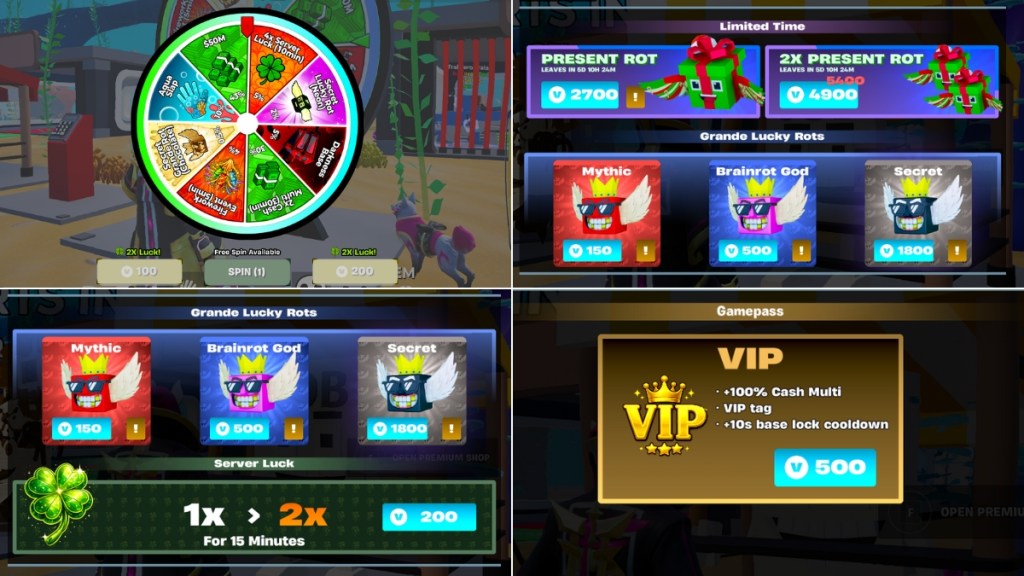
After update 39.20, “Steal the Brainrot” integrated V-Bucks into its shop items and a spin wheel, which many on social media are calling a “slot machine”. Players get one free spin every four hours, but extra spins cost 100 V-Bucks (about €0.93), and three spins cost 200 V-Bucks (around €1.86).
Epic is giving UEFN creators a 100% cut of V-Bucks purchases made within their maps. If you spend $10 (€9.30) on an item, the creator gets the full amount; Epic takes nothing.
The sting comes from the limited-time shop. A brainrot costs 2,700 V-Bucks ($18.99 or €17.66), and a 2x brainrot present is 4,900 V-Bucks ($35.99 or €33.47). The catch? These items can be stolen and have no use in the standard Battle Royale mode. If you buy an item with real money, it can be taken away.
The community erupted in response. One UEFN creator said, “Super disappointed in the Brain Rot guys… You make us all look bad with this kind of stuff.” Another added, “They better remove gambling and the ridiculous 4,900 V-Bucks purchase on a creative map. Epic should cap them at 1,000 V-Bucks maximum.”
Should Fortnite creators be allowed to charge any amount they want for in-game items?
Think of the Fortnite UEFN creator ecosystem as a gold rush. The lure of riches is strong, but the question is, where do you draw the ethical line? Epic’s decision to hand over all the revenue to creators is enticing, but it could lead to practices that feel exploitative.
Briefly, the map was delisted from the Discover row because of a bug, creating panic. The developers assured full refunds for those who bought items just before the takedown. Within six hours, the map was back online with a new thumbnail, but the questionable monetization remained untouched.
Is This the Future of Fortnite UEFN?
I worry about the long-term impact. If other maps follow “Steal the Brainrot’s” example, the UEFN landscape could become a minefield of microtransactions and gambling mechanics. Imagine a world where every corner you turn in Fortnite asks you to spend more money for fleeting advantages. That’s a grim future.
“Steal the Brainrot” is still listed in the top Discover row, and players are hoping other UEFN maps don’t follow suit. There is an unsettling feeling that the ecosystem’s future is uncertain.
What is Epic Games’ role in regulating UEFN monetization?
Epic’s silence is deafening. They’ve created a system that, while potentially beneficial for creators, lacks oversight. They are the architects of this world, and they need to set some ground rules to prevent exploitation. Without intervention, the floodgates could open, and the game could become less about fun and more about extracting money.
How can players protect themselves from predatory monetization in UEFN maps?
The best defense is awareness. Do some research before spending V-Bucks on a UEFN map, and ask yourself if the item being offered provides real value or is just a fleeting dopamine rush. Look for user reviews and opinions from trusted sources. Don’t be afraid to speak out about maps that seem exploitative. Let the developers know you won’t stand for predatory practices.
The game feels like a tightrope walk. Fortnite must balance creator freedom with player protection. How should Epic handle the rise of gambling-style systems in its user-generated content?