
The email hit inboxes like a cold draft through a cracked window. I clicked, scrolled, and watched a community that taught me patience fracture into hot takes. You could feel a season’s high giving way to something raw and unsettled.
On a Tuesday morning the company’s blog quietly posted an update — Epic Reveals Downturn in Fortnite Engagement Led to Over 1000 Layoffs
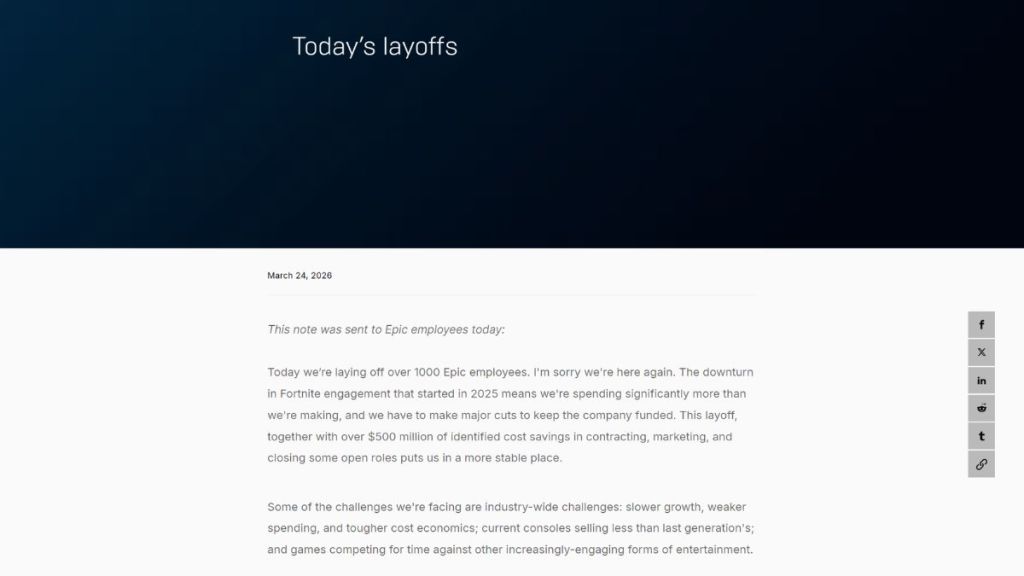
I read Tim Sweeney’s post so you don’t have to: Fortnite engagement has been slipping since 2025 and the numbers finally caught up with spending. Epic says they’re targeting over $500 million (€460 million) in cost savings, and that cut comes with more than 1,000 roles eliminated. Sweeney also stressed the layoffs are not driven by AI; he mentioned efforts like optimizing Fortnite for the Google Play Store as another strain on resources.
Why did Epic Games lay off employees?
Because engagement fell short of the spending trajectory Epic set for itself. When a live-service product like Fortnite needs constant content, mobile porting (including Google Play Store work), partnerships, and engine upkeep with Unreal Engine, costs balloon. I see this as a business correction: revenue signals faded, so the company is cutting payroll to bring costs back into line with what the game is bringing in.
At my keyboard I noticed three game tabs open — Which Fortnite modes are being removed?
Epic confirmed three modes will go offline: Ballistic, Rocket Racing, and Festival Battle Stage. Rocket Racing and Festival Battle Stage surfaced back in Chapter 5 and kept niche, loyal audiences; Ballistic was Epic’s attempt at a tactical 5v5 shooter in the mold of Valorant. Removing them is less about immediate impact on the core BR loop and more about pruning features that cost staff time and server cycles.

Will the shutdown of these modes affect my Fortnite progress or purchases?
Most likely, the core Battle Royale progression and V-Bucks economy remain intact. Epic’s message focused on content removal rather than a rollback of purchased items. Still, when niche modes disappear, cosmetic demand and event-driven microtransactions tied to them can evaporate—so if you’ve invested in mode-specific items, I’d keep screenshots and receipts handy and ask support if you have concerns.
During a midday stream chat I watched people scramble to make sense — What this means for players and staff
For players, the change is an emotional one. Communities that grow around a single mode feel abandoned when their space is deleted. For staff, Epic promises severance and benefits to help people find their next roles, but losing a job at a platform company that builds engines and storefronts like Epic is a hard pivot.
This budget tightening hits like a power cut: the lights stay on, but the parts you relied on stop being visible. And when you remove features players loved, a house of cards built on niche loyalty risks collapsing faster than you expect.
How are industry figures reacting?
People from across gaming — devs who use Unreal Engine, publishers that watch monetization trends, and even platform competitors like Steam and the Epic Games Store teams — are parsing the move. There’s talk about whether Fortnite can shift investment back into evergreen systems or if Epic will focus on fewer, larger projects. Tim Sweeney’s emphasis on mobile optimization and the Google Play Store return signals they’re still investing in reach, but at a smaller payroll cost.
You can feel the trade-offs: Epic keeps the flagship live service running, but the cost is visible in staff cuts and the removal of smaller modes. If you play any of the affected modes, what will you miss most about them?