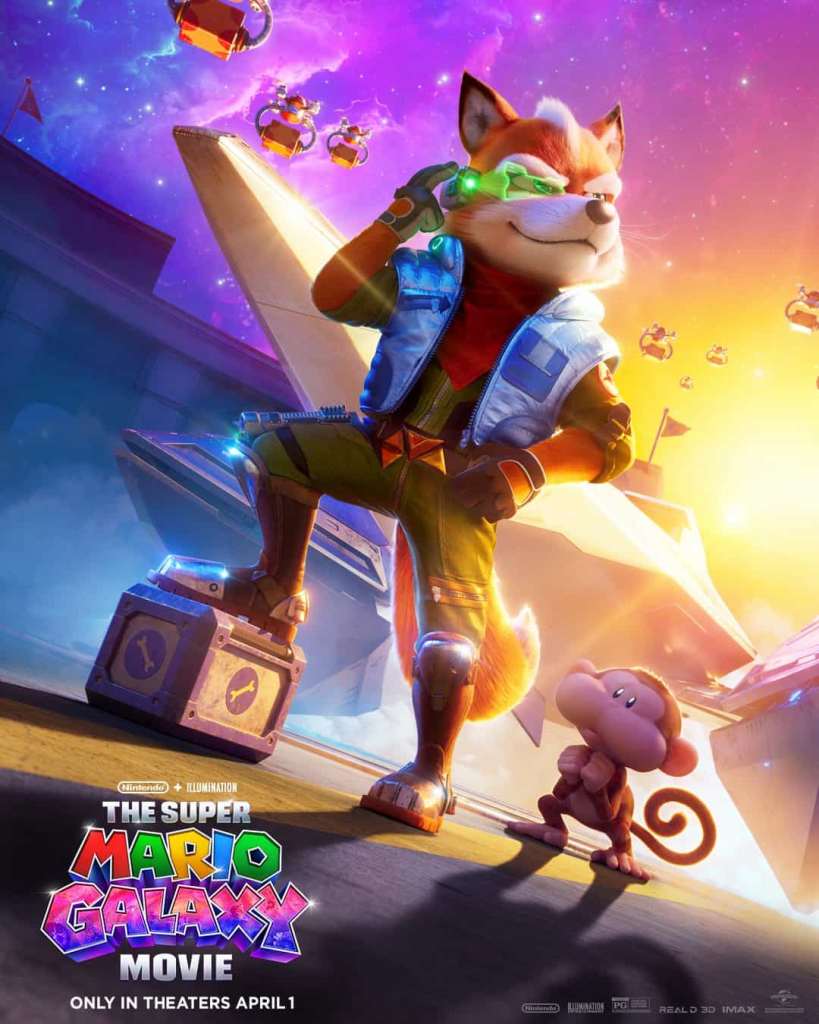
My phone buzzed while I was making coffee. A poster filled the screen: FOX MCCLOUD, helmet glinting, announced in the same frame as Mario. My first thought was annoyance at the leak; my second was a thrill I couldn’t hide.
I’m going to be blunt with you: if you haven’t seen the new poster or trailers and you want to stay surprised, this is your exit. If you stayed, good—because this reveal changes the conversation about where Nintendo movies can go.
My phone buzzed at 7 AM — FOX MCCLOUD’s poster hit X and everything shifted
You saw the clip earlier: an eagle-eyed fan caught him in a trailer, and now Nintendo has confirmed it with a poster that trended across Twitter/X and feeds worldwide. The announcement racked up over 4.2 million views and 30,000 reposts in just over an hour, which is a loud signal about audience appetite.
This is not a cameo tossed in for giggles. Fox arriving in The Super Mario Galaxy Movie is a deliberate editorial choice by Nintendo and Illumination. It tells you they’re willing to let characters travel between franchises on screen, and that changes the playbook for every future Nintendo adaptation.
I checked the trailers twice — small signals point to a larger crossover strategy
At my desk I replayed the scene where Pikmin float by and ROB waves in the background. That micro-framing matters: Pikmin and ROB were confirmed, and Mario’s world already shares screen time with Bowser Jr., Yoshi, Birdo, Rosalina, Luma, and Wiggler.
When a studio stitches a supporting cast from multiple IPs into a single film, they’re testing franchise chemistry. Fans recognized Fox instantly; that recognition felt like a secret handshake between Nintendo and its audience. It’s the kind of audience reward that creates chatter, memes, and repeat watch behavior—sustained engagement Illumination and Nintendo want.
Will Fox McCloud be in The Super Mario Galaxy Movie?
Yes—Nintendo’s poster and the trailer sightings confirm his inclusion. This appearance is more than a blink-and-you-miss-it nod; it’s framed to read as a meaningful presence. For players who grew up with Star Fox, seeing Fox alongside Mario is emotional shorthand: it validates a shared universe on film.
I scrolled past fan theories for an hour — and the economics start to make sense
On X, threads multiplied: “Who’s next?” “Is Sonic allowed?” The chatter is free marketing; every reshare is a micro-ad for the theatrical window. A big crossover would be expensive—think of a $200 million (€186M) production—but studios have proven those bets can pay off handsomely at the box office, even pushing toward $1 billion (€930M) totals when execution and nostalgia align.
Imagine a Super Smash Bros.-style movie as a tentpole: it would ask for studio coordination on licensing, voice talent, and tone. It’s a coordination job that benefits from partners who already understand cross-platform merchandising—Nintendo’s IP rules, Illumination’s family-friendly animation pipeline, and social platforms like X that amplify reveals fast.
Could this lead to a Super Smash Bros. cinematic universe?
Short answer: yes, it can. The Fox reveal is a proof of concept. If Nintendo and Illumination treat crossovers as episodic opportunities—post-credits scenes, cameos, shared threats—they can build a cinematic scaffold that echoes ensemble films in other franchises. The cost is real, but so is the upside: expanded merchandising, streaming deals, and global box office runs.
I walked past a theater marquee and thought about fan expectations — casting and tone will be everything
You don’t want a Smash movie that feels like a hollow mashup. Casting, script, and directorial voice must respect each character’s essence. That’s where industry figures like Nintendo producers, Illumination directors, and experienced writers matter: they can protect character beats while letting them collide.
And more than nostalgia, you need stakes. A multicharacter showdown should build to emotional payoffs, not just spectacle. If handled well, the result could feel like a fuse lit under a rocket—slow to start, then impossible to ignore.
Who else might appear in future Nintendo crossovers?
Sonic is a wildcard—Sega has already proven cross-studio film success. Other logical candidates include characters from Metroid, Legend of Zelda, Kirby, and even licensed cameos that have appeared in Smash. Each addition raises fan excitement and licensing complexity in equal measure.
If you follow Nintendo, Illumination, Marvel-style ensemble mechanics, or the way Twitter/X amplifies reveal culture, this Fox moment is a signpost: Nintendo is willing to share its sandbox. The question now is whether they treat these moments as one-offs or the first steps toward a coordinated cinematic strategy—what do you think should come next?