
I watched the courtroom feed blink as a single LinkedIn click became a headline. You could feel the momentum—small, public, and suddenly dangerous. I want to walk you through what happened, why it mattered, and why the judge opted to move the files to other benches.
Reporters in the hallway refreshed LinkedIn as the court file grew louder.
I’ve followed courthouse theatrics long enough to know when optics become the argument. Chief Judge Kathaleen St. Jude McCormick denied that she intentionally “supported” a LinkedIn post celebrating a courtroom win over Elon Musk, but she decided to reassign three pending Delaware Chancery Court cases anyway. You should read that as a judge choosing the health of the court’s reputation over any personal defense.
Did Judge McCormick ‘like’ the LinkedIn post about Elon Musk?
Musk’s lawyers say the judge tapped the platform’s support control—represented by a heart held in a hand—an action they argue is more deliberate than a simple thumbs-up. McCormick told the court she might have hit the button accidentally, then reported suspicious activity and was locked out of LinkedIn. LinkedIn had not responded publicly by the time of filings reported by Bloomberg.
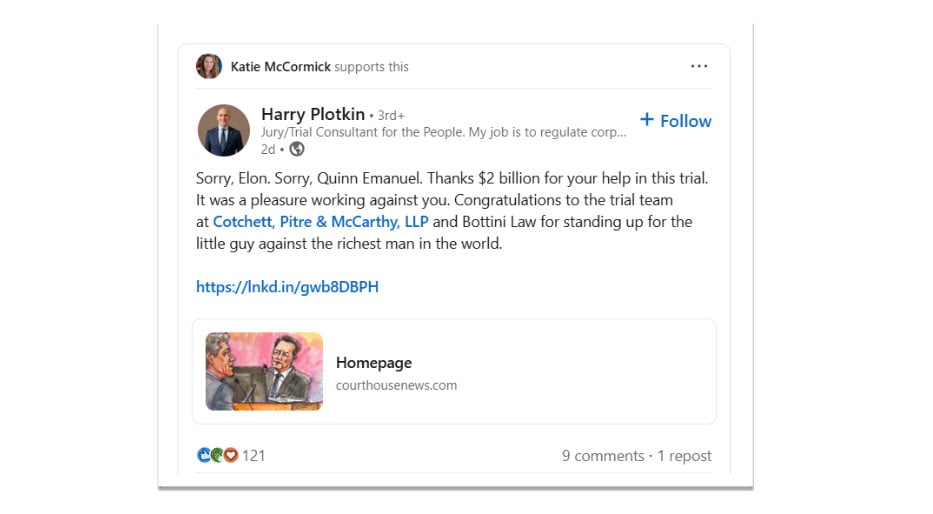
The courthouse hall smelled of coffee and charging phones as lawyers filed a recusal motion.
Musk’s team formally asked McCormick to step aside, pointing to a screenshot of that LinkedIn interaction and arguing the symbol used required a deliberate click. The judge denied the motion but still transferred the cases, citing the volume of media attention and saying, “disproportionate media attention surrounding a judge’s handling of an action is detrimental to the administration of justice.” She added that the Court of Chancery is bigger than any single person.
Why were Musk’s Delaware cases reassigned?
McCormick accepted that the appearance of bias—real or perceived—could harm public confidence. Even if she believed she was impartial, she wrote that the controversy itself justified reassigning the matters so the court’s work wouldn’t be overshadowed by chatter online and on platforms like X (formerly Twitter).
A clerk at the counters scanned three separate dockets and read the allegations aloud.
The files moving off McCormick’s desk are not small: one claims Musk misused Tesla resources to build xAI; another alleges similar cross-use for X when it was Twitter; a third accuses him of trading Tesla stock with insider knowledge. Those suits sit at the intersection of corporate governance, tech ambition, and celebrity—so public interest is intense.
Which companies and allegations are involved?
The suits implicate Tesla, xAI, and X. Bloomberg’s reporting lists claims about improper use of company personnel and assets and one case tied to alleged insider trading related to Tesla shares. These are the kinds of corporate disputes that the Delaware Chancery Court typically resolves.
People in the pressroom compared this moment to a previous ruling that drew Musk’s ire.
McCormick has clashed with Musk before: in 2024 she ruled he had too much influence over his $139 billion (≈€128 billion) compensation package, a decision later reversed by the Delaware Supreme Court. Musk reacted publicly and on X, calling her an “activist chief judge” and accusing her of corruption—language that ratcheted up the stakes for this new controversy.
I’ll be candid: what makes this story sticky is not the click itself but the signal it sent about how public platforms and private power now collide in courtrooms. The click was a pebble in a still pond that produced ripples across media, legal teams, and public trust.
A newsroom editor tapped a timeline and watched sources calcify into narratives.
You should also notice the political and media entanglements. Reporters flagged Musk’s recent conversations with high officials, coverage by the New York Times about a call with President Donald Trump and India’s prime minister, and continuous speculation about SpaceX going public—which would vault Musk closer to being the first person worth $1 trillion (≈€920 billion). Forbes now lists his net worth at $808 billion (≈€744 billion).
I want to point out two practical forces at work: courts are sensitive to appearances, and platforms like LinkedIn and X shape modern perceptions of impartiality. The judge acted to preserve institutional credibility; Musk has both the resources and the appetite to press every perceived grievance.
The courtroom is a lantern in fog for public trust—the slightest tilt can make the light look crooked. Do you think a social media interaction should be enough to move high-stakes corporate litigation? ?