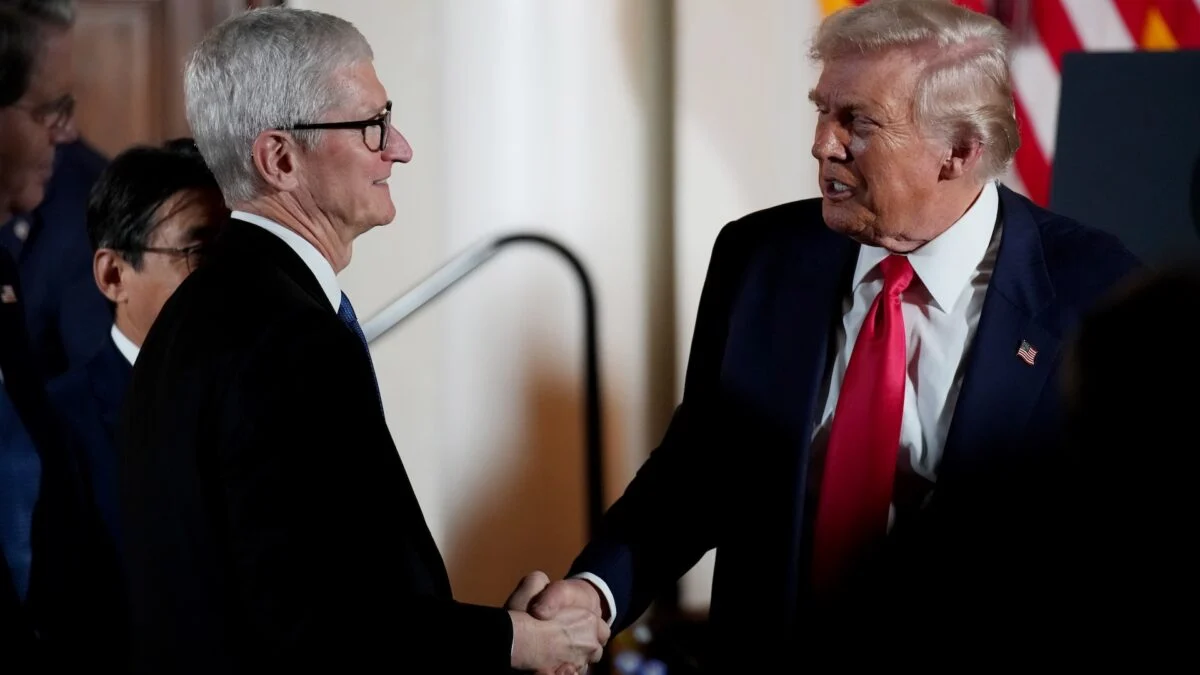
The news hit social media like a swarm of angry bees: Tim Cook, seen entering the White House. Not for a policy meeting, but a film screening. Then came the kicker—the movie was Melania, a paean to the former First Lady, produced during a period of intense political division. Now, the Apple CEO is facing a digital firestorm, and some are calling for a full-blown Apple boycott.
Over the weekend, about 70 guests reportedly gathered in the East Room of the White House for the screening, according to the Hollywood Reporter. Tech luminaries such as AMD’s Lisa Su and Zoom’s Eric Yuan were spotted. The guest list included the controversial director Brett Ratner, boxer Mike Tyson, and motivational speaker Tony Robbins, alongside figures like New York Stock Exchange CEO Lynn Martin, Jordan’s Queen Rania, and Fiat heiress Azzi Agnelli.
Despite the impressive guest list, it’s Cook’s presence that has ignited the most controversy. This isn’t his first waltz with the Trump administration, but the timing couldn’t be worse.
“Cook attended the WH screening of MELANIA, endorsed Trump wholeheartedly and proudly posed with sexual predator and the movie’s director Brett Ratner, while ICE agents were slaughtering a VA nurse in Minneapolis,” novelist Paul Rudnick wrote on X. (Ratner, it’s worth remembering, faced accusations of sexual harassment and misconduct from multiple women in 2017.)
Rudnick didn’t stop there. “Tim reportedly kept asking, ‘Is Goebbels here? Can I get a selfie?’” he joked, invoking the name of Adolf Hitler’s propaganda chief.
Melania purportedly gives viewers a peek behind the curtain during the 20 days leading up to President Trump’s (fictional) second inauguration on Jan. 20, 2025. While Gizmodo hasn’t seen the film, and Amazon isn’t permitting early reviews, you can probably guess the tone, considering the key players. Subtlety and unbiased reporting aren’t likely on the menu.
Trump himself has amplified the film on social media, touting it as a “behind-the-scenes” glimpse at “one of the most important events of our time.”
COUNTDOWN: 7 Days until the World will witness an unforgettable, behind-the-scenes, look at one of the most important events of our time.
MELANIA: TWENTY DAYS TO HISTORY:https://t.co/rjwd5Appkv pic.twitter.com/AHD0rn1M7C
— Donald J. Trump (@realDonaldTrump) January 23, 2026
Even before the screening, the film sparked debate when Amazon MGM Studios acquired distribution rights for $40 million (€36.8M), a hefty sum for a documentary. Some saw it as a gesture from Amazon founder Jeff Bezos, who, in some eyes, has drifted toward right-wing ideologies. Amazon CEO Andy Jassy and Amazon MGM Studios head Mike Hopkins also attended the White House event, according to USA Today.
“Tim Cook and Jeff Bezos are Trump-glazing fascist fucks. If folks would boycott Apple and Amazon, we’d really make an impact,” a typical comment on Bluesky read over the weekend.
Others quipped that making Cook sit through the Melania movie was a fitting punishment for associating with the Trump regime. (Cook previously presented Trump with a trophy and has been seen at other events with the administration.)
“Tim Cook and Andy Jassy should be forced to watch this movie. I don’t typically support torture, but they’ve earned this,” writer Thor Benson wrote.

Historically, White House movie screenings occurred in the White House Family Theater, established by President Franklin D. Roosevelt in 1942. But that space was reportedly dismantled by President Trump. The Melania screening was held in the East Room.
The film is slated for a “premiere” at the Kennedy Center (renamed the Trump-Kennedy Center) followed by a release in 1,400 to 2,000 theaters nationally, with eventual screenings in 27 countries, according to Puck. The varying theater count? Apparently, Amazon’s projections are “all over the place.”
Reports on advance ticket sales are bleak, and Amazon is seemingly trying to boost attendance. Marketwatch reports a $35 million (€32.2M) marketing spend, with Amazon executives supposedly tasked with supporting the film on opening day.
The Price of Admission: Examining the Fallout
When a CEO steps into the political arena, the line between personal choice and corporate endorsement blurs. Cook’s attendance at the Melania screening has ignited a debate about Apple’s values, raising questions about the company’s stance on issues of social justice, human rights, and political alignment. It’s a high-stakes game where reputations can be tarnished in an instant.
Early box office estimates are dismal, projecting a $1-5 million (€0.92M-€4.6M) gross, per Morningstar a troubling return on a $75 million (€69M) investment. Will curiosity draw audiences at the last minute? Or will viewers attend with a critical eye, documenting the individuals complicit in what some see as a slide toward authoritarianism? The answer remains to be seen.
What is a boycott and how can it impact a company like Apple?
A boycott is a coordinated refusal to buy goods or services from a specific company as a form of protest. If a boycott gains traction, Apple could experience a drop in sales, damage to its brand reputation, and increased scrutiny from investors and the public. Social media platforms like X (formerly Twitter) and Bluesky amplify calls for boycotts, quickly mobilizing public opinion.
The Tech CEO and the Tightrope Walk
Tech CEOs often walk a tightrope, balancing the need to engage with political leaders and the imperative to maintain neutrality (or at least the appearance of it). Think about the scrutiny Mark Zuckerberg has faced over Facebook’s content policies, or the pressure Elon Musk has endured since acquiring Twitter. Can tech leaders truly remain neutral in an era of intense political polarization?
It’s unclear if an Apple boycott will materialize. But as societal divisions deepen, individuals are increasingly inclined to use their wallets as a form of protest. Cook’s actions have placed Apple at the center of this cultural battleground.
What other companies have faced boycott threats for political reasons?
Numerous companies have faced boycott threats due to perceived political affiliations or actions. Nike faced backlash for its support of Colin Kaepernick, while Chick-fil-A has been boycotted over its stance on LGBTQ+ issues. Ben & Jerry’s also saw calls for a boycott after announcing it would stop selling ice cream in Israeli-occupied Palestinian territories. These examples underscore the risks companies face when their actions are perceived as taking a political stand.
A Cultural Flashpoint
Movie screenings, such as the one hosted at the White House, aren’t just about entertainment; they’re about symbolism. Who gets invited, what films are chosen, and the optics surrounding these events all send messages. For those critical of the Trump administration, Cook’s presence at the Melania screening was more than a misstep—it was a betrayal.
It’s important to understand that the outrage over Cook’s attendance is about more than just one movie. It’s about the broader issue of corporate responsibility in a hyper-polarized world. Are CEOs obligated to use their influence to promote certain values? Or should they remain detached from political debates? These questions have no easy answers.
How do companies typically respond to boycott threats?
Companies often respond to boycott threats with a mix of strategies, ranging from public relations campaigns to direct engagement with concerned groups. Some may issue statements reaffirming their values or clarifying their position on the issue at hand. Others might adjust their policies or practices in an effort to appease critics. The response often depends on the severity of the threat, the company’s values, and its overall business strategy. For Apple, it may involve emphasizing its commitment to diversity, inclusion, and human rights.
As the culture wars intensify, consumers are becoming more discerning about the brands they support. The digital age has amplified voices and accelerated the speed at which boycotts can spread. In this climate, every action a CEO takes is subject to scrutiny.
The question remains: will this controversy trigger a lasting boycott, or is it merely a fleeting moment of outrage? And, either way, will Tim Cook think twice about his next VIP invite?