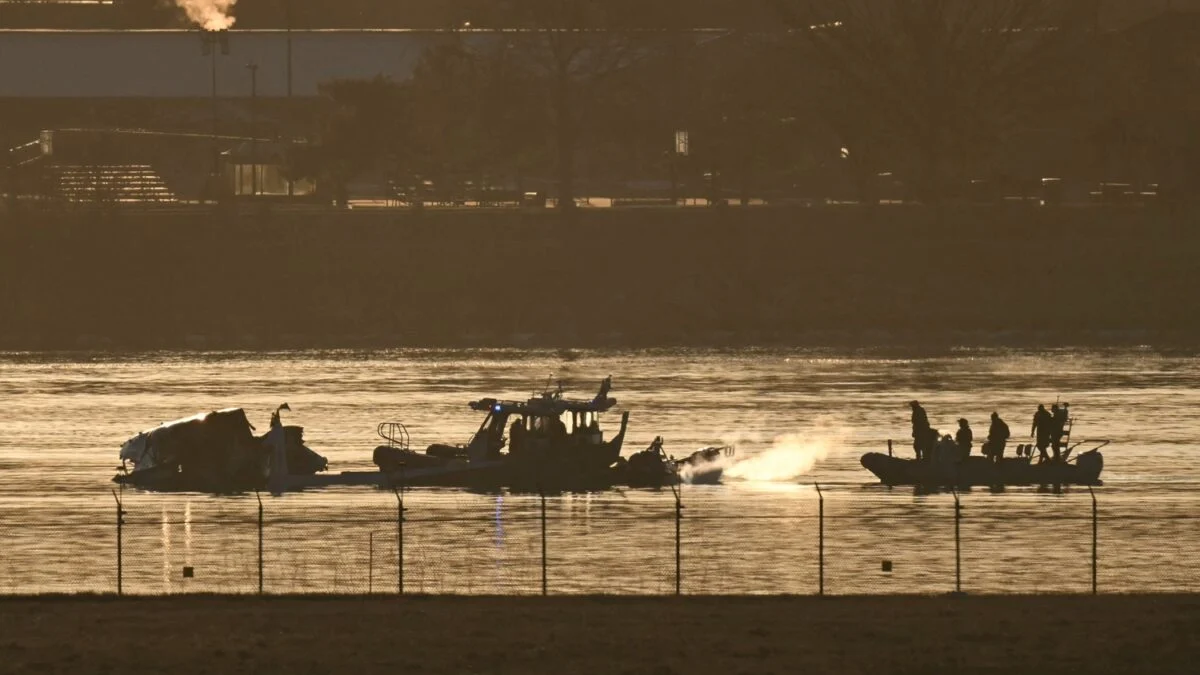
The wreckage told a grim story: twisted metal, silent screams. Investigators walked the scene, each fragment whispering negligence. Sixty-seven lives, reduced to a report, all because someone, somewhere, didn’t connect the dots.
A National Transportation Safety Board (NTSB) review pinpointed systemic safety failures within the Federal Aviation Administration (FAA) prior to the January 2025 mid-air collision between an Army Black Hawk helicopter and an American Airlines regional jet. The crash, near Ronald Reagan Washington National Airport, claimed 67 lives.
“The Federal Aviation Administration Air Traffic Organization had multiple opportunities to identify the risk of a mid-air collision between airplanes and helicopters at Ronald Reagan Washington National Airport. However, their data analysis, safety assurance, and risk assessment processes failed to recognize and mitigate that risk,” the board stated.
The investigation revealed that the helicopter route was dangerously close to civilian aircraft paths. NTSB Chair Jennifer Homendy noted the FAA’s responsibility to conduct annual safety reviews of helicopter routes, yet the board found no evidence of these reviews.
The NTSB also alerted the FAA to 15,214 close-proximity events, 85 classified as serious. Reviews were conducted on a case-by-case basis, investigators stated at a hearing.
“The data was in their own systems,” Homendy told reporters. “This was 100% preventable.”
NTSB investigators cited a lack of a positive safety culture at the FAA’s Air Traffic Organization. Some employees reported facing retaliation for raising safety concerns. The FAA’s operational arm, Air Traffic Organization, failed to respond to these concerns.
Tower personnel formed their own helicopter working group to “repeatedly” voice concerns and submit recommendations, Homendy said.
Homendy also mentioned “some concerns with an overreliance on AI by the FAA,” but did not directly link it to the accident.
“They’ve got to be careful on the use of AI to pick up trends, to make sure it doesn’t discount some reports,” Homendy said. Loren Groff, NTSB’s chief data scientist, stated that the FAA utilizes AI to analyze large quantities of pilot reports.
“There really does need to be a human understanding of what all of these things mean together,” Groff said.
The chair indicated that the FAA seems to have not learned from past errors.
“Commercial airlines have called me to say the next mid-air is going to be in Burbank, and nobody at the FAA is paying attention to us,” Homendy said.
Investigators pointed out the FAA lacks a standardized definition of a close-proximity event.
In addition to FAA shortcomings, the report cited failures within the Army’s aviation safety system. Inadequate resources were allocated to aviation safety management for D.C. area helicopter operations, and a positive safety culture was absent, according to investigators.
The NTSB has repeatedly raised alarms about close calls in aviation. In 2023, Homendy told a U.S. Senate panel of an increase in serious near-miss aviation incidents, symptomatic of a strained aviation system.
“We cannot wait until a fatal accident forces action,” Homendy said at the time.
What Went Wrong That Fateful Day?
January 29th, 2025. Imagine standing on the banks of the Potomac, watching in horror as debris rains down. On that day, an Army Black Hawk helicopter collided with an American Airlines regional flight from Wichita, Kansas, approaching Ronald Reagan National Airport. It stands as the deadliest plane crash in the U.S. since 2001.
The tower at Ronald Reagan National Airport managed both helicopter and flight traffic simultaneously. While understaffed, the Board determined adequate personnel were present to separate control positions. The operations supervisor, working a long shift, made the decision; investigators suggest that “lack of mandatory relief periods for supervisory air traffic control personnel” may have led to impaired performance.
“Keeping the helicopter control and local control positions continuously combined on the night of the accident increased the local control controller’s workload and negatively impacted his performance and situation awareness,” the report stated.
Controllers alerted the helicopter to the approaching passenger plane but failed to warn the flight crew of the helicopter. The pilots couldn’t see the helicopter, and the airplane lacked airborne collision avoidance systems.
The helicopter crew acknowledged the incoming flight but likely mistook it for another, as the controller hadn’t specified direction or distance.
The helicopter flew approximately 30 meters (32.8 yards) above its maximum altitude. The crew might have seen an incorrect altitude reading. The NTSB found the FAA and the Army failed to identify “incompatibility” between the error tolerances of barometric altimeters in the helicopters and the helicopter route, meaning helicopters were “regularly” exceeding altitude limits and potentially crossing into airplane paths.
“It is possible that incorrect settings may be present on other aircraft used throughout the Department of War armed services,” the board concluded.
What are the implications of the NTSB report for the FAA and the aviation industry?
The report paints a concerning picture, revealing a system where warnings were ignored, and safety protocols were either absent or not enforced. The FAA is now in the spotlight, under pressure to reform its safety oversight. Think of the agency as a referee who wasn’t watching the game; now, everyone is questioning every call.
This isn’t just about bureaucratic shuffling; airlines might face increased scrutiny and potential operational changes. The report also sparks a broader discussion about the balance between technological advancements, like AI, and the irreplaceable value of human oversight.
What specific failures within the Army’s aviation safety system contributed to the collision?
Beyond the FAA’s missteps, the Army’s aviation safety system was also compromised. Resources were spread too thin, and a “positive safety culture” was missing in D.C. area helicopter operations, contributing directly to the circumstances. It’s a stark reminder that safety isn’t just about equipment; it’s about fostering an environment where concerns are heard and acted upon. Could cultural changes within the Army have altered the course of events?
What role did technology, particularly AI, play in the lead-up to the crash?
The NTSB flagged the FAA’s increasing reliance on AI to sift through pilot reports. While AI can be a powerful tool, it needs to be handled with care. The system becomes a house of cards when data is misread, undervalued, or, crucially, not understood within a human context. The real question is: was the AI being used as a crutch, replacing the critical thinking of experienced personnel?
The situation is akin to a high-stakes poker game where the players keep upping the ante. In this case, airlines have already voiced concerns about potential mid-air collisions in other cities, highlighting the urgency for change. The NTSB report raises serious questions about accountability and the effectiveness of current aviation safety measures. Will this tragedy serve as a catalyst for change, or is the aviation industry destined to repeat the same mistakes?