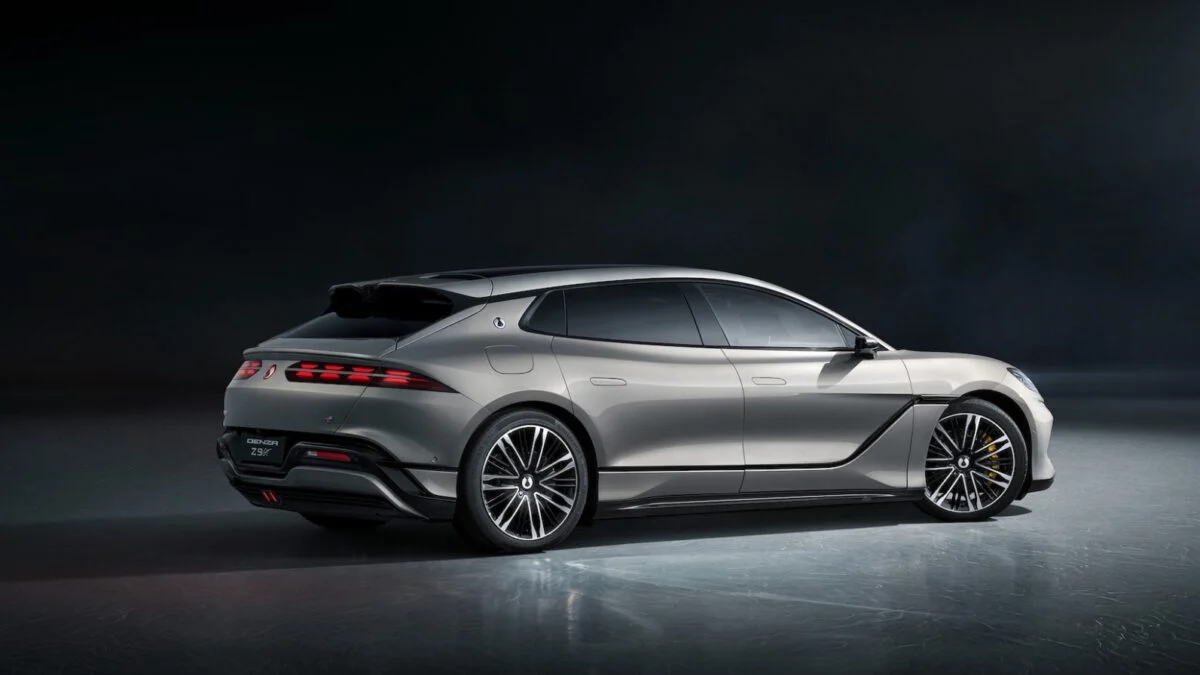
Lights glare off a lacquered Denza badge as a crowd hushes; someone in the back checks their phone and scrolls to Electrek. I felt the room tilt—an economy’s quiet confidence measured in kilometers. You can almost hear boardrooms on both sides of the Pacific recalculating.
I write this as someone who follows both product launches and policy fights. You should know the basics first: Denza, BYD’s luxury arm, posted on X (Xiaohongshu) that the updated Z9 GT will hit 1,036 km (644 miles) under China’s CLTC cycle. Electrek says the model debuts March 5, and a regulatory filing hinted an even higher 1,068 km (664 miles) figure for a standard Z9 variant.
A glossy post on Xiaohongshu showed the Z9 claiming 1,036 km.
The claim is measured on CLTC, which typically returns higher numbers than the EPA. Still, jump from the current Z9’s 630 km (391 miles) to 1,036 km (644 miles) is dramatic. I watched that jump and thought: this is not incremental progress; the Z9 stretches range like a marathon runner.
How far can the Denza Z9 GT go on a single charge?
Denza says the long-range Z9 GT manages up to 1,036 km (644 miles) on CLTC testing. A regulatory filing sealed last month hinted a standard Z9 could reach up to 1,068 km (664 miles). Those are domestic-cycle numbers, but they set a new public target for range that other makers must answer.
A Tesla showroom poster lists about 405 miles for the Model S.
Compare that to American badges: Tesla’s Model S is EPA-rated up to 405 miles; Chevrolet’s Silverado EV reaches roughly 478 miles; the Lucid Air Grand Touring tops out near 512 miles. Those are strong figures, but they sit well below Denza’s headline claim.
Price matters too. The current Denza Z9 starts at 354,800 yuan (about $51,500; €47,400). Comparable U.S. electric offerings often begin at roughly $90,000 (€82,800) or more, leaving Denza a price wedge as well as a range one.
Are American automakers falling behind China in EV technology?
BYD’s production tells part of the story: it delivered about 2.26 million EVs in 2025, a 28% year-over-year jump, while Tesla’s deliveries dropped 9% to roughly 1.636 million. Those numbers are not subtle; they redraw competitive maps.
A quarterly board presentation at Ford acknowledged lower EV orders last year.
The political moment is part of the market moment. After President Donald Trump pulled federal EV subsidies, Ford’s CEO Jim Farley warned demand might halve. Ford then shelved production of an all‑electric F-150 and canceled plans for a new electric van, shifting dollars back toward hybrids and internal-combustion models. Other U.S. makers have quietly trimmed or delayed EV programs.
Consumer sentiment is a governor here: a Deloitte survey found only 7% of Americans want their next car to be electric, citing range, charging time, and price. Sales followed sentiment—EV deliveries in the U.S. fell last year, and policy changes only sharpen that feedback loop.
A Canadian trade announcement opened a small gate for Chinese-made EVs.
Canada signed a strategic partnership that would allow up to 49,000 Chinese-made EVs into its market, while the U.S. still levies a 100% tariff on many Chinese EV imports. Those barriers slow direct entry but don’t stop manufacturing strategies: assembly plants, joint ventures, and regional supply chains can move the cars closer to buyers.
Will Chinese EVs enter North America?
Short answer: yes, through a mix of routes. Tariffs keep many Chinese models out today, but automakers can localize production or export through partner-friendly markets. BYD and other Chinese brands have global ambitions—production footprints often follow demand, and Canada’s policy shift is a test case.
An academic interview with Case Western’s Susan Helper warned of lost capacity.
Helper—former Commerce Department chief economist—told The New York Times that the U.S. risks waking up in a decade without a domestic industry that does significant R&D. That’s the exact kind of slow erosion that accelerates once investments dry up and talent migrates.
The geopolitical and commercial pressures stack: a tariff wall, changing incentives, and a Chinese supply chain that scales faster. I’ve covered industries that slipped from dominant to dependent; the moves are surgical and quiet until they aren’t, leaving U.S. firms to pick up the pieces like a chessboard with missing pieces.
I’ll be watching BYD’s March 5 event and the regulatory filings that follow, and I hope you will too—because the question here isn’t only which car goes farther on a charge, it’s whether the U.S. will compete on those terms or hand the lead to others?