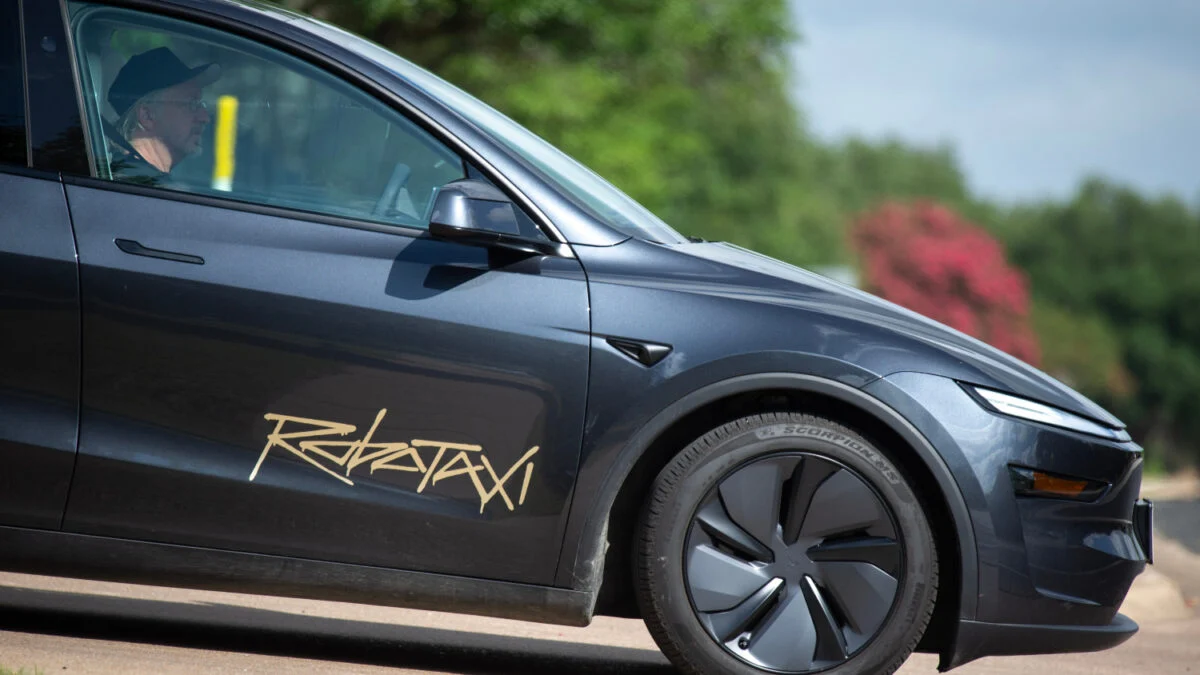
I watched a Tesla pull up to a curb in San Jose and the driver swivel his head while a passenger booked a ride on their phone. You see the badge “Robotaxi” and you expect a car that can drive itself; instead, a human sits where the law still calls a driver. That split-second mismatch is exactly what California regulators are now calling out.
I want you to keep one thing in mind: the label on the door does more than sell rides. It redefines who answers for safety when a system falters. The California Public Utilities Commission (CPUC) has told me, through its deputy executive director Pat Tsen, that Tesla’s permit isn’t the same legal paper other robotaxi companies hold.
A Tesla idles at a curb with a person at the wheel. Why the CPUC treats it like a limousine
Pat Tsen explained on The Driverless Digest podcast that Tesla operates under a charter party carrier permit — the same permit a limousine firm would use. That means, in the CPUC’s view, the person behind the wheel is a driver, not a “safety driver” being quietly supervised by regulatory standards designed for true autonomous fleets.
The practical consequence: Tesla isn’t bound to send the CPUC the operational telemetry that Waymo and Zoox must submit. Those firms, operating at higher autonomy tiers, report detailed metrics — location trails, passenger counts, vehicle miles traveled, and stoppage events where a car is stuck for more than two minutes. Tesla’s permit keeps it largely outside that reporting net.
Is Tesla’s Robotaxi legal in California?
Short answer: It’s legal to operate — but not as a government-recognized robotaxi. The CPUC accepts Tesla’s rides under a charter-style permit, not an AV permit for SAE Level 3 or above. You can sell a trip as a ride-hail and keep calling it Robotaxi, and yet regulators still read the paperwork and see a conventional chauffeur operation.
A CPUC official spoke on a podcast about definitions. Here’s what she said about autonomy levels
Tsen laid out how California defines an autonomous vehicle: the state treats SAE Level 3 as the floor for a machine to be considered autonomous for regulatory purposes. Level 3 requires the onboard system to handle driving under specific conditions without constant human oversight.
Tesla’s system, by contrast, is classified as SAE Level 2. That means the driver must be ready to take control at any moment. Waymo and Zoox run Level 4 operations in designated geofenced areas — cars that can drive themselves without expecting instant human intervention. Those higher-tier operators therefore carry a different regulatory burden and different transparency obligations.
Why doesn’t Tesla have to submit robotaxi data?
Because the permit Tesla holds is for a conventional carrier model, not an AV operator. The CPUC requires telemetry and incident reporting from authorized autonomous fleets; it doesn’t demand the same from services licensed under charter-party rules. Tesla lobbied in November to keep Level 2 ride-hailing services from being forced to hand over this kind of data, according to Electrek.
A Waymo SUV navigates a mapped neighborhood without a person steering. What that means for public safety and data
When a Waymo or Zoox vehicle stops, regulators see the stoppage, the location, the passenger count and the miles traveled. With Tesla’s setup, those data streams are not routinely available to the CPUC.
That gap creates a problem for anyone trying to measure risk or spot systemic issues. If you want to compare incident rates between a Level 4 fleet and Tesla’s ride service, you’re missing a lot of the raw numbers. Think of it as two players in the same game but reading from different rulebooks — and the referee only publishes one team’s stats.
I’ll be blunt: branding sells narratives. Tesla calls its service “Robotaxi,” Musk’s messaging leans on Autopilot and Full Self-Driving labels, and customers often repeat those phrases. The California Department of Motor Vehicles flagged that marketing as potentially misleading and initially ruled against Tesla; the automaker is now suing the DMV to reverse that finding.
What is the difference between Level 2 and Level 4 autonomy?
Level 2 means the system can assist with steering or speed but a human must supervise and intervene. Level 4 means the vehicle can perform all driving tasks within a defined environment without expecting a human to take over. The regulatory consequences follow those technical distinctions: Level 4 operators face stricter oversight and more transparency requirements.
You should be asking not just whether a car can move on its own, but whether regulators can see how it moves. When data is withheld, assessing safety becomes speculation rather than evidence. That secrecy is the real story behind the Robotaxi label — and it’s what companies like Waymo and Zoox have tried to counter with public reporting and cooperation with regulators.
I’ve seen this kind of branding game before; a name can act as a stage costume that makes a thing feel more advanced than it is. The permit gap functions as a shadow cloak that hides whole swaths of operational truth.
If you care about where control and accountability land — and you should — then the debate around Tesla’s permit is one of the clearest fights over what the public gets to know about the vehicles it buys rides from. So who should decide which label carries responsibility, regulators or marketers?