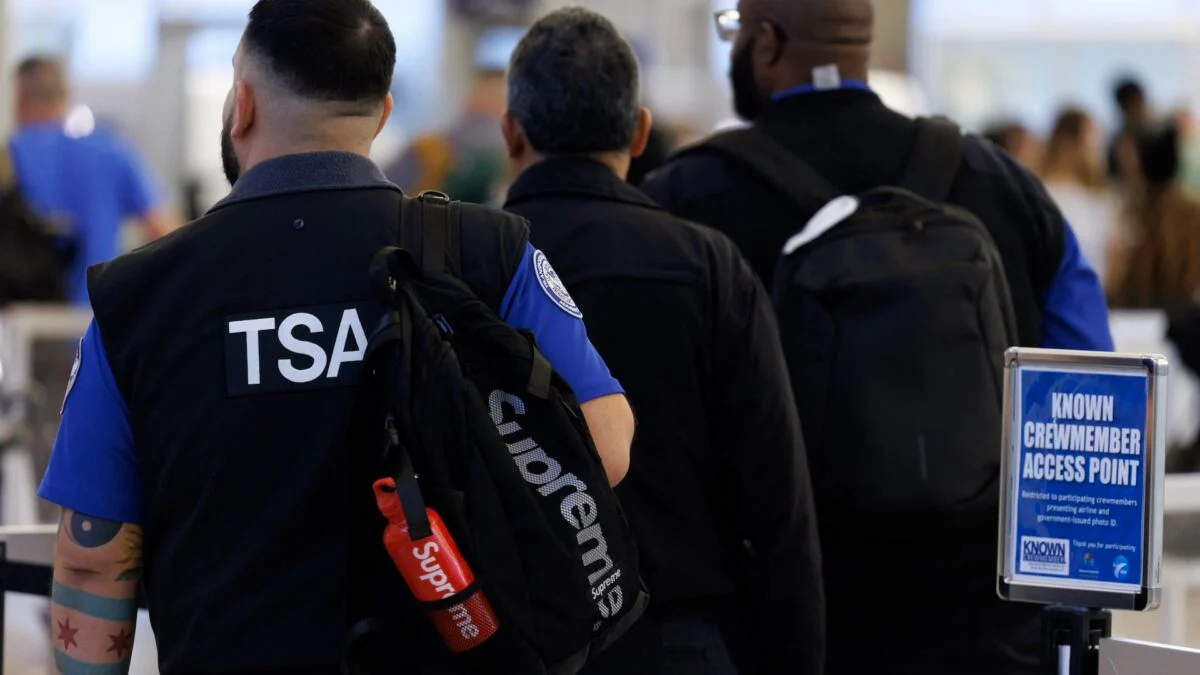
I was standing behind a family with two toddlers at my local airport when a man in a plain polo and a contractor badge waved them through faster than the uniformed screener behind him. You could see the moment of relief on their faces — and then a slow, sinking thought: who exactly was responsible if something went wrong? I felt the air change in the terminal, as if policy had quietly shifted beneath our feet.
I’ve followed budgets and bureaucracies for years, and you should know two things up front: budgets are blueprints for power, and words like “cost savings” are often the first tools of a larger plan. The White House’s FY2027 proposal — yes, the one posted on WhiteHouse.gov — includes a line that reads: “The Budget begins the privatization of TSA’s airport screeners by requiring small airports to enroll in the Screening Partnership Program, under which TSA pays for private screeners at designated airports.”
At 20 airports, private companies already run screening operations
That’s not hypothetical. The Screening Partnership Program (SPP) currently operates at roughly 20 airports where TSA funds a private contractor to staff checkpoints. You’ve probably seen contractors from firms such as Allied Universal or Securitas working security at malls and corporate campuses; SPP lets those firms wear the airport badge and get federal pay.
I’ve watched airports join SPP, then back out after community pushback or performance problems. It felt like swapping a government badge for a contractor’s business card. There are cost arguments — but there are also liability, oversight, and training questions that rarely make the quick budget headlines.
At small regional hubs, the Budget wants mandatory SPP enrollment
The proposal doesn’t suggest a pilot; it proposes requiring small airports to enroll in SPP. That language comes from a plan drafted by Russ Vought, a chief architect of Project 2025, who has openly favored privatizing many federal functions while protecting defense spending.
Read plainly, the Budget requests roughly $1.5 trillion (€1.4 trillion) for the military and trims away funding from FEMA, federal health agencies, and the EPA. It also requests $152 million (€140 million) to reopen Alcatraz as a functioning prison. On the domestic front, the plan would cut $2 billion (€1.8 billion) from humanitarian aid, $393 million (€360 million) from housing programs, and $1.2 billion (€1.1 billion) from the Food for Peace program.
At crowded checkpoints, the staffing crisis has real causes
During recent funding fights in Congress, TSA has been starved of appropriations as Democrats and Republicans sparred over DHS policy changes. You saw the result: long lines, operational improvisation, and public pressure. President Trump tried a series of extraordinary fixes — from deploying ICE officers to airports to executive orders about pay — moves that raise constitutional and practical questions about where money and authority should come from.
Will TSA be privatized?
Short answer: the Budget starts the process. By making SPP mandatory for smaller airports, the administration isn’t flipping a single switch; it’s changing the default. Once private vendors staff more checkpoints — with federal dollars but less direct federal management — the political momentum to expand that model grows.
What is the Screening Partnership Program?
SPP is a program created in 2004 that lets airports hire private security contractors whose wages and operations are paid for by TSA. The agency retains regulatory oversight but cedes day-to-day management. Airports opt in or out; the Budget wants to push small airports toward opting in, funded by public money but run by private firms.
How would privatizing TSA affect airport security?
There’s no single, simple answer. Proponents promise cost savings and flexibility; skeptics point to accountability gaps and uneven training standards. You should ask: if a private contractor fails an audit or lapses on training, who is answerable — the contractor, TSA, or local authorities? The proposal feels like a Trojan horse for wider privatization, and oversight structures will determine whether that horse carries reinforcement or risk.
At the center of this push sits ideology and messaging
Russ Vought and Project 2025 frame these moves as a way to “reform a troubled Federal agency.” That language is persuasive to a base tired of long airport lines and bureaucratic headlines, and it fits a broader agenda favoring private provision of public services. You should know the playbook: privatize pieces of a service, show short-term savings or stability, then expand the model.
And don’t forget the optics: headlines about military spending hitting a modern high help reallocate political capital. Media outlets from CNN to HuffPost have flagged the $1.5 trillion defense ask and the odd line-item for Alcatraz, but the quiet clauses about SPP could reshape everyday travel faster than a lot of people realize.
At the gate, accountability will be the test
If you travel, this matters to you. If you care about public oversight, this matters to you. Private contractors can bring efficiency or uneven performance; the difference will be whether Congress and regulators build real, enforceable standards — and whether local communities get a voice.
I’ll keep watching the budget hearings, vendor contracts, and any proposed legislation that would alter TSA’s authority. Will private firms be subject to the same transparency rules, background checks, and union protections? Who pays when systems fail?
So ask yourself: are you comfortable letting contractors, paid with public dollars but governed by private contracts, hold the keys to airport security?