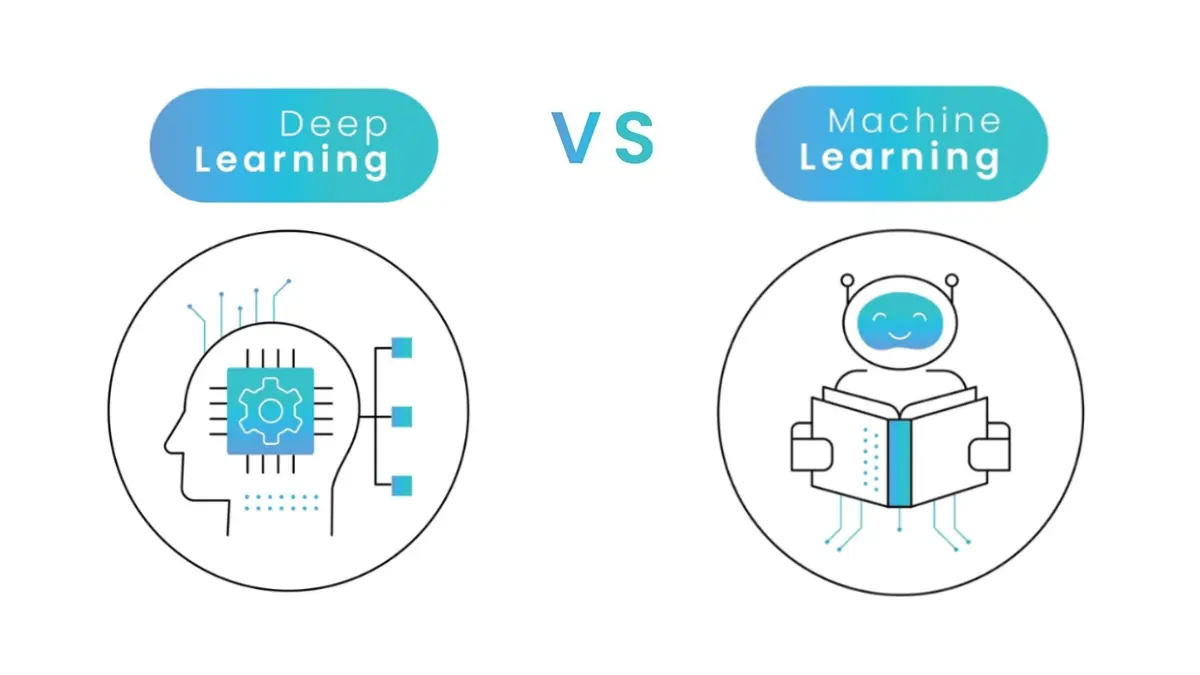
In the rapidly evolving realm of artificial intelligence (AI), machine learning (ML) and deep learning (DL) have emerged as crucial players in the learning process from raw data. However, the distinction between these two concepts can often be muddled. Let’s dive into the differences between deep learning and machine learning, and why they matter to you.
Understanding the nuances between ML and DL is essential not just for tech enthusiasts but also for anyone interested in how AI is shaping various sectors. As someone who has navigated these concepts in depth, I’m here to help clarify these terms and their applications.
What is Machine Learning?
Machine learning involves algorithms that can learn from data independently and make predictions. Unlike traditional programming, where rules are explicitly defined, ML models derive patterns autonomously. However, human intervention is still required to categorize features of data, particularly in classical ML methods.
For instance, teaching a model to recognize a cat requires you to identify specific features, such as ears, whiskers, and tails. This demonstrates why traditional machine learning excels in handling structured, smaller datasets.
Types of Machine Learning Models
The breadth of machine learning is impressive, encompassing various types, including:
- Supervised Learning: Utilizes labeled data where both features and targets are clearly defined, minimizing prediction errors. Commonly applied in spam detection and real estate price forecasts.
- Unsupervised Learning: Works with unlabeled data to identify underlying patterns or groupings. This technique is a fundamental part of clustering and some neural network applications.
- Reinforcement Learning: Involves learning through trial and error. It enables algorithms to experiment and receive rewards or penalties based on their actions. Robotics and autonomous vehicles often employ this model.
Use Cases of Machine Learning Models
Machine learning has integrated itself into our daily lives, appearing in various applications, such as:
- Email filtering for spam detection
- Recommendation systems for personalized ads
- Fraud detection mechanisms
- Search engine algorithms
- Real estate pricing predictions
What is Deep Learning?
Deep learning, a subset of machine learning, takes a different approach. It can automatically learn from raw data without requiring explicit feature engineering. This means it can work with both labeled and unlabeled data, making it versatile.
Deep learning employs multiple layers of neural networks to derive complex patterns from data autonomously. Its applications are wide-ranging, from creating AI chatbots to generating images, music, and text, encompassing everything from language translation to automatic video editing.
Types of Deep Learning Models
Deep learning models come in various architectures tailored for specific tasks. Here are the key types:
- Convolutional Neural Networks (CNNs): Focus on visual data and automatically extract significant features such as edges and textures. Perfect for images and videos.
- Recurrent Neural Networks (RNNs): Designed for sequential data, they remember previous information to understand context, making them vital for speech recognition.
- Long Short-Term Memory Networks (LSTMs): A specialized type of RNN that overcomes limitations in remembering long sequences, widely used in complex tasks like language processing.
- Generative Adversarial Networks (GANs): Consist of a generator and a discriminator to create new data, effective in producing realistic images and text.
- Transformer Architecture: The backbone of large language models such as ChatGPT, this design includes a self-attention mechanism for prioritizing relevant data.
Use Cases of Deep Learning Models
Deep learning has found its home across various industries, with applications like:
- Face and object recognition technologies
- Innovative large language models like ChatGPT
- Content creation across image, video, and music
- Personalized recommendation algorithms on platforms like TikTok and YouTube
- Speech-to-text conversion services
Deep Learning vs Machine Learning: Key Differences
Having explored both concepts, let’s compare them side by side to highlight their differences:
| Feature | Machine Learning (ML) | Deep Learning (DL) |
| Data Size | Effectively manages small to medium datasets. | Requires large datasets for optimal performance. |
| Hardware | Operates on standard CPUs. | Needs advanced GPUs or TPUs for effective training. |
| Feature Extraction | Involves manual feature engineering. | Automatically learns features through the network. |
| Architecture | Utilizes traditional algorithms or shallow neural networks. | Employs deep neural networks (3+ layers). |
| Performance | Performance levels off with increasing data. | Continues to enhance with more data. |
| Interpretability | Decisions are generally easier to understand. | Often perceived as a “black box” in decision-making. |
How does machine learning differ from deep learning in their applications? ML is often used for simpler tasks like email categorization, while DL addresses more complex challenges like image and speech recognition.
Are machine learning models hard to interpret? Generally, ML models yield results that are easier to trace back, making them more understandable compared to their deep learning counterparts, which can be quite opaque.
Can deep learning be applied to smaller datasets? While it can technically handle smaller data, deep learning tends to shine with larger data inputs, leading to superior performance.
Why is feature extraction crucial in machine learning? Effective feature extraction ensures that the models can learn patterns more accurately, directly impacting their predictive performance.
As we navigate the landscape of artificial intelligence, understanding these distinctions not only helps us harness their potential but also opens avenues for innovation in countless sectors. Join me in exploring more about AI as you visit Moyens I/O for additional insights.