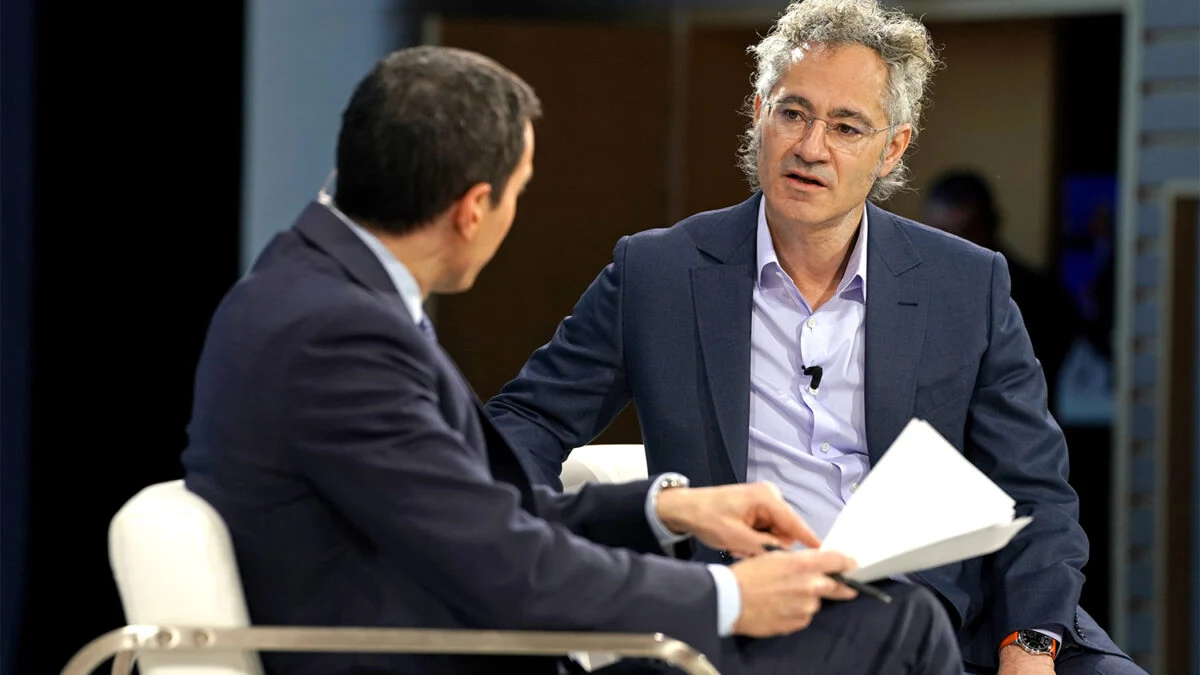
The room was thick with anticipation, but as Alex Karp spoke, a wave of disbelief washed over the crowd. It was as if he’d declared that with enough coding, we could simply wish away the tides. During an appearance at the World Economic Forum in Davos, Switzerland, Palantir’s CEO posited that AI will generate so many jobs, immigration will become obsolete.
When all you have is AI, everything begins to resemble a data point. During his talk with BlackRock CEO Larry Fink, Karp made statements that felt like they came straight from a sci-fi dystopia. The claim that AI will eliminate the need for immigration was particularly striking, even by Karp’s standards.
Asked whether AI will destroy or create jobs, Karp meandered through an answer about the decline of white-collar work and the rise of vocational skills. He then veered into what he himself called a “political screed.” His argument? An abundance of jobs, thanks to AI, would negate the need for large-scale immigration, except for individuals with highly specialized skills.
It ignores the multitude of reasons people leave their homelands. People migrate due to political unrest, war, or environmental crises (something AI contributes to, ironically). Countries might also welcome immigrants for humanitarian reasons, such as offering refuge to those fleeing persecution—often exacerbated by foreign intervention.
Karp, who managed to remain seated this time, touched on numerous subjects, often tangentially related to the initial question. He mentioned that his engineers advised him to limit his public appearances, advice he clearly disregarded.
The interview was a tapestry of digressions. He spoke of a desire to return to graduate school, not for knowledge, but for “fun.” He highlighted that a leader within Palantir’s Maven system, an AI tool used by the US Army, only had a junior college degree, implying further education was unnecessary. In Karp’s view, talent is simply innate.
Perhaps Karp believes his own university experience was inconsequential, that his thinking and understanding remained untouched by his studies. Considering he holds a PhD in philosophy, his perspective might reveal more about him than the education itself.
The Human Cost of Automation
A friend of mine recently lost his job to an AI-powered system. It wasn’t a matter of lacking skills; it was simply cheaper to automate his tasks. The narrative that AI creates more jobs than it destroys feels increasingly detached from reality.
What jobs will AI not replace?
While AI excels at repetitive tasks and data analysis, uniquely human skills remain in demand. Roles requiring empathy, critical thinking, and complex problem-solving are less susceptible to automation. These include specialized trades, healthcare, creative arts, and leadership positions that require emotional intelligence.
Karp’s vision is a world where AI solves all economic woes, eliminating the need for human migration. His perception seems disconnected from the complex realities that drive people to seek new lives elsewhere. This reflects a deeper detachment, a perspective that prioritizes technological solutions over human considerations.
The Siren Song of Technological Determinism
I saw a documentary recently about the early days of the auto industry. People predicted that cars would solve all transportation problems, ushering in an era of unprecedented freedom and prosperity. We know how that story turned out.
Karp’s vision seems rooted in a belief that technology can solve any problem. It is the kind of technological utopianism that has been proven wrong repeatedly throughout history. His faith in AI feels less like a reasoned argument and more like a personal religion.
Will AI reduce the need for immigration?
While AI might reshape job markets, it’s unlikely to eliminate immigration. People move for diverse reasons: family reunification, educational opportunities, or escaping conflict and persecution. These factors transcend economic considerations. Even if AI creates jobs in some countries, it won’t erase the inequalities and crises that compel people to seek refuge and opportunity elsewhere.
The Unexamined Life
I once attended a lecture by a prominent philosopher who argued that the greatest danger to society is not malice, but unexamined assumptions. It struck me as profoundly relevant to the conversation around AI.
Trying to decipher Karp’s complete belief system is like chasing shadows. His core conviction seems to be that he deserves success and wealth, and the world should align to facilitate that. He appears to believe that AI is the tool to deliver that outcome, regardless of the human cost.
What are the ethical implications of AI?
The ethical implications of AI are wide-ranging and demand careful thought. Algorithmic bias, data privacy, job displacement, and the potential for misuse are primary concerns. As AI systems become more integrated into our lives, it’s essential to establish guidelines and regulations that ensure fairness, accountability, and transparency. Palantir, and figures like Alex Karp, have a responsibility to address these concerns proactively.
The future is not something to be predicted, but something to be achieved. It’s shaped not just by technology, but by the choices we make about how to use it. The belief that AI will solve all problems ignores the complex tapestry of human needs and desires, reducing people to mere economic units in a grand technological scheme. What happens when the promise of AI clashes with the realities of human experience?