The screen flickered, lines of code cascading down like digital rain. A transportation regulation, usually months in the making, materialized in seconds. Was this the future of governance, or a dangerous shortcut?
This story was originally published by ProPublica.
According to U.S. Department of Transportation records and interviews with six agency staffers, the Trump administration was exploring using artificial intelligence to draft federal transportation regulations.
At a demonstration for DOT staff last month, agency attorney Daniel Cohen wrote to colleagues about AI’s “potential to revolutionize the way we draft rulemakings.” The showcase would feature “exciting new AI tools available to DOT rule writers to help us do our job better and faster.”
Inside the DOT’s AI Rulemaking Plan
Imagine a world where algorithms write the rules of the road. Discussion of the plan continued among agency leadership. According to meeting notes reviewed by ProPublica, the agency’s general counsel, Gregory Zerzan, said that President Donald Trump was “very excited about this initiative.” Zerzan suggested that the DOT was at the forefront of a wider federal push, calling the department the “point of the spear” and “the first agency that is fully enabled to use AI to draft rules.”
Zerzan seemed more focused on the volume of regulations AI could produce than their quality. “We don’t need the perfect rule on XYZ. We don’t even need a very good rule on XYZ,” he said, according to the meeting notes. “We want good enough… We’re flooding the zone.”
These developments sparked concern at DOT. The agency’s regulations affect transportation safety, including rules that keep airplanes in the sky and prevent gas pipelines from exploding. Some staffers questioned why the federal government would outsource drafting such standards to a technology known for errors.
What are the risks of using AI to write government regulations?
One major risk is the lack of human oversight and critical thinking, potentially leading to flawed or biased regulations. The answer from proponents: speed. Writing and revising regulations can take months, or years. Two DOT staffers who attended the December demonstration recalled the presenter saying that with DOT’s version of Google Gemini, employees could generate a proposed rule in minutes. One staffer recalled the presenter saying that most of what goes into the preambles of DOT regulatory documents is just “word salad,” adding that Google Gemini can do word salad.
Zerzan reiterated the ambition to accelerate rulemaking with AI. The goal is to compress the timeline in which transportation regulations are produced, from idea to complete draft ready for review by the Office of Information and Regulatory Affairs in just 30 days. “It shouldn’t take you more than 20 minutes to get a draft rule out of Gemini,” he said.
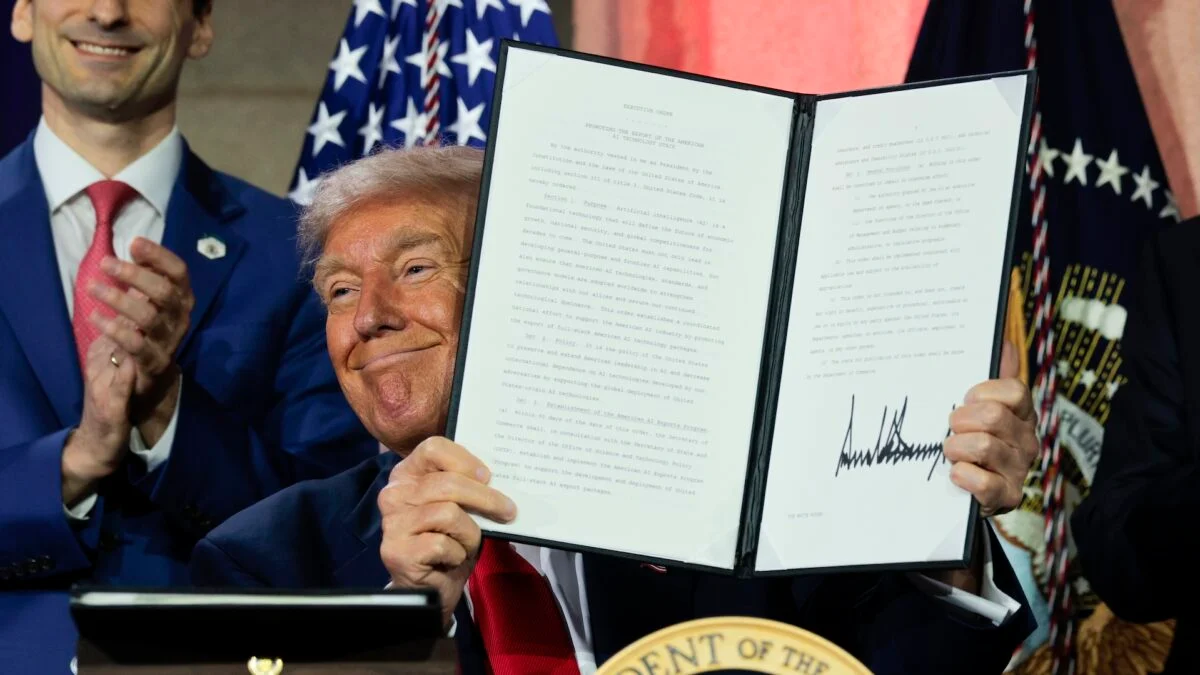
The DOT plan represents a new front in the Trump administration’s campaign to incorporate AI into the federal government. Federal agencies have been integrating the technology into their work for years to translate documents, analyze data, and categorize public comments, among other uses. Trump released multiple executive orders in support of AI last year. In April, Office of Management and Budget Director Russell Vought circulated a memo calling for the acceleration of its use by the federal government, followed by an “AI Action Plan.” DOT has used AI to draft a still-unpublished Federal Aviation Administration rule, according to a DOT staffer.
The Great AI Debate: Efficiency vs. Expertise
Every line of code holds potential, but also risk. Skeptics say that so-called large language models shouldn’t be trusted with the responsibilities of governance, given that those models are prone to error and incapable of human reasoning. But proponents see AI as a way to automate tasks and wring efficiencies out of a slow-moving bureaucracy.
At an AI summit, federal technology officials discussed adopting an “AI culture” in government and “upskilling” the federal workforce to use the technology. Justin Ubert, division chief for cybersecurity and operations at DOT’s Federal Transit Administration, spoke on a panel about the Transportation Department’s plans for “fast adoption” of artificial intelligence. He noted that many people see humans as a “choke point” that slows down AI and predicted that humans will fall back into merely an oversight role, monitoring “AI-to-AI interactions.” Ubert declined to speak to ProPublica on the record.
The presentation at DOT was attended by over 100 DOT employees, including division heads, attorneys and civil servants from rulemaking offices. The presenter said that Gemini can handle 80% to 90% of the work of writing regulations, while DOT staffers could do the rest, one attendee recalled.
To illustrate this, the presenter asked for a suggestion from the audience of a topic on which DOT may have to write a Notice of Proposed Rulemaking. He plugged the topic keywords into Gemini, which produced a document resembling a Notice of Proposed Rulemaking. It appeared to be missing the actual text that goes into the Code of Federal Regulations, one staffer recalled.
According to three people present, the presenter expressed little concern that the regulatory documents produced by AI could contain so-called hallucinations. He said that’s where DOT’s staff would come in. One employee said, “It seemed like his vision of the future of rulemaking at DOT is that our jobs would be to proofread this machine product.” Attendees believed the lead presenter was Brian Brotsos, the agency’s acting chief AI officer. Brotsos declined to comment, referring questions to the DOT press office.
How does AI compare to human rule writers?
AI offers speed and efficiency, but human rule writers bring expertise, critical thinking, and accountability to the process. A spokesperson for the DOT, Cohen, and Zerzan did not respond to a request for comment. A Google spokesperson did not provide a comment.
The December presentation left some DOT staffers skeptical. They said that rulemaking is intricate work, requiring expertise in the subject, statutes, regulations, and case law. One who requested anonymity said, “It seems wildly irresponsible.”
Mike Horton, DOT’s former acting chief artificial intelligence officer, criticized the plan to use Gemini to write regulations, comparing it to “having a high school intern that’s doing your rulemaking.” Horton said the agency’s leaders “want to go fast and break things, but going fast and breaking things means people are going to get hurt.”
The Academic View: AI as a Research Assistant?
The law is a tapestry woven with precedent and nuance. Academics and researchers who track the use of AI in government expressed mixed opinions about the DOT plan. They said that if agency rule writers use the technology as a research assistant with supervision and transparency, it could be useful and save time. They added that if they cede too much responsibility to AI, that could lead to deficiencies in critical regulations and violate the requirement that federal rules be built on reasoned decision-making.
Bridget Dooling, a professor at Ohio State University who studies administrative law, said, “Just because these tools can produce a lot of words doesn’t mean that those words add up to a high-quality government decision. It’s tempting to try to figure out how to use these tools, and I think it should be done with skepticism.”
Ben Winters, the AI and privacy director at the Consumer Federation of America, said the plan was especially problematic given the exodus of subject-matter experts from government as a result of the administration’s cuts to the federal workforce last year. DOT has had a net loss of nearly 4,000 of its 57,000 employees since Trump returned to the White House, including more than 100 attorneys, federal data shows.
What role did Elon Musk’s Department of Government Efficiency play?
Elon Musk’s Department of Government Efficiency was a major proponent of AI adoption in government. The Washington Post reported on a leaked DOGE presentation that called for using AI to eliminate half of all federal regulations, and to do so in part by having AI draft regulatory documents. “Writing is automated,” the presentation read. DOGE’s AI program “automatically drafts all submission documents for attorneys to edit.” DOGE and Musk did not respond to requests for comment.
The White House did not answer a question about whether the administration is planning to use AI in rulemaking at other agencies as well. Four top technology officials in the administration said they were not aware of any such plan. Two of those officials expressed skepticism regarding DOT’s “point of the spear” claim. One said, “There’s a lot of posturing of, ‘We want to seem like a leader in federal AI adoption.’ I think it’s very much a marketing thing.”
As AI’s presence in government grows, how do we balance innovation with accountability?