The lab fell silent as Dr. Anya Sharma stared at the AI-generated anomaly—a protein folding pattern that defied known physics. Her career, built on rigorous methodology, now hinged on lines of code she didn’t fully trust. Was this a breakthrough, or just a mirage shimmering on the digital horizon?
OpenAI Wants You to ‘Vibe Physics’
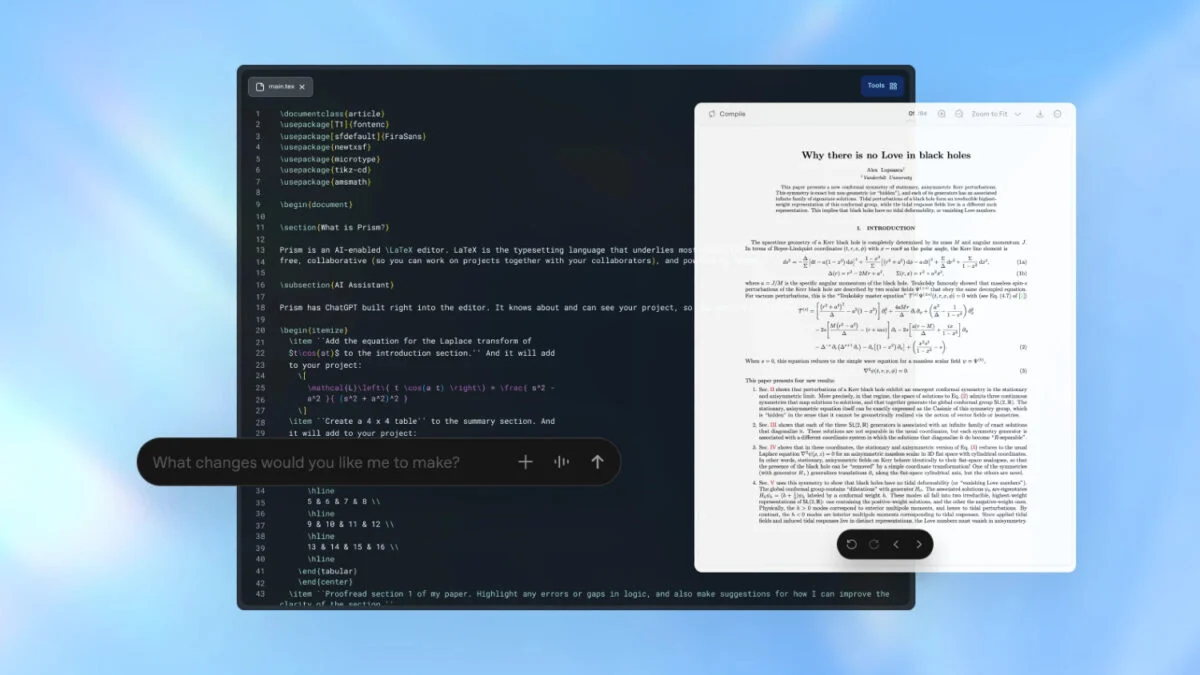
I saw a guy at a coffee shop the other day, sketching equations on a napkin and muttering about “quantum vibes.” Turns out, he might’ve been onto something (sort of). OpenAI just launched Prism, a workspace designed to help scientists write and collaborate on research, powered by their GPT-5.2 Thinking model. The goal? To streamline the research process by integrating tools like PDF editors, LaTeX compilers, and reference managers into one AI-driven platform.
Think of Prism as a central nervous system for your research, aiming to prevent the current chaos of jumping between different programs. OpenAI says you can draft and revise papers directly within Prism, search for relevant literature, and use AI to manipulate equations and citations. Multiple users can also revise and comment in real-time.
What are the potential drawbacks of using AI in scientific research?
Here’s where things get tricky. Since ChatGPT and other AI tools exploded onto the scene, scientific journals have been swamped with questionable papers, the result of farming out work to AI. Remember the journal that published an AI-generated image of a rat with, shall we say, *anatomical exaggerations*? The flood of submissions was already straining the peer-review process, and AI assistance has only intensified the pressure. In this environment, the siren song of efficiency risks drowning out careful analysis. If you use a sledgehammer where a scalpel is needed, the result can be chaos.
A study from UC Berkeley Haas and Cornell University indicates that scientists using AI can increase their output by up to 50%, but the work is often of “marginal scientific merit.” The study also found that human-written papers still surpass AI-generated content, especially when dealing with complex topics.
The “Vibe Physics” Problem
Last year, Uber founder Travis Kalanick claimed he was using AI to explore “the edge of what’s known in quantum physics” and engaging in “vibe coding.” Kalanick may not be discovering anything, but he *feels* like he is, thanks to AI. This highlights a potential danger: AI can empower individuals to overestimate their understanding and produce work that sounds impressive but lacks substance. OpenAI is trying to build tools for real scientists, not venture capitalists trying to reinvent themselves.
How does OpenAI plan to handle user data in Prism?
Data privacy is a major concern. Prism is currently free, so how does OpenAI profit? According to their FAQs, Prism doesn’t use the “Zero Data Retention” API and maintains logs to improve the product. While they claim not to train on API-provided data by default for many customers, there’s no guarantee your data won’t be used in some way. A mode with no text storage or human review is on the roadmap, but there’s no firm timeline.
Prism is available for free to anyone with a personal ChatGPT account, offering unlimited projects and collaborators. It will eventually roll out to organizations using ChatGPT Business, Enterprise, and Education plans. More powerful AI features will be available through paid ChatGPT plans.
Could AI tools democratize access to scientific research?
One could argue that Prism levels the playing field, giving smaller labs and independent researchers access to tools previously only available to well-funded institutions. But what about the risk of homogenizing research? If everyone is using the same AI tools, won’t that lead to a convergence of ideas and methodologies, potentially stifling innovation?
The concern is that the scientific research is at risk of becoming a garden, with everyone planting the same hybrid seeds. Will Prism advance science, or simply create the illusion of progress?