Imagine trying to convey the beauty of a sunrise through words alone while your audience stands in the dark, waiting for the first light. That’s the challenge many content creators face when presenting images without proper descriptions. An effective image description is more than just a label; it’s a guiding light that enhances accessibility, improves SEO, and enriches the user experience.
As we transition more of our work online, collaborating with effective tools has never been more critical. But generating these descriptions can be time-consuming, especially when the right tools aren’t at your disposal. This is where the right AI Image Description Generators come into play. Here’s an insightful look at the top 15 free and easy-to-use AI image description generators you can utilize to create precise and engaging captions in 2026.
What Is an Image Description Generator?
At its core, an AI Image Description Generator serves as your visual interpreter, conjuring text from images through advanced computer vision techniques. It’s like having a skilled artist who can translate visual stimuli into written narratives. The generator analyzes images, identifying objects and their attributes, then crafts readable captions using natural language processing. Both functions make visual content accessible and enhance searchability.
- 1. Analyzes the Image: The AI identifies various elements within an image, from objects to actions, drawing on methodologies like Convolutional Neural Networks (CNNs).
- 2. Generates a Caption: Using language models, it then predicts appropriate words, producing clear, human-like sentences that capture the essence of the visuals.
While traditional systems relied on a simple encoder-decoder setup, modern tools like BLIP and GPT-4V integrate vision and language into a seamless process, resulting in richer and more context-aware descriptions.
Best 15 AI Image Description Generator Tools
Here’s a closer look at the 15 standout tools for generating image descriptions in 2026, along with their main features and strengths:
1. Image Describer
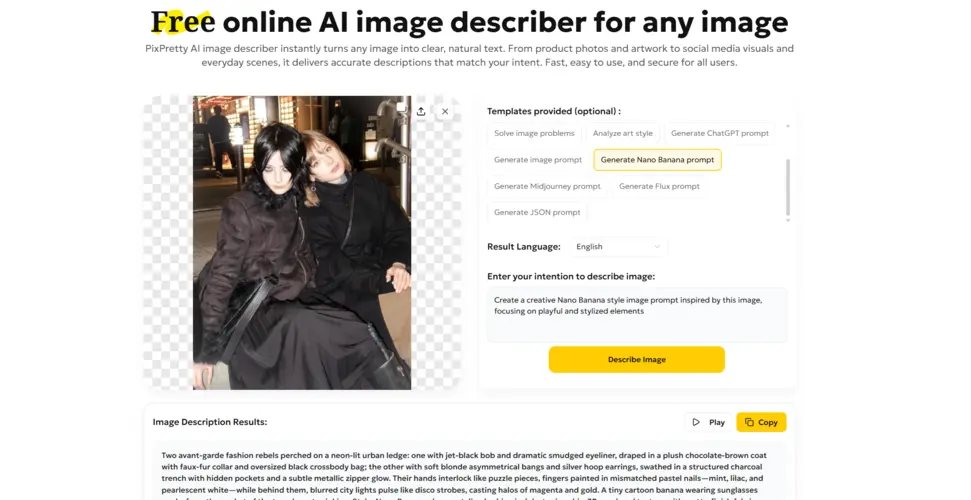
PixPretty offers a user-friendly approach where images are securely processed by a trusted AI, ensuring privacy by deleting them after generating the description. You can quickly obtain a detailed description without any technical skills.
2. FoundMyself Image Description Generator
FoundMyself streamlines the process, allowing creators to transform images into clear, written descriptions effortlessly.

Pros:

Cons:

Beginner-friendly interface with simple image upload and readable descriptions.
Lacks advanced features like style control, which may limit creativity.
Ideal for accessibility, providing plain language descriptions swiftly.
Standalone utility without integration in larger content pipelines.
No installation required, working directly in your browser for quick use.
Less detailed information regarding limits and data handling compared to competitors.
3. DocsBot AI
DocsBot stands out as a free generator focused on accessibility and SEO, catering to e-commerce and social media teams without the need for login.

Pros:
Cons:
Accessible to all as it requires no login for quick integration.
Better for single images; high-volume needs may require extra tools.
Strong emphasis on compliance and search visibility.
Limited control over the tone for brands needing specific voice guidelines.
Covers diverse scenarios, making it versatile for various content types.
Advanced features are locked behind a premium version of the platform.
4. Pics.io AI
Pics.io not only crafts descriptions but also generates titles and SEO-friendly keywords, ideal for content teams aiming for structured data.

Pros:
Cons:
Simultaneously produces descriptions, titles, and keywords, saving time.
Daily limitations on free tier may hinder high-volume users.
Facilitates exporting as JSON or CSV, simplifying CMS integration.
Bulk generation necessitates transitioning into the broader product.
No sign-up is necessary; the process prioritizes user privacy.
The interface favors users familiar with metadata, potentially challenging for novices.
5. Pallyy Image Description Generator
Pallyy merges image describing with a broader social media toolkit, streamlining descriptions into your content flow.

Pros:
Cons:
Seamless integration with your social media management, enhancing your posts.
Users might feel compelled to purchase additional features for fuller value.
Clearly explains how the AI processes images for user assurance.
SEO metadata export isn’t prioritized, which might limit broader impacts.
Offers various complementary AI tools, covering diverse content needs.
Best for users focused on social management rather than standalone image descriptions.
6. Nuelink
Nuelink allows users to generate descriptions without registration while functioning as a gateway to a full social media suite.

Pros:
Cons:
No login required, promoting immediate access for casual users.
File restrictions may deter users with high-resolution or specialized needs.
Offers tone customization, letting you align descriptions with your brand voice.
Advanced features often reside behind paid plans or trials.
Integrates with Nuelink’s extensive social tools, enhancing unified workflows.
Marketing efforts primarily target social teams, adding complexity for simpler tasks.
7. Krea AI Image Generator
Krea boasts an array of image generation capabilities that allow users to not only create images but also derive descriptive content through text prompts.

Pros:
Cons:
Incorporates advanced image models for seamless visual creation and description.
Not designed for automatic text summarization like other dedicated tools.
Offers user-friendly controls for styling and image variations.
Business users should evaluate licensing terms before use in campaigns.
Includes free daily credits for exploration before committing to paid plans.
The rich feature set may overwhelm those seeking simple descriptions.
8. AltText.ai
AltText.ai automates the generation of descriptive alt text, ideal for users managing large numbers of assets. It integrates with WordPress SEO plugins and supports a range of formats.
This platform’s InstantAlt feature creates alt text in real-time, making it perfect for seamless workflows.

Saves time through automation for extensive libraries and websites.
Costs can escalate for large-scale usage despite trial options.
Works seamlessly with popular platforms and offers customization.
Some technical glitches reported may hinder overall effectiveness.
Enhances SEO and ADA/WCAG compliance by ensuring thorough descriptions.
May occasionally produce less accurate descriptions for complex imagery.
9. Vidnoz Free AI Image Describer
Vidnoz offers a no-cost AI Image Description Generator, featuring specialized modes for varied needs.
Users can extract text, generate detailed descriptions, or solve visual problems, catering to both educational and professional requirements.

Pros:
Cons:
Completely free and user-friendly, requiring no registration or hidden fees.
Generated text is limited to English, which affects global applicability.
Task-specific capabilities make it versatile for various professional uses.
Edit functionality exists outside the tool, adding extra steps for refinements.
Simple interface allows for quick results through intuitive navigation.
Complex images may generate inaccuracies, warranting a review of outputs.
10. Repixify
Repixify uses Google’s AI to create useful descriptions for various purposes, from social media to accessibility, all without any signup requirements.
With a straightforward interface, users can upload images and generate captions quickly.

Pros:
Cons:
Free usage without registration, offering rapid and basic functionality.
Limited customization options may restrict creative approaches.
Generates fast results, supporting diverse requirements from captions to alt text.
Descriptions might be overly simplistic or need tweaking.
User privacy is respected with temporary image processing.
Ads present on the site can detract from the user experience.
11. Image Describer
Image Describer harnesses sophisticated AI to create vivid descriptions tailored to user needs, including emotional tone and social media hashtags.
With customization options, it extends beyond mere descriptions to support various professional applications.

Pros:
Cons:
Facilitates versatile writing tasks, from marketing to educational needs.
Image size restriction could limit its application for larger files.
Allows users to define their desired output for enhanced results.
Generic descriptions may result if user inputs lack clarity.
Includes built-in OCR for extracting written text.
Usage limits and other details might not be adequately communicated.
12. Modelia
Modelia’s tool specializes in fashion descriptions, leveraging its database to provide detailed mentions of clothing attributes.
Focused mainly on fashion images, it ensures users can easily obtain descriptions while streamlining their content creation process.

Pros:
Cons:
Streamlines product description creation, enhancing workflow efficiency.
Highly specialized, potentially missing broader application for other categories.
Provides keyword-rich descriptions, promoting SEO and discoverability.
Smaller details might be overlooked if image quality is subpar.
Improves accessibility by generating alt text.
Primarily functions within the platform, not standalone if needed.

Note:
The following tools boast advanced features and impeccable accuracy for users needing detailed control, although easier options are available for general use.
13. Hugging Face
Hugging Face provides a wealth of models for image analysis and description creation, appealing primarily to developers and researchers.
With numerous pre-trained models available, it caters to various levels of sophistication, from easy integration to complex custom applications.

Pros:
Cons:
Free, open-source models allow for versatile testing and implementation.
The technical barrier may overwhelm users seeking simpler solutions.
Endpoints can be tailored for precise applications and integrations.
Self-hosting may be required for advanced functionalities, inviting expertise.
Access to community-shared models for continuous learning and innovation.
Results can be inconsistent due to the variability between models.
14. Microsoft Azure Computer Vision
Azure Computer Vision leverages the power of enterprise-level AI for comprehensive image analysis and description generation, catering to businesses and developers easily through API integration.
This service is particularly beneficial for organizations adhering to strict compliance and security standards.

Pros:
Cons:
Excellent performance for both OCR and image captioning.
Costs may escalate for high-volume users, impacting budget allocations.
A wide-ranging suite of capabilities, perfectly tailored for large enterprises.
API reliance can introduce latency for heavy users or slower connections.
Rapidly deployable models without needing deep machine learning knowledge.
Generalized models may not meet niche requirements without extensive customization.
15. Google Cloud Vision API
The Google Cloud Vision API simplifies image analysis through powerful ML tools, excelling in labeling, object detection, and extracting text.
Designed for seamless integration into Google services, it creates opportunities for fully automated workflows.

Pros:
Cons:
Accurate and scalable, capable of processing large datasets efficiently.
API integration may discourage less technically inclined users from engagement.
Integrates smoothly with Google’s ecosystem for automated solutions.
Cost could escalate depending on usage volume and feature access.
Offers a free tier that’s beneficial for developers testing the waters.
Limitations on the free tier might necessitate upgrades for larger projects.
16. Amazon Rekognition
Amazon Rekognition analyzes images and videos at scale, distinguishing objects and identifying specific features with pinpoint accuracy.
Its capabilities are suitable for enterprises looking to enhance security or create interactive experiences.

Pros:
Cons:
Combines analytics for images and videos, offering comprehensive solutions.
Ethical ramifications regarding facial recognition and privacy must be considered.
No prior knowledge needed to utilize, with intuitive APIs for developers.
Charges can accumulate swiftly for large-scale image processing tasks.
Integrates within the AWS ecosystem, enhancing security and operational workflows.
General models may necessitate custom adjustments for niche objects.
Why Create Image Descriptions?
Generating descriptions for images can change the game for various users:
- 1. Digital Accessibility: Image descriptions facilitate understanding for the visually impaired, complying with accessibility standards.
- 2. SEO Benefits: Effective descriptions improve image indexing, driving organic traffic through search engines.
- 3. Enhanced User Experience: They provide valuable context when images fail to load or clarify complex visuals.
- 4. Streamlining Content Creation: AI-generated descriptions can populate social media captions, hashtags, and metadata, enhancing organization.
- 5. Professional Uses: In education or e-commerce, they clarify product features and enhance interpretability.
Is AI-Generated Image Description Accurate?
AI-generated descriptions tend to be reliable for common object identification, yet they can overlook nuances or context. It’s wise to conduct a quick review for accuracy, validating the AI’s insights before publication or use.
Can AI generators replace manual writing?
AI tools save considerable time for large batches of images, making them ideal for general use. Yet, if precision is paramount, manual writing may still hold the advantage for nuanced descriptions.
AI Image Description Generators are not just tools; they’re catalysts for change, opening doors to accessibility, SEO enhancement, and streamlined content creation. From robust components like Amazon Rekognition to user-friendly platforms like Repixify, they cater to a spectrum of needs—and the question remains: which one will you choose to elevate your visual storytelling?