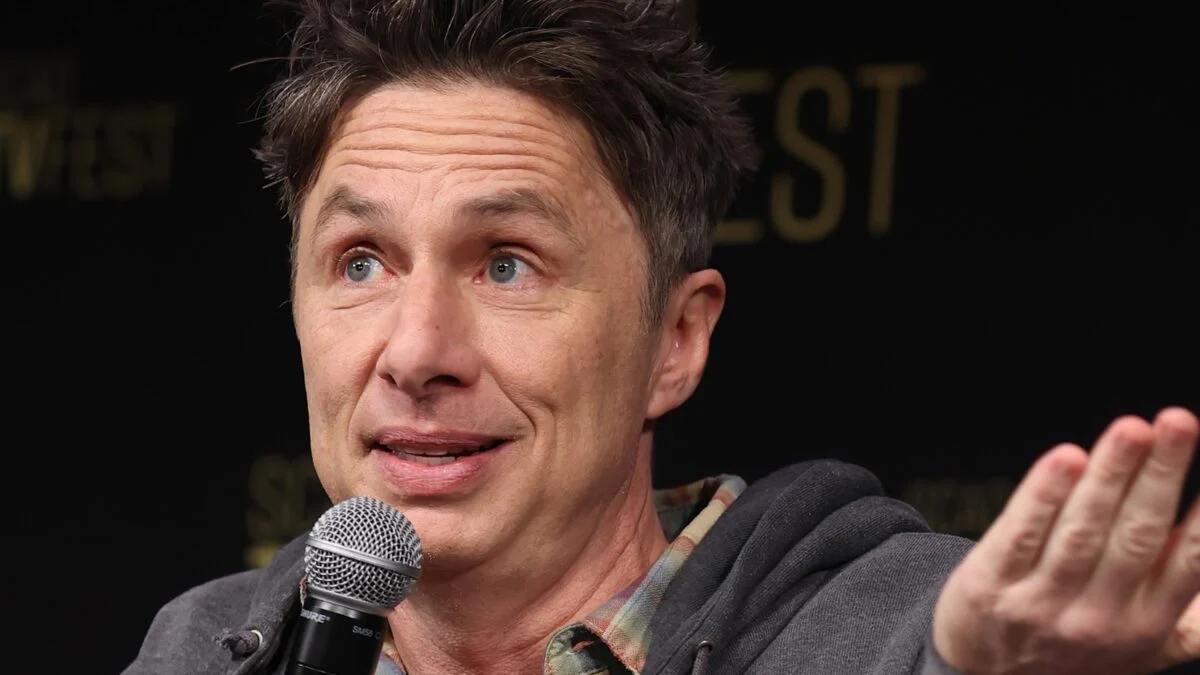
He posts a Story and the rumor refuses to die. You feel the room tilt as gossip multiplies, and even a denial becomes oxygen for more headlines. I watched the ripple turn into a wave.
I reached out to Braff’s reps twice; both times they declined to comment. You should know that before you judge the trajectory of this little media fire.
On Thursday Zach Braff posted a Story that read, in full:
“I’m not dating a chatbot.I can’t believe I have to type these words.It is a storyline in an upcoming ep of Scrubs.Maybe it came from that?Not sure.But not me.Love,The guy not dating his chatbot.Please update all gossip sites.”
On Instagram he named himself “The guy not dating his chatbot.” That tiny flourish changed everything.
That is not a neutral denial. It reads like a stage direction: personal, amused and oddly theatrical. You can see why gossip engines—DeuxMoi, Vulture, and the podcast clip from Max Silvestri, Jenny Slate, Gabe Liedman and Kumail Nanjiani—turned up the volume. Anonymity had already done the work; a specific, self-referential phrase handed reporters a hook.
Is Zach Braff dating an AI chatbot?
No credible evidence has emerged. Online chatter began as an unnamed anecdote on a podcast, resurfaced on DeuxMoi, and metastasized into headlines across Cosmopolitan, The Cut, BuzzFeed, People, Entertainment Weekly, Vulture and more. The denial paused the rumor for a moment, then acted like a bell that won’t stop ringing—each outlet repeating the rebuttal extended the story, rather than ending it.
On social platforms the rumor was anonymous, then it wasn’t. That shift matters.
Anonymous gossip behaves like a whisper; attach a recognizable voice and it becomes a broadcast. Jenny Slate and friends joked about a “major actor” interacting with a chatbot. Someone clipped it. Someone reposted it on Instagram and Reddit. YouTube and TikTok algorithms then nudged the clip into new audiences. You can trace the lifecycle through platform names: Instagram, Reddit, TikTok, DeuxMoi, Vulture and media outlets that scraped the social trail.
Why did Braff respond publicly instead of ignoring it?
Because silence can be interpreted as consent. You and I both know publicity calculus: for a celebrity, the cost of ignoring a viral rumor sometimes outweighs the cost of addressing it. But the way he framed that response—playful, self-aware—gave people more to chew on. That phrasing invited curiosity, and curiosity keeps clicks flowing.
On legacy context: Braff has fought public narratives before. That history informs reactions now.
Remember his 2014 Kickstarter controversy and the way he engaged on social platforms—those episodes taught audiences to expect candidness. He once defended direct engagement with fans, arguing AMAs should be authentic. That background lends him authority, but it also means every public utterance is read against past PR battles.
Let’s name names: Vulture’s Megh Wright documented the chain; DeuxMoi amplified it; outlets from Page Six to The Independent circulated the denial; and Gizmodo reached out to Braff’s reps twice with no answer. You see the ecosystem—podcasts, gossip accounts, aggregation sites, legacy outlets—working together to escalate a rumor into national copy.
I watch this pattern because it teaches the mechanics of modern celebrity rumor. One offhand joke becomes fodder, then a denial becomes a headline, then coverage begets coverage. It’s a loop that rewards attention.
Consider the psychology at work: people crave secret knowledge; they relish being first to share it; they reframe denials as new data. Platforms optimize for engagement; journalists chase signals; the subjects find themselves pushed into defensive packaging. The result is a conversation about authenticity and AI that feels larger than the original anecdote.
Two practical takeaways for you if you follow these stories closely: first, trace the origin point—identify the podcast clip, DeuxMoi repost, or TikTok that catalyzed the spread. Second, read denials as actions, not end points. Language choices—“The guy not dating his chatbot” instead of “not dating a chatbot”—carry intent and performativity.
I’m not asking you to choose sides. I’m asking you to pay attention to process: how gossip mutates into cultural questions about AI, intimacy, and truth in the attention economy. Platforms like Instagram, Reddit, TikTok and gossip hubs work like a second newsroom, and industry figures—Jenny Slate, Kumail Nanjiani, Max Silvestri—become unwitting sources.
One more observation: denials can be a magnet. They attract coverage the way a moth circles a porch light, and that light is now a conversation about how humans relate to synthetic companions, whether the premise is real or imagined.
So where does that leave Braff—and you, paying attention? We have a denial, a list of publications that amplified it, a cluster of platform signals, and a handful of comedians who started the rumor as an inside joke. The story now sits at the intersection of celebrity behavior and the public’s anxieties about AI. Is the furor proportionate, or are we chasing reflections of our own curiosities?
Will a fuller conversation about AI, intimacy, and media responsibility finally follow, or will the thread fray into the next viral anecdote?