
I opened Truth Social and there it was: a glossy, impossible tower dangling above a Miami parking lot. You felt the momentum—publicity, provocation, and a little bit of theater—before the first frame even finished. I want to show you what that clip hides, and why the flubbed letters matter more than the shine.
Politico reported that a parking lot in Miami is slated to become a 47-story Donald J. Trump Presidential Library, with an anonymous source sketching the program as library floors, a hotel, offices, and a restaurant crowning the top. The rendering credit goes to the architecture firm Bermello Ajamil; the promo video was posted on Truth Social and amplified by Eric Trump on X.
FIRST LOOK: The Donald J. Trump Presidential Library is officially here.
Over the past six months, I have poured my heart and soul into this project with my incredible team at @Trump.
This landmark on the water in Miami, Florida will stand as a lasting testament to an… pic.twitter.com/azV1hx0HG2
— Eric Trump (@EricTrump) March 31, 2026
A Miami parking lot sits empty, and a rendering fills the skyline
I watched the render as if it were a lacquered model for a theme-park trophy.
Bermello Ajamil’s credited drawings reportedly became the bones of a 47-story proposal: public archives at the street level, a hotel mid-rise, offices above, and a restaurant with views over Biscayne Bay. Politico’s reporting frames the design as part museum, part hospitality play—a hybrid that reads as much like a brand experience as an archive.
What is the Donald J. Trump Presidential Library?
The short answer: a proposed mixed-use tower tied to the Trump name, pitched as a presidential archive plus commercial space. The longer answer is political theater wrapped in real estate—documents and memorabilia would be part of it, but the revenue-generating floors (hotel, offices, dining) appear central to the plan. Bermello Ajamil is listed for the renderings; the sales pitch landed on Truth Social and X.
The promo video arrives on your feed and the title can’t keep up
I clicked the clip and paused on a line of text that read wrong; you probably would, too.
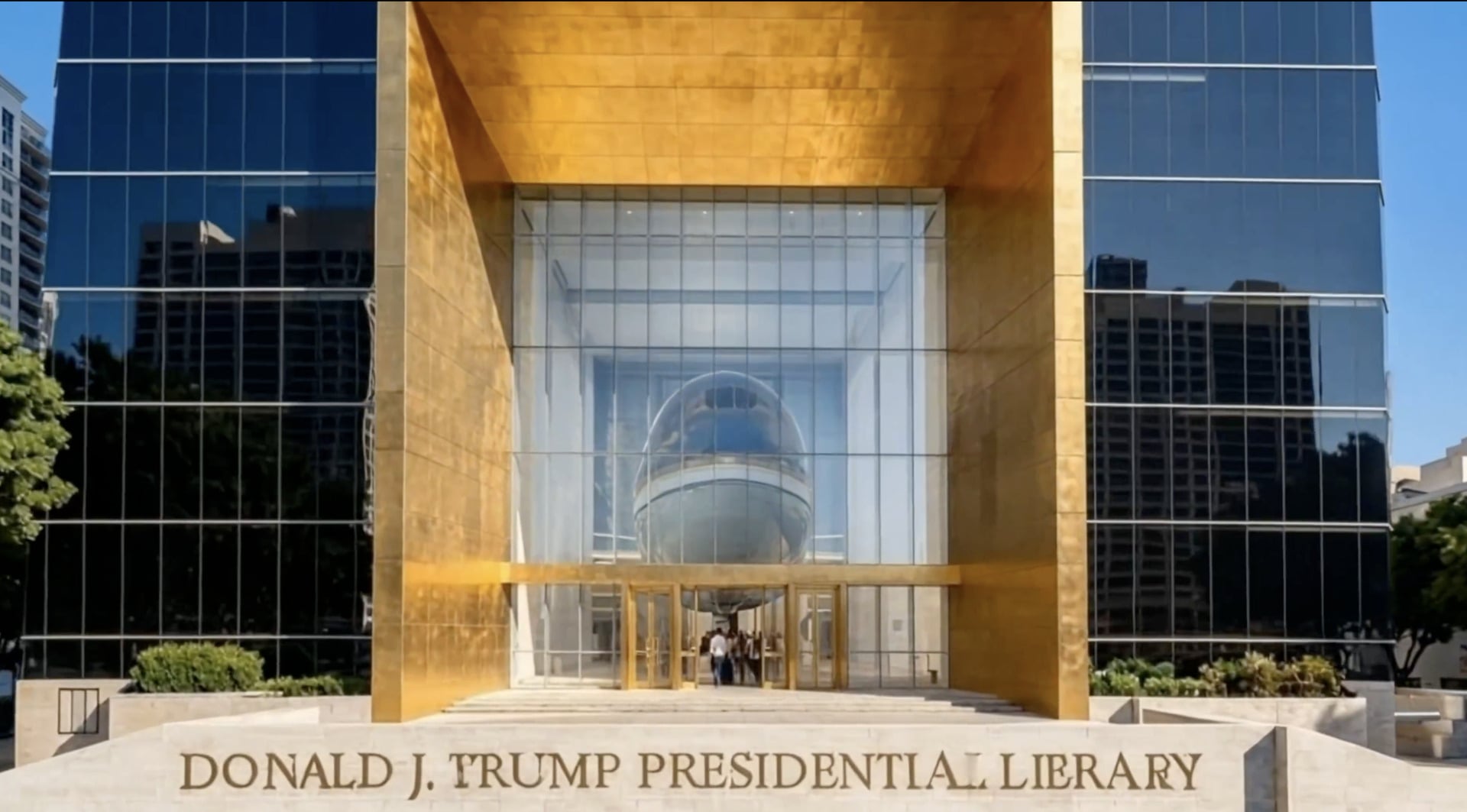
The video looks like a polished promo at first: soaring camera moves, dramatic soundtrack, and glossy cuts. But it’s not a pure hand-rendered film. Sources say the firm’s renderings were fed into an AI video tool—Sora is named in chatter—as part of a quick promo edit. The result: lovely visuals, and an AI that mangles typography.
At one point the title rendered as “Donald J. Trump Presidential Lierary,” which is funny and awkward at once. That typo isn’t a scandal by itself, but it’s a tiny public proof that the process leaned on generative tools that still trip over simple tasks like letterforms.
Was AI used to create the video?
Yes. Real architectural renderings were repurposed into a promo that appears to have been assembled using an AI video generator plus human editing and music. The clip mixes bona fide visuals from Bermello Ajamil with generative smoothing; where the machine stumbled, the text errors exposed the seam between human design and machine assembly.
People are already responding on social platforms and in planning circles
A few Miami locals I follow posted screenshots and sighed; you might see the same split reaction.
Trump’s post on Truth Social—and Eric Trump amplifying the content on X—was clearly designed for virality. The video behaves like a campaign ad and a product reveal at once. If you care about how public memory is curated, watch where funding, zoning, and brand management meet. That intersection decides whether a “presidential library” becomes a genuine research site or a branded monument to a personality.
The mistakes reveal the affordances—and limits—of quick AI promos
A friend in design joked that the clip reads like a bad photocopy of a press release, and the joke landed hard.
AI can scale production and make a campaign feel omnipresent in minutes. But when it trips over fundamentals—text, attribution, nuance—you’re left with spectacle that betrays its own haste. That matters when the subject is a public archive: if the presentation is performative, what will the substance be?
Where will the Trump Presidential Library be located?
The site is described as a waterfront plot in Miami—currently a parking lot—where developers imagine a tower rising above the bay. Politico’s reporting and the Truth Social promo both place the work on Miami’s water, and Bermello Ajamil is credited for the original renderings. Gizmodo has reached out to the firm for comment and will update coverage if they reply.
You and I can argue about taste, memory, and monumentality, or we can pay attention to how this project gets permitted, financed, and presented—because those details decide whether this becomes an archive or an attraction?