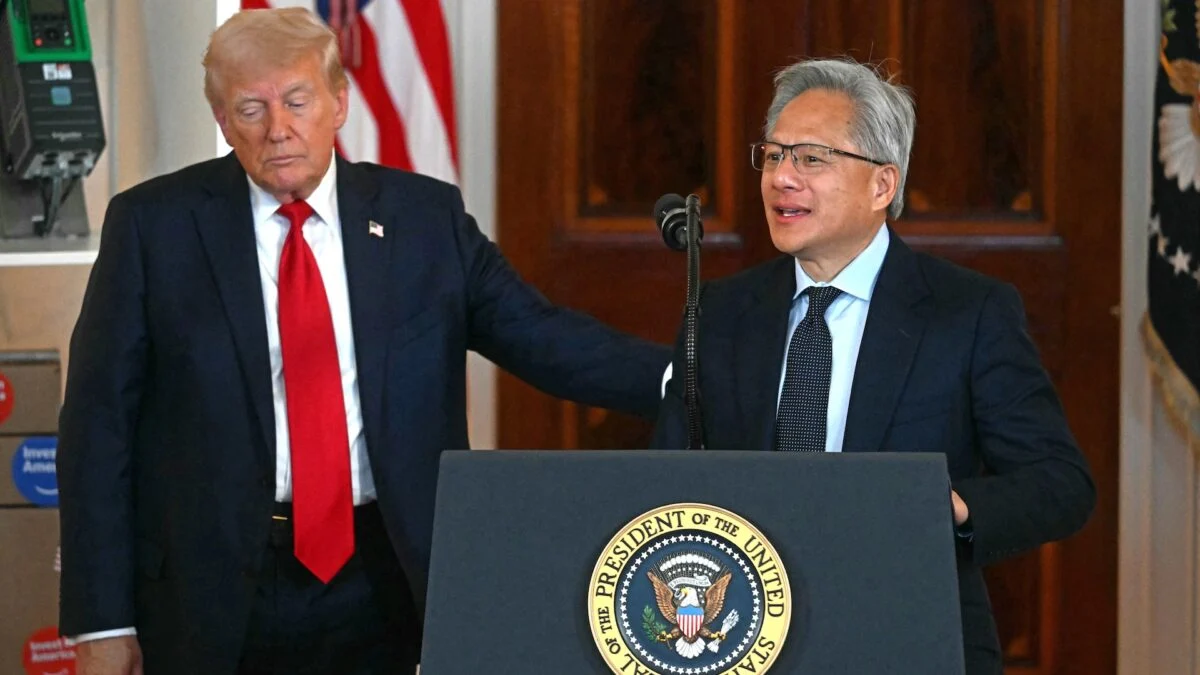
In a surprising recent announcement, Donald Trump revealed plans to allow Nvidia to sell its H200 artificial intelligence chip to China. This decision comes via a post on Truth Social. While the sale of Nvidia’s advanced Blackwell chips remains prohibited, the clearance for the less powerful H200 is seen as a significant opportunity for the tech giant, which faced rejection from the Chinese government earlier this year due to its perceived lack of capability.
On Monday, Trump stated that he had informed Chinese President Xi Jinping of this decision, emphasizing a framework that would maintain “strong National Security.” He did not specify what these conditions would be but mentioned that Nvidia will remit 25% of their chip sales to the U.S. government.
Earlier this summer, Nvidia and AMD had a bizarre arrangement with the U.S. government to hand over 15% of their revenues from selling chips to China, a legality that had experts scratching their heads. As Trump’s administration has forged ahead with unconventional initiatives, such moves raise questions about executive power and its limits.
Trump touted the sale of the H200 chips as beneficial for American workers but awaits the U.S. Commerce Department’s formal approval to finalize the decision. Under current conditions, the agencies seem unlikely to counter Trump’s directives.
“This policy will support American Jobs, strengthen U.S. Manufacturing, and benefit American Taxpayers,” Trump asserted. He criticized the Biden administration for supposedly forcing U.S. firms into developing subpar products that failed to innovate and hindered job growth. In his view, such products were a strategic approach to retaining a technological edge.
“That Era is OVER! We will protect National Security, create American Jobs, and keep America’s lead in AI,” Trump declared. He added that Nvidia’s U.S. customers are already pressing forward with the advanced Blackwell chips, which are not part of this particular deal.
As noted by Bloomberg, the Chinese government has been advising potential customers against using the less powerful H200 chips, although there remains some demand for them. This guidance seems to exert pressure on the U.S. to reassess their position in a market that is critical for chip manufacturers.
Recently, Nvidia CEO Jensen Huang has aligned himself closely with Trump, similar to many tech leaders. His lobbying efforts appear to have paid off, especially as figures like David Sacks downplay security concerns related to supplying chips to China, arguing that it could enhance U.S. tech dependency.
The future of the SAFE CHIPS Act, a bipartisan bill introduced to restrict Trump’s ability to ease export limitations, remains uncertain. Supported by both Republican Pete Ricketts and Democrat Chris Coons, it reflects a rare consensus in Congress against Chinese tech influence. However, Trump’s pull can sometimes override congressional decisions, demonstrated previously in the TikTok debacle.
“My Administration will always put America FIRST,” Trump emphasized. The Commerce Department is currently in the process of finalizing the details, with a similar approach set to be applied to AMD, Intel, and other top American companies. He concluded with a rallying call, “MAKE AMERICA GREAT AGAIN!”
In April, Trump is scheduled to visit Beijing for a meeting with Xi.
Is the sale of chips to China a good idea?
Experts are divided, as it could bolster U.S. technological dependency but may also raise security concerns.
How does this decision impact American jobs?
Trump claims it will support job creation in the U.S. manufacturing sector, but the long-term implications remain to be seen.
What are the potential legal ramifications of Trump’s actions regarding chip sales?
The legality of previous agreements with companies has raised constitutional questions, particularly around executive power.
Will the SAFE CHIPS Act be successful?
The bipartisan support signals a strong chance, but its fate largely depends on Trump’s influence over Congress.
What is the significance of the H200 chip in AI development?
While less powerful than Blackwell chips, the H200 could still serve key functions in AI applications, crucial for maintaining competitive advantage.
For more insights into the tech industry and its intersection with politics, continue exploring related articles at Moyens I/O.