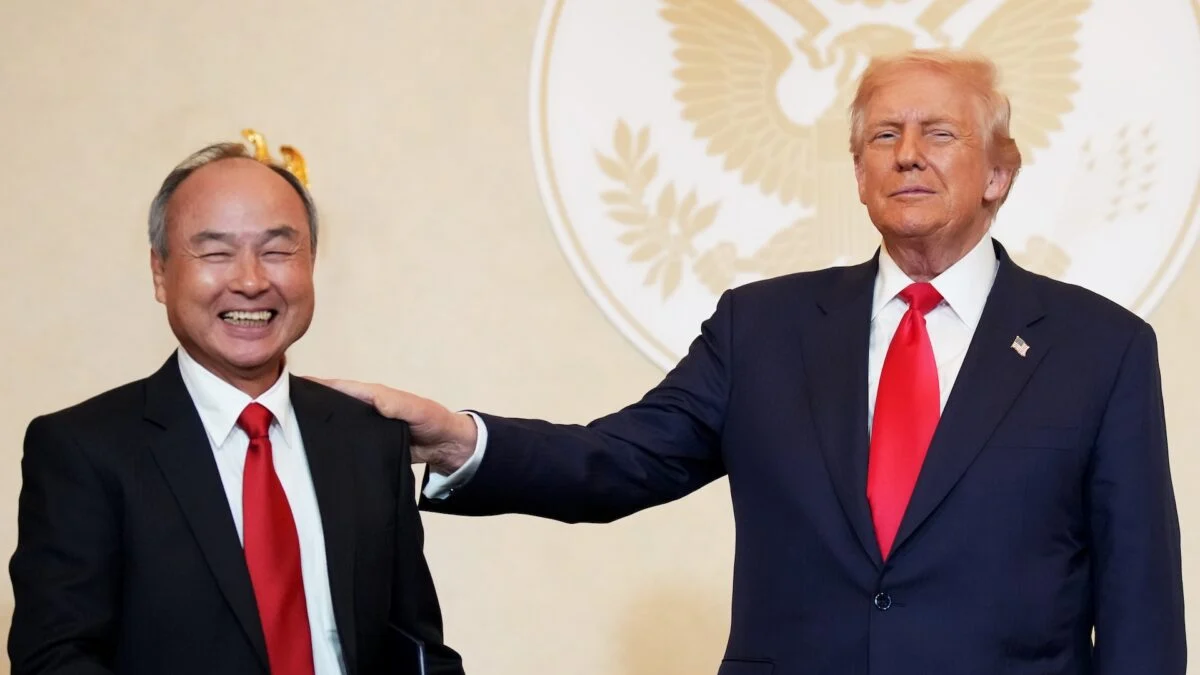
Billionaire Masayoshi Son is setting ambitious plans in motion to use significant investments from Japan to establish Trump-branded industrial parks on federal land across the United States. According to a recent report from the Wall Street Journal, the intention is to manufacture cutting-edge hardware. While the specifics are still being finalized, the concept has been described as “ambitious to the point of science fiction.”
Internally referred to as Project Crystal Land, Son’s initiative has been under development for roughly six months. Initial ideas included a massive $1 trillion smart city in the Arizona desert near Phoenix, proposed as a competitor to China’s Shenzhen, the core of its tech industry.
By summer, Son communicated this bold vision directly to former President Trump, including elements like “robot-filled semiconductor-fabrication plants.” This new metropolis would provide housing for workers and bears resemblance to Trump’s own proposal from March 2023, termed “freedom cities,” aimed at being constructed on federal land.
In 2023, Trump’s freedom cities focused on futuristic transportation solutions, even mentioning the prospect of flying cars. Comparatively, current plans emphasize the integration of artificial intelligence, illustrating the technological evolution since ChatGPT’s launch in November 2022.
In a 2023 video, Trump asserted, “Just as the United States led the automotive revolution in the last century, I want to ensure that America, not China, leads the revolution in air mobility,” highlighting his interest in transformative technologies.
While Son has scaled back elements of the plan, particularly concerning high-tech robotics and worker housing, the core idea of industrial parks remains intact. These parks would be funded by Japanese investment, specifically $550 billion pledged as part of a trade agreement with the U.S., which included a reduction of tariffs from 25% to 15% on Japanese cars.
There are discussions within the Trump administration to leverage this investment for Project Crystal Land, actively seeking partnerships with major Japanese companies like TDK, Mitsubishi Electric, and Hitachi. The long-term goal is to create chip manufacturing facilities that can rival the advanced production capabilities found in Taiwan, South Korea, and Japan.

On an interesting note, Lutnick has been collaborating with the Department of the Interior regarding the potential use of federal land for Son’s industrial parks. Despite facing criticism for suggesting that new jobs may primarily be filled by robots, Lutnick continues to support the vision.
The notion of creating entirely new cities for technology experimentation echoes back to the 20th century’s visionaries, much like EPCOT, Walt Disney’s idea for a prototype community designed for innovative technologies. Although that dream transformed into a theme park, the essence of exploration remains relevant today.
However, there are hurdles to overcome. Funding for the project may materialize in early 2026, yet previous pledges, such as the $500 billion committed to the Stargate data center, have yet to come to fruition. Additionally, some companies, including Taiwan’s TSMC, have opted out of participating in Son’s plans, and lingering concerns about the viability of the AI sector are prevalent among Wall Street investors.
What does this mean for the future? Experts predicted that Trump’s tariffs would wreak havoc on the economy, leading to modest job losses and slight inflation, but the fallout wasn’t as severe as anticipated. Thus, the future remains uncertain, and while we cannot predict outcomes, the landscape is ripe for surprises.
What are the key components of Son’s industrial parks? They aim to integrate advanced technology focused on manufacturing while fostering partnerships with Japanese investment, establishing a significant footprint in the U.S. tech landscape.
Will this project be created on federal land? Yes, as part of the agreement, Son’s industrial parks are intended for construction on federally owned land, which comprises nearly 40% of Arizona.
Why do some businesses hesitate to join the project? Concerns about profitability in the current economic climate and the uncertain future of AI might deter established companies from committing to this venture.
In conclusion, while Masayoshi Son’s vision is ambitious, it also faces significant challenges. The potential creation of technology-centric industrial parks could redefine aspects of American manufacturing and innovation. For more insights into emerging technology trends, don’t hesitate to explore related content on Moyens I/O.