
I scrolled past a thousand corporate feeds this morning and stopped. Asha Sharma’s short post about “Project Helix” landed like a hand on the table: quiet, confident, a little dangerous. You can feel a shift—one company pulling its gates open while the other quietly tightens them.
I want to walk you through what that means for you as a player, a PC owner, or someone who buys consoles when a must-have exclusive drops. Read this like a briefing from someone who’s watched platform wars before: clear, blunt, and tuned to what actually changes your time and money.
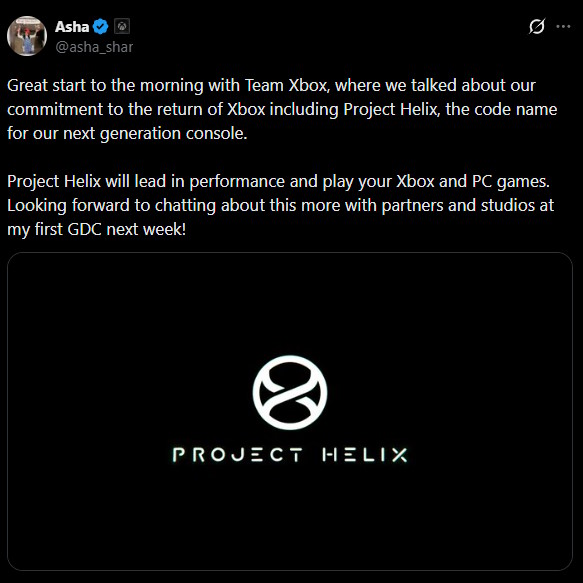
My feed went quiet when Asha Sharma named Project Helix — now the plan is public
She didn’t write a manifesto. She wrote four lines that change the frame: Project Helix will “lead in performance and play your Xbox and PC games.” That sentence flips the old sales pitch for consoles on its head.
Here’s what I read between the lines: Microsoft is positioning hardware as a platform for access, not a walled garden for exclusives. The core idea is this device behaves like a console in feel but accepts the whole PC library under its hood. If you use Steam, the Microsoft Store, Epic Games Store, or run native Windows apps, Helix is being designed to tolerate—and host—those ecosystems.
At developer meetups you hear two things: Sony retreats to exclusives, Xbox sells openness
Sony is reportedly pulling back on first-party PC ports, trying to make PlayStation hardware feel scarce again. Microsoft, by contrast, is leaning into flexibility: hybrid architecture, AMD silicon rumors, and a system interface that can read like a console even if it’s running a Windows-like environment.
Think of Project Helix as a Swiss Army knife for players: it’s a single tool that folds a handful of different platforms into one pocket. That’s attractive if you dislike juggling a gaming PC and a console, and terrifying if you sell exclusives for hardware.
Will Project Helix play PC games?
Short answer: yes, that’s the sales pitch. Microsoft used the phrase “play your Xbox and PC games” publicly. Reports point to AMD chips and a hybrid design that can run both UWP/Win32 titles and classic Xbox binaries. For you, that means Steam, Epic, and the Microsoft Store could be available on the same box—plus Xbox Game Pass and cloud streaming as fallbacks.
At GDC conversations always split between hardware engineers and studio heads
Engineers talk silicon, studios talk exclusives. Project Helix seems aimed at resolving that tension by giving studios more platforms to target while offering players fewer hardware choices to buy. If studios can ship to PC and Helix with minimal overhead, you may see faster ports—except where Sony decides to keep titles console-only.
Is Project Helix a PC or a console?
It’s going to behave like both. Microsoft is packaging the experience as console-first—controller layout, living room UX—but under the hood it may use Windows components and standard PC drivers. That hybrid approach will matter for modders, developers using Unreal or Unity, and anyone who values access to Steam Workshop or PC-exclusive tools.
I heard a friend ask: “Why buy hardware if every game is on PC?” at a coffee shop
That’s the fear of loss for platform holders: if software is everywhere, why sell hardware? Microsoft’s bet is that you’ll buy Helix for convenience, subscription value, integration with Xbox Live and Game Pass, and the simplicity of a curated experience. Sony’s bet is that scarcity and exclusives still drive console purchase decisions.
This is also a business play: more avenues to sell software and subscriptions across devices equals more opportunities for Microsoft to bundle services like Xbox Game Pass and Xbox Cloud Gaming with native storefront support.
Will Project Helix kill console exclusives?
No—at least not immediately. Some exclusives are business decisions tied to Sony’s strategy and to studios signing platform deals. But the pressure changes: if Helix makes it cheap and simple for a studio to put a game on PC and an Xbox-branded box at launch, platform exclusivity loses leverage. That could push companies toward time-limited exclusives or content splits instead of permanent walls.
At my desk I mapped out the winners and losers: players, devs, and platform holders
Winners: players who want choice, developers who target more storefronts without extra QA cost, and PC-focused services like Steam and Epic that gain a new hardware outlet. Losers: hardware-centric exclusivity strategies, and anyone who monetizes scarcity.
This design is a bridge between islands—Microsoft wants the islands connected so you can travel freely, while Sony may prefer ferry schedules you have to buy a ticket for.
If you care about where you spend money and time, watch three things at GDC: the Helix spec reveal, Microsoft’s SDK and partner tools (will Steamworks run smoothly?), and Sony’s public messaging about PC ports. I’ll be watching AMD chatter, Xbox developer guidance, and how Game Pass and Xbox Cloud are packaged around Helix.
I’ll leave you with this: the next console cycle might be less about raw teraflops and more about which company sells you access to a library that feels worth owning—what side are you on?