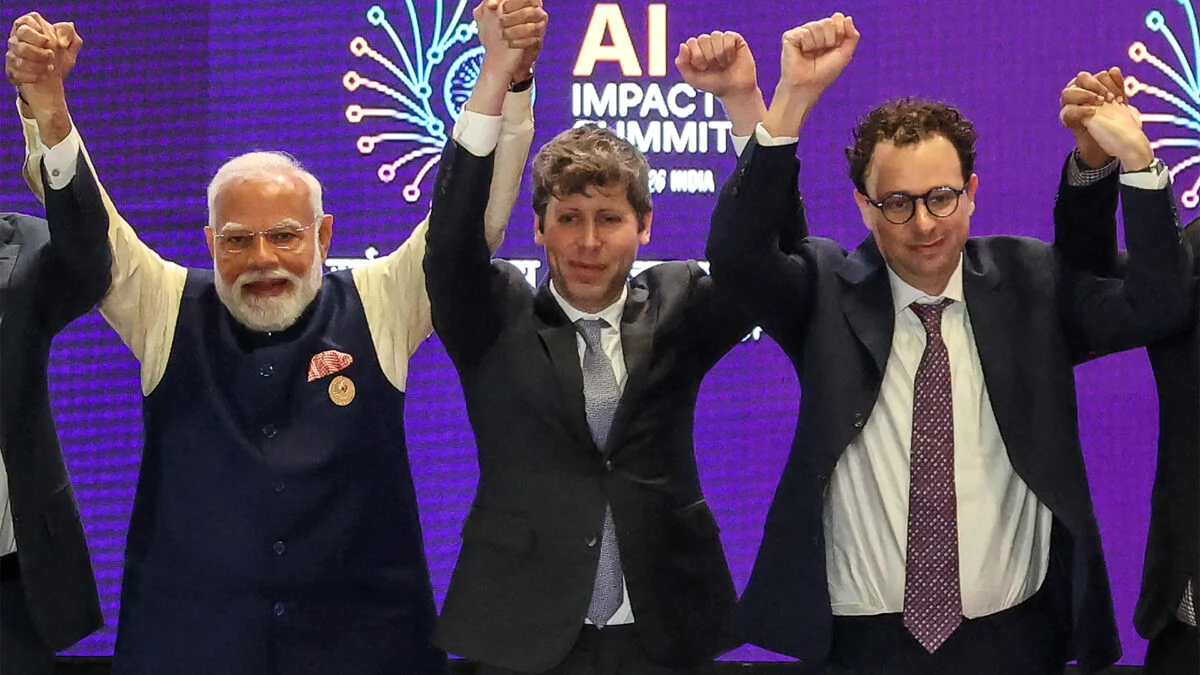
I watched Sam Altman step to the Morgan Stanley stage and say, plainly, “The government is supposed to be more powerful than private companies.” The room tightened—investors quiet, staff messaging each other under the table. That single sentence carried the weight of boardrooms, war rooms, and whispered dinners with the people in power.
At the Morgan Stanley conference in San Francisco Altman framed the debate in a single line.
I told you that because context matters: he wasn’t making a neutral policy point. You’ve seen the footage, read the coverage in the Wall Street Journal and heard the reaction from OpenAI staff. Altman’s remark landed as defense and declaration—an explicit alignment with the current U.S. administration and a rebuke to colleagues who think companies should resist government pressure.
Why did Sam Altman defend working with the U.S. government?
Because he’s betting that industry survives by bending to elected power, not by opposing it. His argument—”trust the democratic process”—is less a legal theory than a political posture. I’ll say it plainly: when your company has scale in dozens of countries, taking the side of a particular administration buys you access, contracts, and breathing room. It also costs you credibility with employees and allies.
At OpenAI’s internal Slack the tension is real: staff accused leadership of rushing into government deals.
You can imagine the scene: engineers alarmed that guardrails were traded away, product leads worried about misuse, and executives calculating risk. There’s a practical question here about safety, and a reputational question about power. Altman has cozied up to Trump; that changes the company’s center of gravity. You don’t need to be a coder to see how fragile consensus is when mission and money start pulling in different directions.
What did the Pentagon demand from Anthropic and why did it refuse?
The Pentagon pressed Anthropic to remove guardrails that prevent Claude from being used for mass domestic surveillance and autonomous weapons. Dario Amodei said no. Defense Secretary Pete Hegseth then threatened to blacklist the firm as a supply-chain risk—an almost unprecedented move against an American AI company. That clash exposed a basic fault line: governments asking for capabilities companies built to limit.
At the international level OpenAI already operates almost everywhere except a handful of states.
You and I both know the company lists exceptions—Belarus, China, Cuba, Iran, North Korea, Russia, and Venezuela—but it otherwise sells into democracies with very different legal expectations. That raises a practical question: whose rules apply when a safety protocol flagged an imminent threat and Canada said it needed to be told earlier? Ottawa met with OpenAI after a mass shooter had been flagged in the company’s systems; the company promised “new protocols” but left the details vague. Governments will disagree about what “new protocols” should look like, and private firms will be forced to choose.
How will OpenAI’s ties to Trump affect its global operations?
Sam Altman’s proximity to the Trump White House is a form of currency. OpenAI executives have funneled millions of dollars into political donations and salons, and that shifts expectations abroad. When your CEO is publicly aligned with a president who is upending alliances—from threats to Canada to actions in the Middle East—partners start to wonder if the company’s loyalties are national, corporate, or personal.
At the center of the debate is a moral choice that looks simple but isn’t.
I’ll give you the blunt framing I use when advising founders: do you build systems to resist misuse, or do you accept trade-offs for access and revenue? Altman argues that governments should have the upper hand. Great, you might say—unless the government in question has different ideas about weaponization, surveillance, or press freedoms. Companies that pick a regime risk becoming instruments of that regime’s ambitions.
Look at Anthropic and OpenAI as two different instincts: one CEO refuses a demand that would enable surveillance; another CEO teams up with the administration and argues for deference to elected officials. It’s a split not between good and bad people but between two operating systems for power.
I’ve watched CEOs in public and private life act like captains steering by one light—one fixed ally, one pathway to contracts. That single-star navigation is a strategy, but it also makes the ship vulnerable when the tide and the politics shift. The tech world now resembles a chessboard where pieces change color overnight.
At the end of the day the question you should be asking is simple and immediate.
Which government? When Altman says “government,” he is not speaking in the abstract. He is speaking to the U.S., and right now that government is led by a president who’s remaking alliances and doctrine in real time. You can argue about democratic legitimacy until the next election, but companies don’t live on arguments; they live on contracts, access, and regulatory cover.
I’m not offering a sermon. I’m telling you what I see: OpenAI’s stance protects short-term alignment with power and risks long-term fractures with staff, partners, and foreign governments. If you care about safety, accountability, or global stability, you should watch—because these choices don’t stay inside conference rooms.
So tell me: when a private company says it will defer to “the government,” which government should you trust to decide how powerful your tools become?