
I remember the moment I turned the final page and felt the room tilt. You can sense when a story closes a long loop—quiet and inevitable. Maru’s Ritual of Harmony does that: it softens the world and changes the rules.
I follow Jujutsu Kaisen closely, and you’re about to get a clear read on what that ritual actually did, why Yuji’s choice matters, and what the ending means for humans and Simurians. No filler—just the signals you need to spot what Gege Akutami set in motion.
On a street where children still play, Maru’s choice reformed the very language of souls

What was Maru’s Ritual of Harmony?
Short answer: Maru didn’t exterminate cursed spirits; he rewrote how cursed energy and souls are formed. His Ritual of Harmony altered the structure of Cursed Energy itself, making the output of future generations far weaker and changing the soul colors assigned at birth.
Think of that change as a dimmer switch, not a sledgehammer: cursed energy becomes less potent across time, and newborn Cursed Spirits no longer carry the same soul-color signatures that used to bind them to certain groups.
The practical effects are immediate and strange. Rumelians, Kalyans, and Cursed Spirits now register differently to one another. Kalyans, previously treating some new beings as their kin, will no longer recognize the future Rumelians as family. That risked a new wave of predation, which forced the Simurian council to decide how to respond.
The council chooses preservation over exile: they refuse to abandon the Kalyans, but they also commit to tighter controls to prevent harm. And yes—Maru’s ritual carried side effects that felt almost restorative: Cross, Tsurugi, and Yuka are revived or healed, proof that soul-manipulation here functions as repair rather than slaughter. If you’ve read Mahito’s arc, you can see how differently soul power can be wielded when intent is controlled.
At a train station, two old friends greet each other; the same small reunion happens on the page

Did Maru exorcise the cursed spirits?
No. That’s the misconception I saw across social feeds after Chapter 25. Maru didn’t purge the world of curses; he changed the blueprint that creates cursed energy. Weak leaks will continue, but the intensity of new cursed energy is reduced dramatically, leaving only single-digit flare-ups for long stretches.
That’s where Yuji’s plan fits in. He meets Nobara and Panda after the ritual, and his role becomes cleanup duty. With future sorcerers born weaker, the remaining threats are small and slow-growing—exactly the kind Yuji can handle over centuries.
Why will Yuji live for 300 years, and what does he plan to do?
Yuji isn’t suddenly granted eternal youth; the story explains he will persist for roughly 300 more years—long enough to follow bloodlines marked by Heavenly Restrictions and stop cursed growth chains before they become dangerous. He plans to track cursed activity by watching those bloodlines, flushing out tiny threats before they spread.
Beyond that, Yuji intends to become a cursed object after death to guard humanity—an immortal sentinel similar to Tengen. That choice turns him into a lighthouse in fog: a single, steady beacon preventing big storms where sorcerers would otherwise be born again.
At a neighborhood baseball field, strangers play and aliens sit in the bleachers
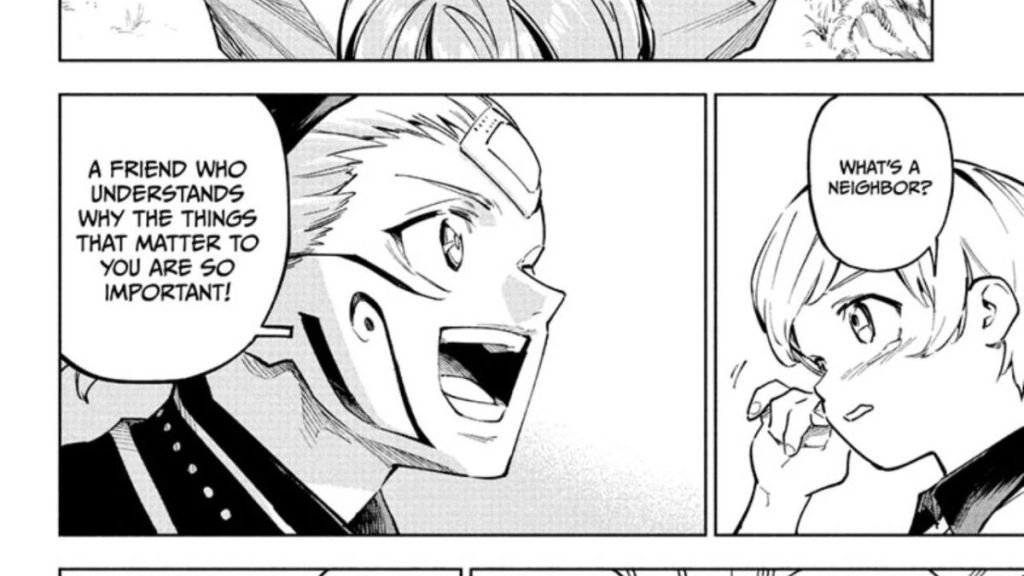
The final images of humans and Simurians sharing small rituals—meals, games, daily chatter—are deliberately domestic. Maru expected punishment, but the Simurian hierarchy accepts his act because it removes the fuel for large-scale conflict. The aliens value the reduction in hostility more than strict protocol.
That social détente matters for two reasons: it keeps the Kalyans within the community under control, and it allows the human world to become a safer place for long-term stewardship. You can read the chapter on Viz Media, Manga Plus, and the Shonen Jump platforms. For community reactions, check X and Reddit for live takes, or search Crunchyroll News for analysis pieces.
If you want a quick checklist of what changed: lowered cursed energy across future births, altered soul-color signatures that shift inter-species recognition, Kalyans retained but regulated, and a plan for long-term cleanup led by Yuji.
Gege Akutami writes a compact epilogue that asks the reader to imagine what peace costs and what sacrifices carry forward. The ending doesn’t erase grief—it repatterns it, and it hands the burden to different hands.
Where do you place the moral weight: on Maru for changing souls, or on Yuji for choosing centuries of quiet vigilance?