
The battlefield fell silent. Two giants, blades trembled in hands that had been stolen from them. One clean, terrible act turned a curse back into a choice.
Spoilers Warning:
This article contains spoilers about the ongoing events in the Elbaf arc. Read at your own discretion if you wish to learn about how to undo the Domi Reversi spell.
I’ll cut straight to the point: Chapter 1176 rewrites a rule you probably assumed was permanent. You and I have seen mind-control curses in fiction that need rare artifacts or soul bargains—this one responds to blood and will. I want to walk you through what happened, why it matters, and the obvious holes that will have fans hunting for an explanation.
At every war memorial, names are inked—and in Chapter 1176 Dorry and Brogy’s sacrifice undoes the Domi Reversi spell
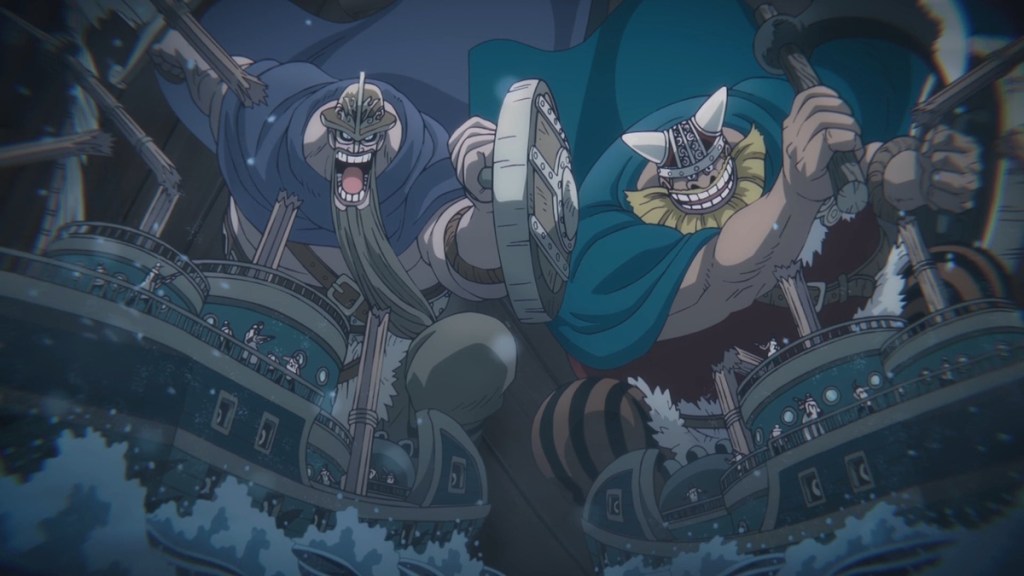
Dorry and Brogy were not plot props. They were the great warriors of Elbaf, and when Imu’s Domi Reversi turned them into demonic puppets, the horror was personal. In this chapter they briefly reclaim their minds, refuse to soil their honor, and choose death over serving Imu’s commands.
The sequence is spare and brutal: regret flickers, the giants take one final, mutual strike, and the curse snaps. The narrative implies a rule: killing the possessed — even if they seem unkillable — can sever Imu’s control. It’s a corrective that feels equal parts tragic and elegant, like a rusted lock finally yielding.
How can the Domi Reversi curse be broken?
Chapter 1176 supplies the working answer: the demonic form can be destroyed by lethal force, and that destruction lifts Imu’s hold. Eiichiro Oda stages it with echoes of earlier events — remember the meat of Rocks-era episodes where Roger and Garp faced a transformed titan — and the pattern repeats here. Theoretically, platforms that carry the chapter like MangaPlus, Shonen Jump, and VIZ Media let you cross-check the panels showing the moment of release.
That said, this is a single data point. It raises immediate follow-ups: does any killing work, or must the death be an act of will from the possessed or their peers? Is there an exception if the attacker is a specific person or wielding a specific technique? The story gives you a plausible rule, but I don’t advise sealing it as canon until Oda provides more context.
In the comment threads on X and Reddit, fans probe every frame—and the chapter reshapes how we think about Imu’s reach
Scroll any thread on X (Twitter) or the One Piece subreddit and you’ll find instant theorycrafting. People are parsing panel composition, color cues from Toei’s anime shorts, and even fan edits on Discord. The reaction splits: some admire the elegance, others bristle at a solution that seems almost mechanical.
If Domi Reversi can be undone by death, the stakes shift. Imu’s instrument suddenly has a blunt countermeasure. That’s not necessarily a narrative cop-out; it could be Oda tightening a moral screw — forcing characters to choose between killing allies and letting atrocities stand. It’s a blade with two edges, like a candle snuffed at dawn.
What happened to Dorry and Brogy in Chapter 1176?
They regained agency, could not stomach murdering Elder Jarul, and chose mutual death. Their act freed them from Imu’s possession and returned them to the fight, later joining Zoro, Stansen, and Hajrudin against the remaining demons. The chapter frames their end as sacrament: a cultural answer to dishonor, a narrative reset that restores them to themselves.
There are immediate story implications: this makes Imu’s technique beatable, but it also forces a moral calculus on every potential rescue. It hands characters options that come with costs, and it hands readers new mysteries to map: Are there limits? Can Imu adapt? Will this rule apply across the world government’s other dark tools?
I’ll be watching how Oda and Toei play the follow-up. Fans will parse interviews, scans, and announcements on official channels — Shueisha, VIZ Media, and the anime’s feed on X — for clarifications. For now the chapter has given us a bloody rule and a ledger of questions: did the giants’ death sever a metaphysical bond, or did their final, honorable act trigger a deeper narrative law?
What do you think is really required to break Imu’s Domi Reversi curse — a physical death, an act of conscience, or something else entirely?