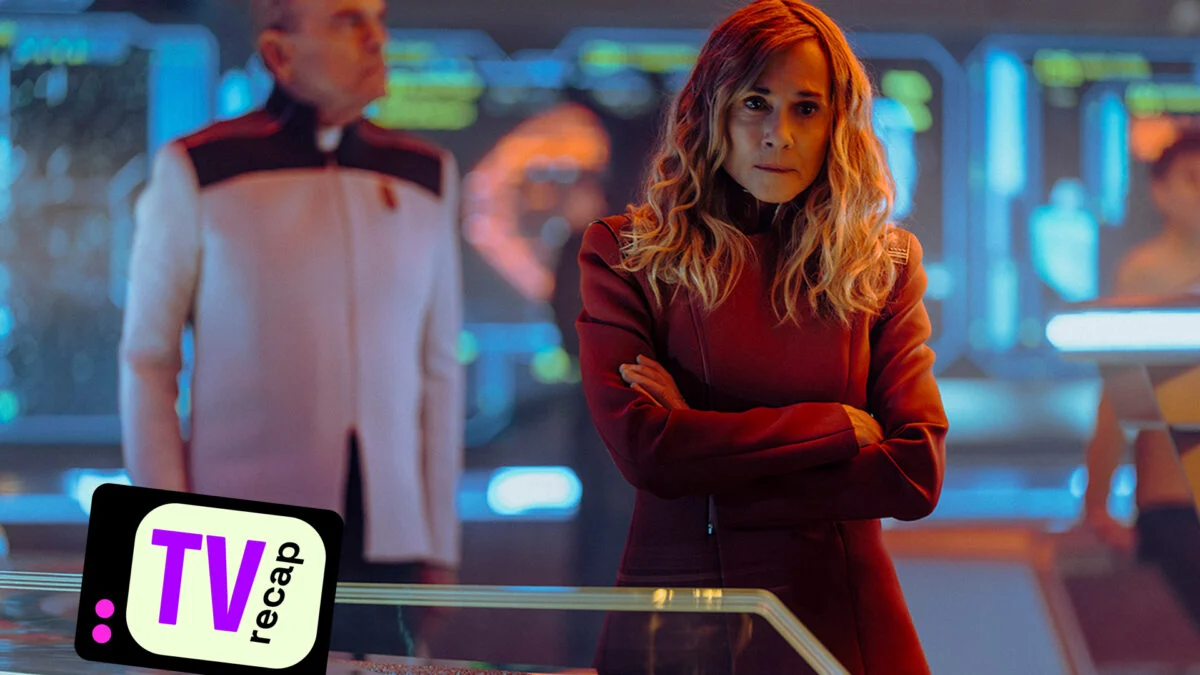
The holo-courtroom smells like scorched metal and old grief. Anisha stares across a jury of planets while Braka barks the past into a camera that will loop forever. I watched the young cadets on the Athena and realized they were the only people who could stop history from repeating.

I write about these shows because I want you to see how the finale of Starfleet Academy didn’t just wrap a plot — it put three generations on trial. You and I both watch finales for answers; here, the show gives a different kind of verdict: the adults are too broken to carry the future.
On screens, finales usually favor spectacle over repair
What Rubincon does instead is hold a hearing. Braka stages a public indictment of Chancellor Ake, and he hands the prosecuting baton to Anisha — a move that forces private grief into public theater. I’ve seen this kind of courtroom gambit in political dramas and real-world tribunals: it’s a way to make moral injury legible to viewers and voters alike.
What happens in “Rubincon” of Starfleet Academy?
The short answer: everything doubles as a test. Anisha and Ake are trapped in a staged trial while the cadets aboard the Athena scramble to stop a weaponized Omega minefield. The emotional core is the trial; the ticking clock is the minefield. Paramount+ and the writers choose to let the two threads reflect one another: blame and responsibility in the chamber, improvisation and collective action on the bridge.
A real-world courtroom can ruin reputations in minutes
That’s the skillful pressure this episode applies to its older characters. Ake, Braka, and Anisha are all living archives of failure — scar tissue that defines their choices. Braka’s grievance is simple and bitter: he remembers a Federation that ignored his colony. That picture of abandonment acts like a cracked compass, forever mispointing his moral sense.
Braka does not want justice; he wants a narrative that absolves his rage. Ake cannot stop mourning losses from the Burn, and Anisha carries a wound that law alone cannot suture. The show argues that history’s survivors, even those with titles and medals, can be trapped by grief in ways that prevent repair at scale.

In everyday teams, trust has to be rebuilt with action
On the Athena, you can see how the writers stage repair as a set of small, repeatable choices. Reno steps in as a pragmatic guide — Tig Notaro’s performance supplies warmth and dry authority — but the kids do the heavy lifting. Conflict is acknowledged, then set aside in service of a plan. It’s teamwork that snaps into place like a rusted relay.
Caleb, Genesis, Darem, Sam, Tarima, and Jay-den keep squabbling long enough to feel real, then cohere. They use Tarima’s abilities and Caleb’s memory to locate Anisha; they rewire the ship’s systems to interfere with Braka’s detonation signal; they act as a single instrument rather than a chorus of complaints. That is the show’s claim: the next generation learns how to act collectively because they practice it, not because they inherited virtue.

Is Starfleet Academy connected to Discovery?
Yes. The series is part of the Alex Kurtzman-produced Trek lineup on Paramount+ and repays fans who followed characters and themes from Discovery. Reno’s arc in particular echoes her earlier survival beats, and the show rewards viewers who know the Burn’s mythology — the Omega molecule, Admiral fallout, and Federation trauma all land harder if you’ve followed the franchise through previous series.
Public narratives and private harm rarely match perfectly
Watch how the episode frames public spectacle as sympathy theater. Braka streams the trial as a demonstration against the Federation, but the camera work and the production choices make it plain: this is about personal catharsis as much as political theater. That mismatch is where the show sharpens its critique of elder leadership — titles, memories, and medals do not automatically translate into moral competence.
And while the end wraps with a patrol armada and arrests — a tidy procedural beat — the show gives you a different aftertaste. Ake and Anisha compromise in a way that preserves Caleb’s future, and Braka is jailed at episode close (with an obvious narrative loop left open). Starfleet Academy does not pretend the older generation is villainous by default; it insists they are human and fallible, and that their failures matter because they shape the world the cadets must inherit.

In normal life, handing power to the next generation is risky and intentional
You can’t hand a torch to people who haven’t earned one; you also can’t keep it forever. Starfleet Academy makes the argument theatrical: the torch in this story is earned through cooperation, emotional labor, and technical improvisation aboard the Athena. The cadets don’t simply inherit authority — they prove they deserve it.
That proof matters because the stakes are literal: detonating Braka’s Omega mines would kill billions and cripple FTL travel for untold generations. The show forces you to feel the fear of loss and then to watch a younger group accept responsibility under pressure. It’s not sentimental; it’s pragmatic drama with feeling.
I’ve been writing about Trek for years and I can tell you the finale’s message is neither naive nor cynical. It is a wager: believe the future if the future earns our belief. Will you accept that wager, or do you think the past still deserves the last word?