I was seated with my phone dimmed and my attention full when Kumail Nanjiani opened the envelope. You felt the room tilt—names spoken, a beat too long, then two winners instead of one. For a moment the Academy felt less like a machine and more like a live experiment.
I’ll walk you through what happened, why it matters, and the odd history that makes this tie feel like a proper jolt to the awards season script.
From the Dolby Theatre floor: Best Live-Action Short Film Awards Result in a Historic Tie at Oscars 2026
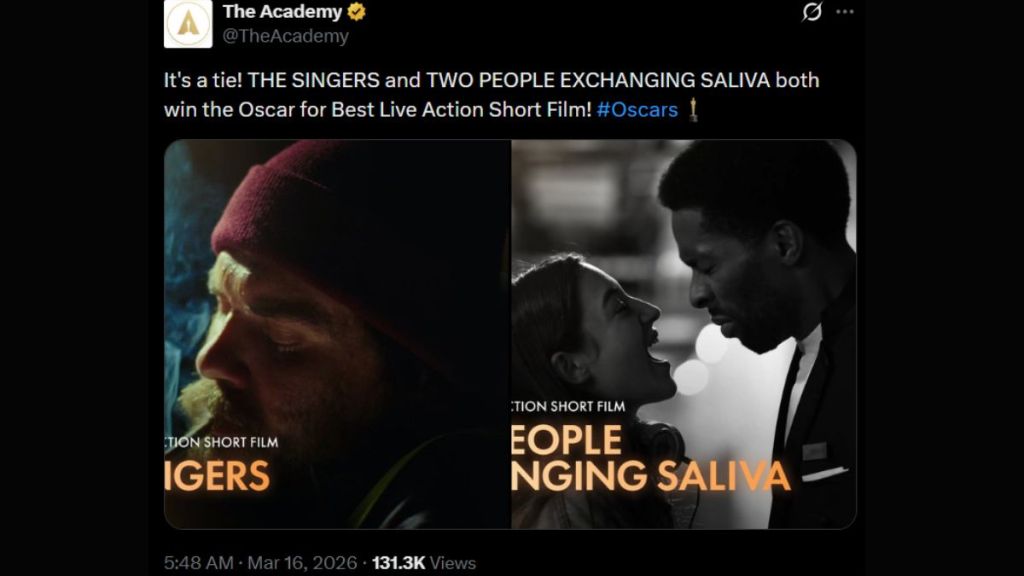
I was watching the presenters’ expressions up close; yours probably mirrored mine when the second name landed. The announcer—Kumail Nanjiani—read both titles, and the scoreboard didn’t change. The Best Live-Action Short Film category ended in a tie between The Singers and Two People Exchanging Saliva, a result that folded surprise into the script of the night like lightning splitting a calm sky.
You might remember press predictions. Moyens I/O had tipped A Friend of Dorothy as the likely winner, but the Academy’s voters chose differently. What happened was less about a misfire and more about cultural weight meeting voter appetite: two very different shorts, both raw and immediate, each compelling in its own register.
The Singers is a 17-minute documentary short built from viral moments—unknown faces made cinematic—and a daring adaptation of an Ivan Turgenev story. It premiered in March 2025 and stepped into Netflix’s library in February 2026, widening its audience and giving the film the streaming runway many shorts need to be seen and talked about.
Two People Exchanging Saliva carries a title that stopped people in their tracks. Its plot is lean: two characters working through intimacy, consent, and emotional exposure. That simplicity, presented without ornament, hit voters the way pared-down storytelling often does—directly and stubbornly.
How rare are ties at the Oscars?
Ties are uncommon. Very uncommon. In the Oscar era they’ve happened only a handful of times, across acting, documentaries, shorts, and technical categories. For voters, ties are a function of split ballots and evenly scattered preferences; for audiences, ties become a cultural shorthand for unpredictability and conversation material for months afterward.
Which Oscars categories have tied before?
Ties have cropped up in acting categories, documentary categories, and technical awards. The reasons vary—sometimes it’s a mathematical quirk in the voting system, sometimes it reflects a year where no single choice dominated the room. Either way, ties leave everyone asking whether tastes have fractured or simply broadened.
In the Academy’s records: Has There Ever Been a Tie at the Oscars?
I pulled the Academy’s history and film archives—there are six documented instances that stand out. Reading the list feels like tracing the industry’s temperament through decades, each tie a small headline in the awards’ broader story, like a coin landing on its edge.
- Best Actor (1932) – Fredric March (Dr. Jekyll and Mr. Hyde) and Wallace Beery (The Champ)
- Best Documentary Short (1950) – A Chance to Live and So Much for So Little
- Best Actress (1969) – Barbra Streisand (Funny Girl) and Katharine Hepburn (The Lion in Winter)
- Best Documentary Feature (1987) – Artie Shaw: Time Is All You’ve Got and Down and Out in America
- Best Live Action Short Film (1995) – Franz Kafka’s It’s a Wonderful Life and Trevor
- Best Sound Editing (2013) – Zero Dark Thirty and Skyfall
That 2013 tie in sound editing is the most recent precedent until tonight, which makes the 2026 result the first headline tie of this scale in over a decade. Industry figures—from The Academy to studios on Netflix—now have a fresh talking point in their annual retrospectives.
So what does a tie mean beyond the ceremonial moment? For filmmakers, it’s extra oxygen: festival bookings, streaming placement, interviews, and a chance to reach audiences who might have missed the shorts’ festival runs. For distribution platforms like Netflix, a tied winner becomes a promotional asset; for critics and outlets like Moyens I/O and X, it’s a story that feeds listicles and long-form takes for weeks.
I’ll leave you with this: the Oscars just reminded us that consensus can fracture in aesthetic ways that nonetheless reward two very different kinds of risk—so which of the two winners will hold up when the dust settles and the conversation sharpens?