
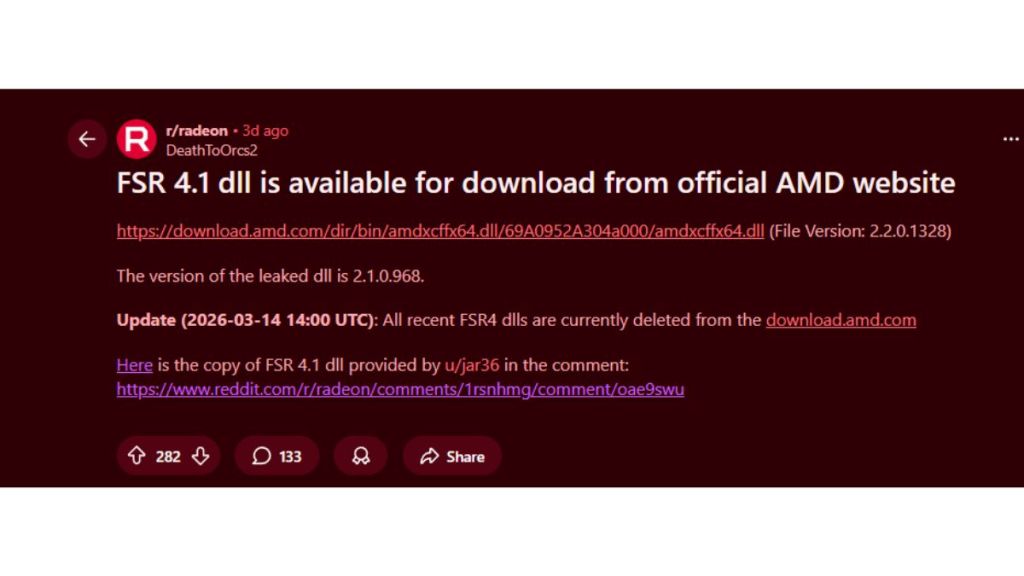
I found the file name by accident at 2 a.m., and it felt wrong in a way that makes you check the timestamp twice. A DLL meant for testing was sitting on AMD’s CDN long enough for people to copy it. By morning, images and download links were all over Reddit.
I’m going to walk you through what that leak actually means and what you should expect when Crimson Desert arrives on March 19. You don’t need to trust every screenshot; you need to know which parts matter if you care about frame rates and visual clarity.
A DLL file sat on AMD’s servers and people copied it. AMD FSR 4.1 leak: what we actually saw
You saw the same Reddit thread I did — an r/radeon post pointing to a new FSR DLL pulled from AMD’s CDN. The file version (2.2.0.1328) and the timestamps were newer than earlier leaks, and a follow-up file dated March 12 showed up later. AMD removed the files, but not before community members mirrored them and began testing on games such as Stalker 2.
I don’t care about anonymous screenshots; I care about the code behavior people are reporting. Testers say the DLL exposes FSR 4.1 hooks that aren’t present in public drivers. That’s the sort of breadcrumb that suggests an imminent release rather than an experimental side project.
When will FSR 4.1 be released?
There’s no official date from AMD, only a pattern: developers often time feature pushes to match major game launches. With Crimson Desert arriving March 19, the presence of March-dated DLLs on the CDN makes a release window plausible. If you want a practical rule of thumb: watch AMD’s driver portal and Radeon developer channels in the week around launch.
A game partnership was announced months ago. Why Crimson Desert is the obvious test bed
Pearl Abyss listed AMD as a partner for FSR Redstone features in Crimson Desert. That public tie gives any leak a clear motive. Developers want their titles to look best on partner hardware, and AMD wants a real-world headline to counter NVIDIA’s recent DLSS 4 day-one support for the same game.
Think of this moment like a backstage pass for new rendering tools: a game launch gives both developers and GPU makers a live audience. If AMD times FSR 4.1 with Crimson Desert, players will get day-one options that could push frame rates on Radeon cards without manual modding.
Will Crimson Desert support FSR 4.1 at launch?
Officially, only Pearl Abyss can confirm the exact build, but the partnership and the leaked DLLs create a straightforward path to integration. If AMD ships FSR 4.1 as part of a driver or a downloadable runtime, Pearl Abyss can enable it in day-one patches or through driver-level compatibility—similar to how NVIDIA enabled DLSS 4 with a Game Ready Driver for GeForce RTX 50 GPUs and added DLSS 4.5 Super Resolution with their Transformer model.
Community testing produced immediate results. What those tests tell you about performance and quality
Enthusiasts already dropped the DLL into titles and reported results. Early testers claim visible gains in frame rates and some sharpening improvements where FSR Redstone targets image stability. That feedback is raw, inconsistent, and valuable all at once.
I’d treat those reports as early engineering notes rather than consumer benchmarks. Expect driver polish to change outcomes before any official release, and remember that AMD’s public drivers typically pass through QA and certification cycles that tweak performance and compatibility.
How does AMD FSR 4.1 compare to NVIDIA DLSS 4?
On paper, FSR and DLSS take different technical approaches. NVIDIA’s DLSS 4 brings Multi Frame Generation and DLSS 4.5 Super Resolution with Transformer-driven models to GeForce RTX 50 cards, which emphasizes frame synthesis and AI temporal coherency. AMD’s FSR Redstone focuses on upscaling pipelines and artifact reduction across a wider set of hardware. The leaked FSR 4.1 DLL suggests an iteration toward better temporal stability and feature parity on visuals that matter to players.
Practically, you should expect trade-offs: raw synthetic frame output from DLSS 4’s MFG may beat upscaled frames in some scenes, while FSR’s broader hardware compatibility may appeal if you’re not on the latest GeForce silicon.
Let me close with the simple truth I’ve seen in GPU cycles: vendors release when marketing and engineering align, and big games are the accelerant. If AMD times FSR 4.1 with Crimson Desert, you’ll feel it in menus and on the battlefield, but the details will reveal themselves only after driver releases and patch notes land on official channels.
Are you ready to swap anecdote for benchmark when the drivers go live?