I watched a Rivian R2 glide past a bus stop in Miami and felt the city tilt a degree I hadn’t accounted for. The SUV carried no driver, a small crowd craned their necks, and someone laughed nervously — half wonder, half alarm. You can feel a future pulling at the seams of the present.
I’ve covered transportation shifts for years, and I’ll tell you plainly: this partnership between Uber and Rivian changes the chessboard. You should know what’s at stake, what’s guaranteed, and what’s still a guessing game.
San Francisco mornings now include driverless SUVs — and the question is who controls the ride
The deal announced Thursday drops Uber and Rivian into the same operating theater. Uber will invest $1.25 billion (≈ €1.16 billion) in Rivian through 2031, with an initial $300 million (≈ €279 million) committed after regulatory sign-off. That money secures not just cars but an alignment: vehicles built by Rivian, software and compute tuned to those vehicles, and Uber or its partners handling commercial fleet operations.
How much is Uber investing in Rivian?
Plain answer: up to $1.25 billion (≈ €1.16 billion) over the next five years, with the first $300 million (≈ €279 million) already pledged pending approvals. The remaining balance depends on Rivian hitting autonomous milestones — meaning the checks are tied to technical progress, not blind faith.
San Francisco and Miami will be the first to host unmanned fleets — then the rollout widens
Uber and Rivian plan an initial deployment of R2 SUVs in San Francisco and Miami in 2028. From there, the plan scales to as many as 25 cities across the U.S., Canada, and Europe by 2031. Uber or its fleet partners will buy 10,000 R2s up front, with an option for another 40,000 in 2030 — a commitment that reads like an intent to mass-produce robotaxis rather than run pilots forever.
When will Uber and Rivian robotaxis launch?
The target is 2028 for San Francisco and Miami rollouts, with multi-city expansion through 2031. If Rivian clears the milestones and the vehicles pass regulatory checks, you’ll start seeing them in earnest within that window.
Waymo and Zoox are already on the road — and that competitive pressure matters
Waymo has roughly 3,000 vehicles in service across about 10 metro areas, including Phoenix, San Francisco, Los Angeles, Miami, and Houston. That gives Waymo both data scale and operational muscle. Uber’s move is an offensive play: partner with a vehicle-maker that controls manufacturing and hardware-software integration, then layer on Uber’s fleet know-how and marketplace.”
I’ve watched platforms fold their strengths into each other before — think of this as a technology merger where one side builds the car and the other runs the city’s rides. The fleet is a chessboard come alive.
Charging hubs, depots, and the logistical grind — the unseen infrastructure
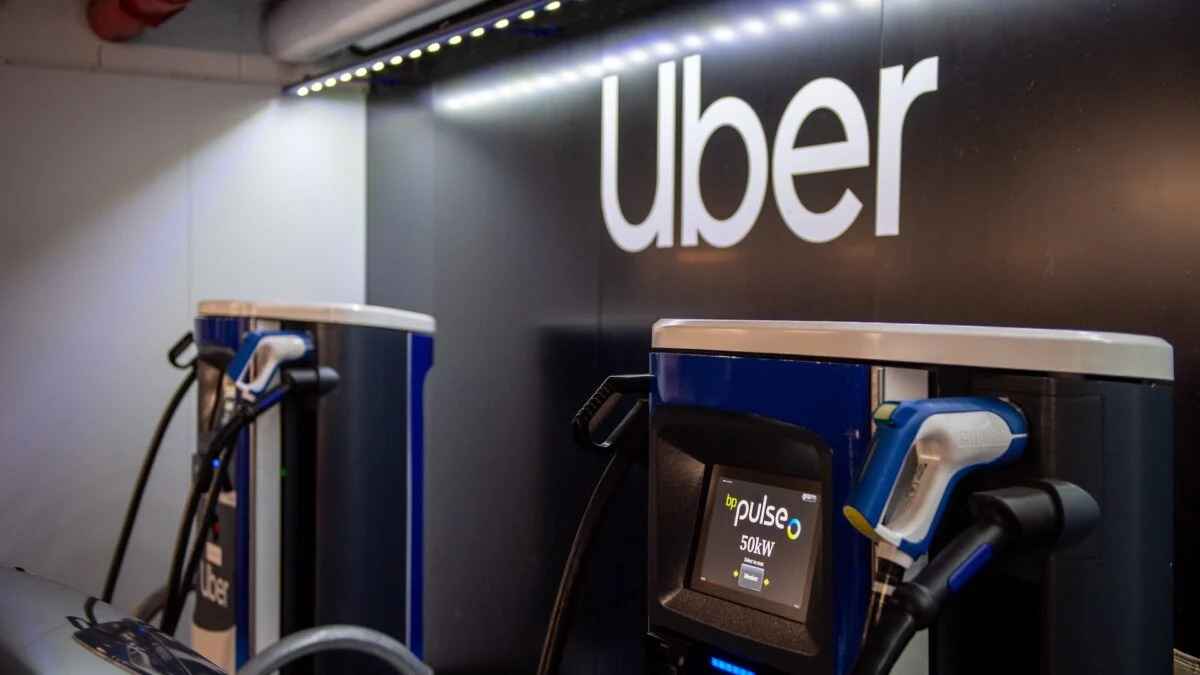
Uber isn’t just buying cars. It said it will invest more than $100 million (≈ €93 million) to create autonomous-vehicle charging hubs and depots where cleaning, maintenance, inspections, and fast charging keep robotaxis on the road longer. Those facilities will matter more than you might expect: they’re the backstage crew that determines uptime and safety.
Past partnerships set the pattern — Lucid, Nuro, and the lessons learned
Uber’s previous deals matter because patterns repeat. Last July, Uber announced a partnership with Lucid and Nuro to deploy at least 20,000 Lucid Gravity SUVs with Nuro’s self-driving stack over five years. That effort showed Uber’s appetite for multiple hardware/software relationships instead of betting everything on one approach.
How many robotaxis will Uber deploy?
Officially: up to 50,000 vehicles by 2031 under the Rivian arrangement, plus at least 10,000 R2s purchased immediately and an option for 40,000 more. Combine that with other partnerships and you’re looking at a very large fleet-level ambition across the company’s autonomous efforts.
A regulatory crack in the armor — safety incidents and public trust
Real observation: regulators investigate when things go wrong. The NHTSA opened a probe into a January incident where a Waymo robotaxi struck a child near a Santa Monica elementary school. Such events slow approvals, tighten oversight, and shift public opinion. You shouldn’t assume scale follows technology; it follows permission.
That’s the other half of the business case: technology proves itself in the wild, but policy and public trust flip the switches on deployment speed.
What this means for riders, drivers, and cities
On one hand, riders could get more efficient, lower-cost trips and fewer empty cars circulating. On the other, drivers and local workforces face disruption that cities will have to manage. You’ll see fights over curb space, charging infrastructure placement, and labor rules. The companies involved — Uber, Rivian, Waymo, Zoox, Lucid, Nuro — will all be lobbying, testing, and iterating in public.
The metaphors matter: the launch feels like a freight train built in plain sight, and the city becomes a library of motion where chapters are written by software. I’ll be watching how quickly the technology proves safe, how regulators respond, and whether riders embrace or resist these vehicles.
If you follow the players — Dara Khosrowshahi at Uber, Rivian’s manufacturing teams, Waymo’s Phoenix factory plans, and the NHTSA investigations — you start to see the levers that will move the market. You can use that view to ask sharper questions about timelines, safety, and who pays for the infrastructure.
Do you want to bet on the idea that robotaxis will silently rewire cities, or do you think the political and safety frictions will slow this down — and which side are you on?