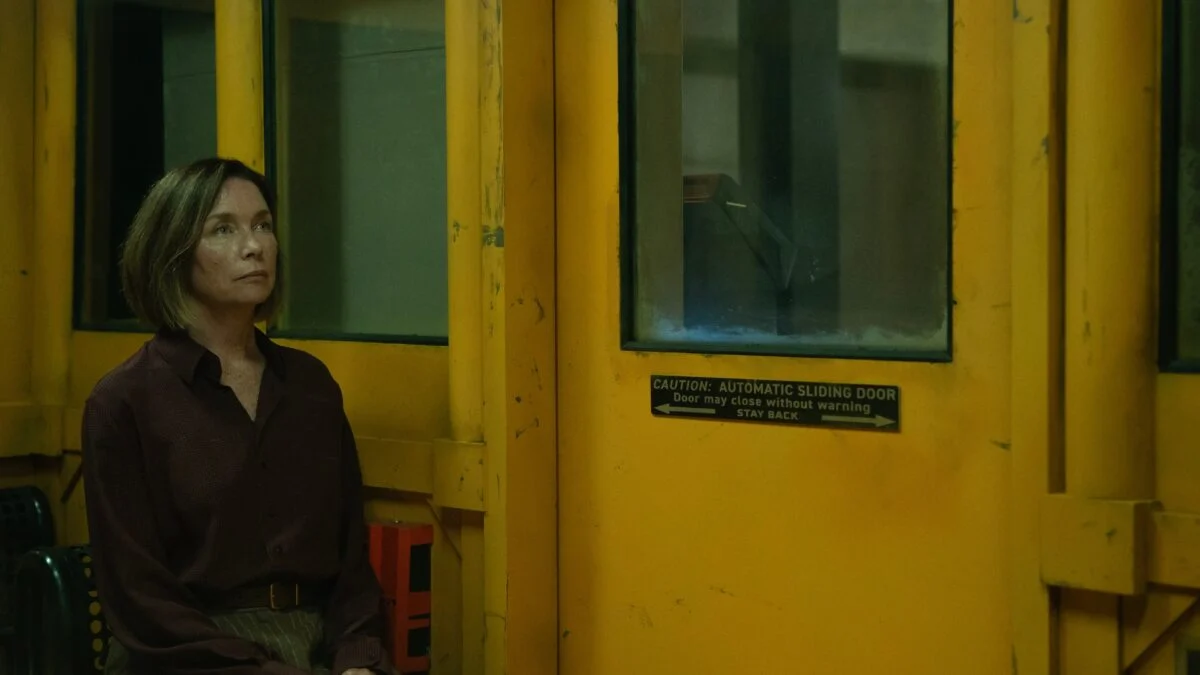
I watched the bunker clock crawl toward catastrophe while a teenage girl pressed her palm against a sealed elevator door. You can feel the air thinning through the screen; I felt it in my chest. If you’ve made it this far, you and I both want answers—and we want them to sting.
I’ve been covering Dan Fogelman’s twists since season one for io9 and I’m going to walk you through the five questions that must land in the season two finale on Hulu (also streaming on Disney+). Read this like preparation—you’ll want the mental map before the next episode detonates.
At a diner, I overheard strangers arguing about plot leaks before the coffee went cold — Who or what is Alex?
That diner argument felt like episode three: a handful of details and a lot of noise. Sinatra’s whispered “Hi, Alex” is the season’s magnet. From the euthanasia scene with Henry Miller to the scientist warning about Venus syndrome, every beat points at one of two possibilities: an extraordinary technology or something that bends time itself.
Sinatra buying time with money and Henry’s cryptic last lines—“Do you think things happen for a reason?”—tilt the scales toward experiments on causality rather than a simple person-in-a-closet reveal. If Alex is the artifact, it’s a machine that treats time like a ledger. If Alex is a person, she’s been moved out of sequence.
The visuals in episode seven—Sinatra heading to a hidden wing and greeting someone—are a staging moment, not proof. I’d trust the show’s willingness to be literal only until the next reveal. Expect Alex to be an axis that reframes motives rather than a tidy McGuffin.

Who is Alex in Paradise?
Short answer for search engines and your curiosity: Alex is not merely a name to kill or save. The show frames Alex as the fulcrum of Sinatra’s obsession—either a person displaced by technology or the technology itself. Think less soap-opera reveal and more pivot-shift that will rewrite characters’ motives.
On my morning run I saw two fathers watch the same little league game — Is Link really Sinatra’s son, Dylan?
That shared view of a baseball diamond is a useful pattern: small, public facts with private meaning. The show drops birthday matches and the name Dylan into your lap like clues on a scavenger hunt. Link’s real name being Dylan and his age aligning with Sinatra’s dead son is not coincidence; it’s a narrative lever.
Sinatra’s reaction—unmistakably lighter—reads as recognition and relief. If Alex’s technology concerns time or memory, Sinatra may have replicated or retrieved a version of her lost son. This explains both her investment and her willingness to make morally ugly decisions.
Don’t expect a tidy parentage reveal. Fogelman has been building moral fog: what Sinatra gains emotionally will cost the bunker politically.
Is Link Sinatra’s son?
Answer in the finale needs to reconcile DNA-level fact with narrative intent. If the show leans into tech, Link could be a reconstructed Dylan, a clone, or a time-displaced version. If it’s a human coincidence, the payoff still must justify Sinatra’s extreme behavior. My money is on a causality trick—because the show has been teasing questions about time all season.
While waiting for an elevator, I watched a man rub his nose after stepping off a subway — What is Xavier’s connection to Link, and why the nosebleeds?
That nose-rub was an accidental relay of anxiety. The series’ repeated nosebleeds—Xavier, Link, Billy—are signaling a shared phenomenon, not a medical running gag. Xavier’s visions of future memories and his recognition of Link from a student ID point at a psychic or temporal resonance between him and Link.
The nosebleeds act like a circuit breaker: whenever timelines or memory threads cross, the human body protests. That makes them a physiological shorthand for the show’s sci-fi mechanism. Expect Xavier’s premonitions to be both the key to Link’s origin and a liability; prophetic knowledge in Paradise carries a price.

At my last office all-hands someone tripped the breaker and the whole floor froze — What will happen with the bunker’s system collapse?
Power failures expose more than wires; they reveal true priorities. The simultaneous sabotage of oxygen and the lockdown is a narrative fuse that will either detonate or be defused, but not without cost. The show has already seeded stakes: 25,000 people, dwindling air, possible radiation, and one very unliked Bradford heir.
Small scenes—Hadley and Presley stuck in an elevator—exist to humanize the apocalypse. If the finale wants emotional momentum, it must give us a clear rescue action and a political reckoning. Expect a hard trade: lives saved at a reputational price for Sinatra and a brutal reshaping of bunker governance.

At a crime scene I watched paramedics check pulses that weren’t there — Is Agent Jane Driscoll really dead?
Paramedics verify absence because narratives sometimes require ambiguous ends. Jane bleeding out in Gabi’s shower is a show-stealing moment, but Paradise loves reversible death and techno-mysteries that complicate “dead” into “offline.”
Then there’s AlexQ—the cryptic warning from 1997 that predicted Jane’s lethal potential. Was that an AI, an algorithm, or a human playing a long game? If Alex is time-tech, predictions can be generated and retrocaused; if Alex is code, then “a killer will be born” might be a bootstrap paradox manifested in text messages.
Is Agent Jane Driscoll dead?
Expect a messy answer. The show can (and often will) blur medical finality with technological resurrection. If I were writing the scene as showrunner Dan Fogelman, I’d let Jane’s fate hinge on access to Alex—either she’s buried under trauma, or she becomes evidence for whatever device Sinatra protects.

I’ve named the likely mechanisms: time-manipulation tech, causal feedback in human memory, and political theater inside a failing life-support system. You should watch the finale expecting moral fallout, not tidy answers—Fogelman has threaded character cost into every plot engine.
One last thing: think of this season as a watch with the hands jammed at midnight, and also as a house of cards teetering over a storm drain—either image will be proven right by the next hour. Which image scares you more, and why?