
The chat exploded at 9:12 a.m. with screenshots: Kliff standing over a newly conquered boss, a party of strangers celebrating in town, sales counters spinning upward. I felt the same jolt you get when a small experiment suddenly proves more than incidental. You can sense momentum when it arrives, and Crimson Desert has just generated a tremor.
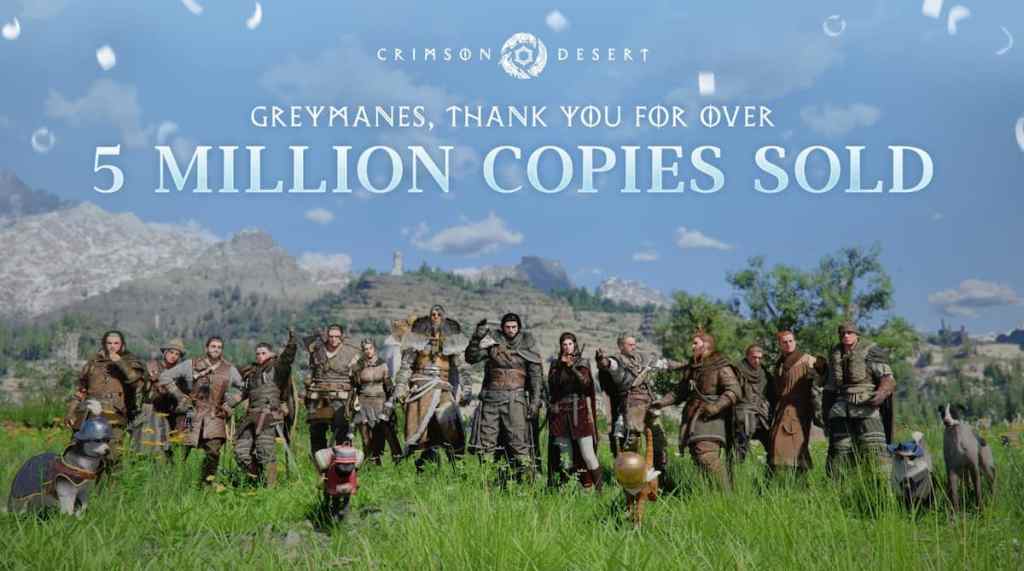
On the morning after launch the numbers were already talking — five million copies in under a month
I watch launches for a living, and this one reads like a headline that keeps rewriting itself. Pearl Abyss confirmed the figure and, if you do the math, five million copies at roughly $60 (€56) apiece suggests about $300M (€280M) in gross sales — a striking return on a risky singleplayer gamble.
I want you to hold onto that contrast: big financial momentum coming from a game that had a rough public reception at first. That split — between early skepticism and the current tide of players — is where stories get interesting.
At 2 p.m. I scrolled through patch notes and forum threads — players were talking about fixes, not quitting
Pearl Abyss has been fast with updates: boss rematches, adjustable difficulty, new skills, mounts, and outfits. The company’s press release through TriplePointPR names April-to-June patches by timeline, and I read that as a deliberate plan to keep retention high across Steam, PlayStation, Xbox, and PC storefronts.
Those fixes are arriving like a rising tide, lifting player sentiment and replay value. If you play on Discord or Reddit, you feel that optimism building — testers and streamers swapping footage, tips, and critiques.
How many copies has Crimson Desert sold?
Pearl Abyss announced five million copies sold in under a month. Platforms include Steam and console storefronts; the figure reflects global sales across digital and boxed versions, and it’s already framed conversations about Pearl Abyss’s financial runway and future projects such as DokeV.
One night I watched a developer AMA and noticed the tone change — responsibility took center stage
The studio admitted issues and detailed performance and UI improvements: control tweaks, distant scenery quality, and quality-of-life items the community requested. That willingness to iterate has flipped the narrative from “flawed launch” to “live service singleplayer with momentum.”
Pearl Abyss is also reallocating resources: most of the team will move to the creature-collector DokeV, while a dedicated subset remains on Kliff’s story. That split matters — it’s the difference between a one-off patch and a continued roadmap.
Will Pearl Abyss add more content to Crimson Desert?
Yes. The roadmap includes mechanical additions (boss rematches, difficulty options), cosmetic content (outfits, mounts), and systems updates. Expect further optimizations aimed at PC graphical settings and controller feel, and continued community-driven fixes that improve discoverability and retention.
In a café I watched a stream chat arguing whether to buy after launch — it’s a perfect data point
You probably asked yourself the same question: is it worth buying now? The social proof is working in the game’s favor. Positive word of mouth, faster patches, and a clear content cadence mean the long tail matters more than day-one impressions.
The studio’s PR and platform moves — from timed updates to targeted optimizations on Steam and consoles — read as conscious attempts to protect sales momentum and player trust. If you’re weighing a purchase, factor in current trajectory, community health on Discord and Reddit, and upcoming patches.
At the end of the week the market chatter turned predictive — investors and players were both placing bets
I track signals from both sides: financial returns, media coverage, and player engagement. Five million copies gives Pearl Abyss leverage they didn’t have two months ago. It buys time to refine the game, experiment with seasonal content, and funnel attention toward DokeV without abandoning Kliff.
Think of the studio as a workshop with multiple benches; a steady income stream lets them keep one bench on continuous improvement while another builds a new product.
I’ve been blunt: some mechanics still need polish and some promises must be kept. But if you’re watching the conversation shift from complaint to curiosity, that shift is the story now. Will Pearl Abyss ride this surge into a sustained comeback, or will momentum fade when attention moves to the next big release?