I pushed through a clump of curious onlookers at the Beijing Auto Show and felt the room tilt a little — not because the car was massive, but because it rejected the usual options. I found myself defending simplicity while everyone around me admired bravado. You can see why: Hyundai just introduced something that courts the future without trying to be a stunt.
I’ve watched a lot of EV launches. You learn to spot the moment a design goes from clever to useful, and the IONIQ V hit that mark for me.
At the auto show floor the IONIQ V didn’t scream for attention — it quietly redirected it
The silhouette is a single curve rather than a flurry of edges. That choice makes the car read as purposeful, not performative.
Hyundai has placed the IONIQ V at the center of a China play that’s both urgent and public. After selling just 125,726 vehicles in China in 2024, the brand needs something that can cut through local competition from BYD and others. The IONIQ V is the first IONIQ model built specifically for Chinese buyers with BAIC Group, and it arrives as Hyundai and its partner pledge 8 billion yuan (about €1.0 billion) to their Beijing joint venture.
On sight: the exterior feels familiar but disciplined
The lines aren’t an assault; they’re a handshake.
Where Tesla’s Cybertruck and Tesla’s new Cybercab lean into theatrical geometry, Hyundai chose restraint. The result is an EV that borrows the Cybertruck’s willingness to break form but trades bravado for everyday logic — a design that’ll turn heads without making drivers daily defenders of their taste. The IONIQ V is a Swiss Army knife on wheels.
How far can the Hyundai IONIQ V go?
Hyundai reports the long-range IONIQ V will top 600 km under China’s CLTC standard (about 372 miles). That number lands it solidly in the middle of the pack: better than entry models, shy of the new premium ranges from some Chinese brands such as Denza’s Z9 GT, which promises ranges north of 1,000 km.
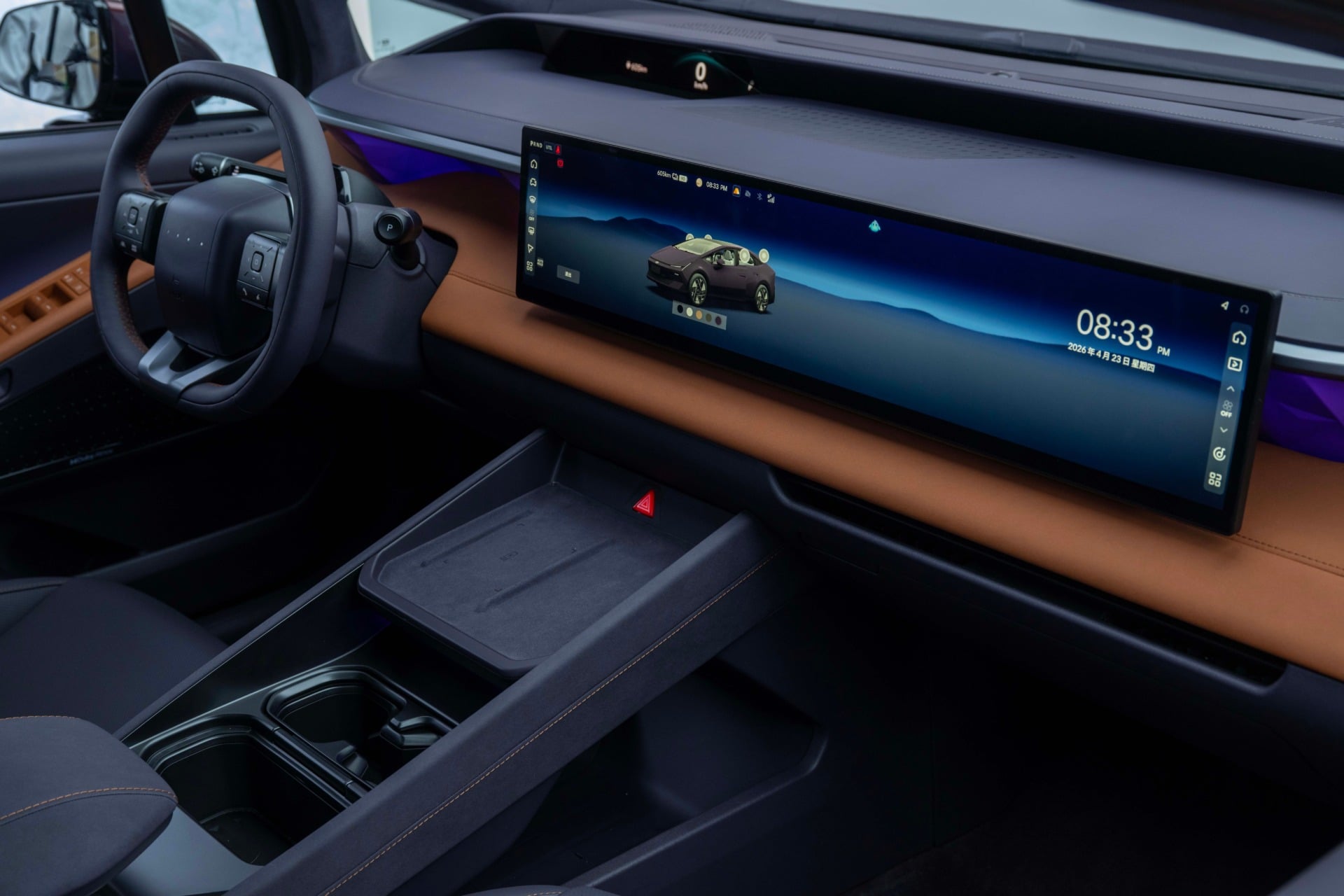
Inside the cabin you can feel the design philosophy again — screens instead of switches
The interior looks like someone removed the knobs and left the essentials.
The IONIQ V swaps most physical controls for a 27-inch ultra-thin 4K panoramic display and relies on a head-up display instead of a traditional instrument cluster. That’s a confident bet on software and UX, and it puts Hyundai on the same field as BMW’s screen-heavy 7 Series EV without leaning into spectacle. Its widescreen dash is a cathedral of pixels — impressive but not excessive.
When will the IONIQ V be available?
For now, the IONIQ V is China-only. Hyundai plans this as the opening move in a five-year offensive: 20 new models and a target of 500,000 annual sales in the market. If you’re outside China, you’ll have to watch how the model performs there before it shows up in your market.
On the industry stage Hyundai is playing catch-up — and trying to make it strategic
The numbers behind the curtain are blunt: BYD shipped over 2 million EVs in the year that made it the world’s largest EV seller.
Hyundai’s CEO José Muñoz has framed China as an essential piece of its EV future, pointing to fast development cycles and a dense battery supply chain. The IONIQ V is the first public proof point of that pledge. Hyundai and BAIC’s investment signals seriousness, but the company still faces a local field that moves fast and scales faster.
How does the IONIQ V compare to Tesla’s Cybertruck?
They’re aiming for different fights. Tesla’s angles and ethos are about spectacle and a specific, polarizing identity; Hyundai’s approach is moderation and purpose. The IONIQ V trades the Cybertruck’s theatrical edge for everyday utility and a cabin built around screens and clarity. For buyers who want an EV that behaves like a car first and a conversation piece second, this will make more sense.
On strategy: the IONIQ V is one step in a long sprint
Hyundai hasn’t announced global rollouts yet, but China is the testing ground.
Twenty new models in five years is an aggressive calendar, and the IONIQ V reads like a model meant to test consumer taste, production partnerships, and software assumptions. If Hyundai can convert curiosity into repeat buyers, it’ll have a template to export. If not, the IONIQ V will be a neat footnote while local brands extend their leads.
You can argue about whether Hyundai is playing it safe or finally learning the market — but either way, this is a car that asks you to choose convenience over spectacle, competence over cult. Will that be enough to shift China’s EV landscape?