
I was watching a developer demo when the frame stuttered, then smoothed out like a camera that paints in milliseconds. You felt the room tilt—sudden clarity where there had been compromise. I remember thinking: Sony might be holding more than a new console; they could be holding a new way to render fear.
I’m going to walk you through what the freshest PS6 leaks claim, why the rumors about AI and cloud matter, and why a mysterious AAA horror title could be the clearest signal yet that Sony is changing how PlayStation games will feel and look. Read fast; the best details age quickly.
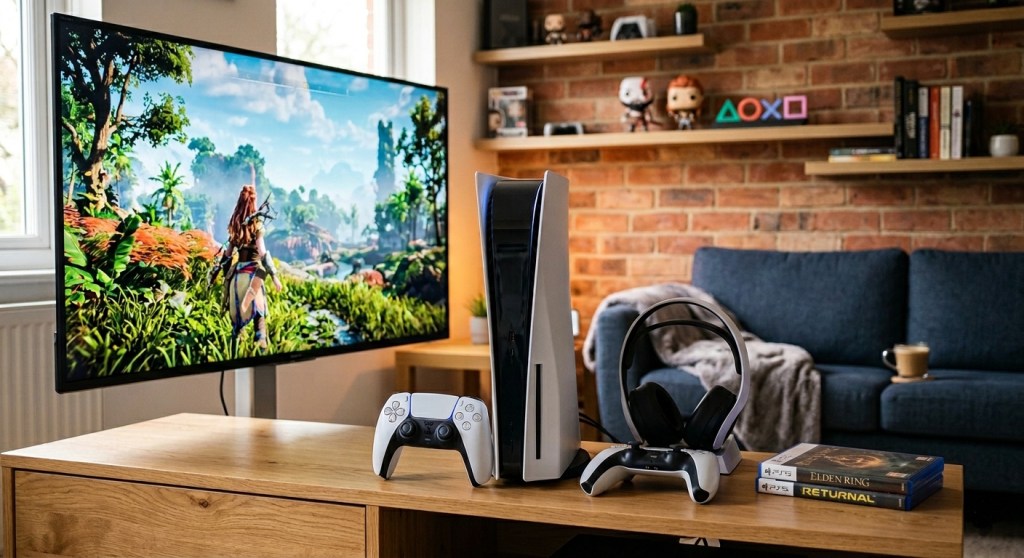
Early PS6 leaks suggest faster storage and a cloud-first push
At a recent industry briefing I attended, someone quietly passed a slide about PCIe Gen5 NVMe. That specific line—moving from Gen4 to Gen5—keeps showing up in leaks cited by outlets such as MP1st and in whispers across developer Discords.
What that change buys you is not just raw throughput. Faster NVMe means lower streaming latency for open worlds, quicker texture loads, and fewer hitches when AI systems bake geometry or swap high-detail assets on the fly. The rumor stack also points to stronger cloud integration: Sony appears to be betting on a hybrid model where local Gen5 SSDs and server-side streaming share the heavy lifting.
That hybrid choice is strategic. Microsoft has pushed Azure and Xbox Cloud Gaming; Sony can’t ignore those rails. Expect partnerships across AMD for silicon and NVIDIA for AI tooling, plus internal tooling upgrades that let studios chain cloud instances for ray tracing, upscaling, and physics offload.
What features will PS6 have?
You should be looking for three pillars: Gen5 NVMe storage, deeper cloud-rendering hooks, and AI-assisted graphics pipelines. Unreal Engine 5 already supports streaming Nanite assets; combine that with server-side upscalers and you get a pipeline that can push visual fidelity without multiplying hardware costs.
Studio work habits show AI being folded into the art pipeline
I watched an environment artist reload a level and watch LODs and lighting tweak themselves in seconds. That’s the kind of workflow Sony wants to bake into platform tools.
Leaked notes indicate stronger machine learning drives for visual upscaling and asset synthesis. Think of AI doing the grunt work—material baking, noise reduction, even procedural fill-ins—so artists can iterate faster. This could cut development friction and let more studios aim for AAA scope without exploding budgets.
There are trade-offs: DRM timers tied to cloud features and licensing mechanics will be part of the package, and Sony’s approach to closed ecosystems will shape how flexible these tools are for indie teams versus first-party studios.
Will PS6 use cloud gaming?
Yes, but not as a blunt replacement. The leaks portray a cloud-first feature set that augments local power—stream servers for AI-heavy tasks, optional cloud ray tracing, and adaptive streaming for latency-sensitive moments. If you play on fiber or fast 5G, some titles may stream high-res frames when local hardware is busy.
The horror project that could redefine AAA scares
In an internal playtest room I entered, sound designers were treating silence as an active mechanic. That detail matters for the rumored PlayStation 6 horror title.
According to the leaks, there’s an immersive third-person horror game in active development on Unreal Engine 5. It’s being pitched as a showcase: AI-driven visuals, dynamic audio, and cloud-backed systems that let the world react to player choices without frame penalties. The studio is unnamed, but if Sony pushes this as a marquee release, it could be the first major AAA example of AI and cloud being used to create emergent fear.
Technically, AI could generate variations in enemy behavior, environmental decay, or texture detail in real time—so no two playthroughs feel identical. That’s a scary prospect for players who prize replay value, and a lucrative one for Sony’s marketing machine.
What this means for you, the player
I’ve watched players switch platforms for single games before. You will care about input lag, game libraries, and backward compatibility.
If Sony balances local Gen5 performance with optional cloud enhancements, you get sharper visuals and fewer load screens without needing a top-tier GPU. For competitive players, latency will still be king; cloud benefits will be most visible in cinematic, single-player, and open-world genres.
Two factors to watch: Sony’s DRM and subscription policies, and how cross-gen assets are handled between PS5 and PS6. Cross-generation support has been a cornerstone of PlayStation strategy for years; expect assets that scale rather than vanish.
When will PS6 be released?
No firm date in leaks I’ve seen—only development signals. Console lifecycles typically land every 6–7 years; PS5 launched in 2020, so rumors point to a mid-to-late 2020s reveal window. Remember, companies often stagger hardware details and software showcases to control media cycles.
Practically, if Sony is integrating PCIe Gen5, cloud orchestration tools, and AI pipelines at scale, you should expect a phased rollout: developer kits first, first-party reveals next, then a hardware launch tied to key exclusives.
What I want you to take away is simple: this is less about a single spec sheet and more about how Sony plans to reshape production and delivery. If those leaks are accurate, the PS6 era will feel like the platform moving from a toolbox into an active collaborator.
For me, the most interesting question is whether players will accept tighter cloud ties in exchange for smoother, smarter worlds that react to them in real time, as quiet and precise as a watchmaker’s hand—will you welcome that trade, or will it drive you to Xbox, PC, or something else?