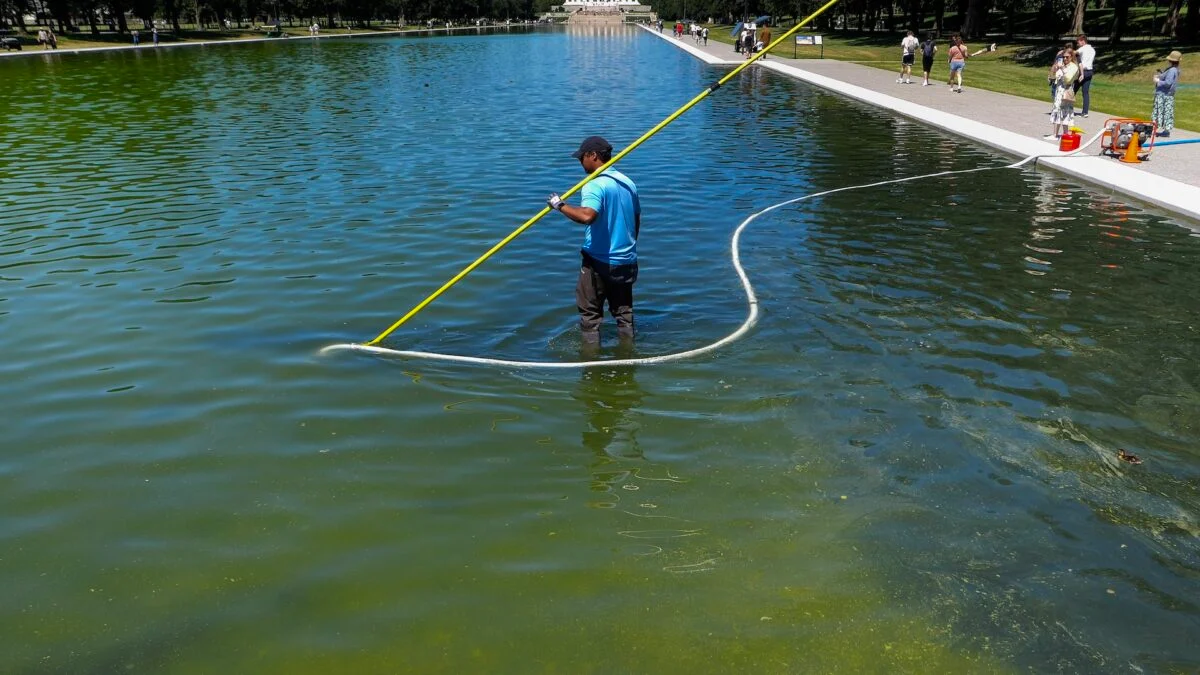
I stood on the stone edge as a parade of small white bottles hissed into the Lincoln Memorial Reflecting Pool and a patch of paint drifted like a rumor across the surface. You could feel the dissonance—an official tweet saying the water was “crystal clear” while the Mall offered something greener and messier. I’ll walk you through what really happened, who said what, and why the optics matter more than the chemistry.
I watched workers pour clear bottles into the pool on a humid Wednesday. The paint job was supposed to be a cosmetic mic-drop.
President Trump ordered the pool drained and its bottom painted dark blue as part of a roughly $14 million (€13 million) renovation meant to make the water look bluer. But water borrows its color from the sky, not the floor beneath it. What actually determines hue is biology: green algae, nutrients and sunlight.
The Washington Post ran an analysis of satellite data suggesting the 6.75 million-gallon pool has more algae than at any point since 2021. That fed a certain schadenfreude online after the administration declared victory and the pool promptly turned green.
Why is the Reflecting Pool green?
The short answer: algae blooms. Warm temperatures, stagnant flow from dormant supply lines during eight weeks of construction, and dissolved nutrients create a perfect gown for green algae to bloom. The Department of the Interior told WUSA 9 the algae resulted from those dormant supply lines and said teams are deploying nanobubble systems and hydrogen peroxide treatments to clear it.
Here at the Reflecting Pool where a big chunk ofTrump’s blue paint-apoxie has peeled off the bottom of the pool and is bobbling in the water.
— Jen Bendery (@jbendery.bsky.social) June 18, 2026 at 12:03 PM
A blue chunk peeled off the bottom and bobbed past a duck family. The scene felt like a small defeat you could photograph.
The administration’s cosmetic approach—paint the bottom, change the PR narrative—runs up against simple fluid optics and biology. Paint chips have reportedly floated to the top; journalists posted images and video showing fragments of the blue coating bobbing in the green water.
The Department of the Interior tweeted that “the Reflecting Pool water is crystal clear, and our National Park Service team is now vacuuming up the dead algae resting on the bottom of some parts of the Reflecting Pool—just like the destroyed Iranian Navy resting on the bottom of the Persian Gulf.” That comparison raised eyebrows and the usual political blowback.
How does nanobubbler technology kill algae?
Nanobubble systems increase oxygenation and can change water chemistry in ways that stress and kill certain algae—but they are not instant magic. Operators combine nanobubbles with oxidizers like hydrogen peroxide to accelerate die-off, then vacuum the dead material. Tools and platforms in play here include municipal-style nanobubble rigs and standard oxidizers; local outlets like WUSA 9 and national outlets like The Washington Post and Reuters have tracked the deployment.
I read the Interior tweet claiming the water was “crystal clear” and then scrolled to pictures of green water. The public saw a mismatch.
That mismatch fed a political narrative. Liberals savored the irony after Trump’s pronouncements. Conservatives tout the memorandum of understanding that briefly re-opened the Strait of Hormuz while negotiations continue with Iran. Meanwhile, figures like Vice President JD Vance offered an unusual public rebuke to Israel after it reacted poorly to the U.S.-Iran MOU—comments reported by The New York Times and amplified by outlets such as The Bulwark and Reuters.
When politics and optics collide, the pool becomes a political prop. The administration’s framing and the National Park Service’s tactics—hydrogen peroxide applications, nanobubble units, vacuuming crews—are less likely to persuade skeptics than a clear photograph would be.
Is the Reflecting Pool safe after renovation?
Short answer: likely safe for visitors but imperfect. Hydrogen peroxide breaks down into water and oxygen and, at controlled doses, is used widely in water treatment. Nanobubble technology is an accepted tool for oxygenation. The remaining concerns are the paint fragments and the timeline for full cleanup—vacuuming has to follow chemical treatment to remove the dead biomass and any floating debris.
The blue paint’s failure to change the pool’s color was predictable; water reflects the sky and algae will hide any cosmetic flooring. The blue chips floating on the surface looked, to many onlookers, like confetti floating on a pond—festive until you realize the celebration was over a managerial misread.
So the administration can claim victory, point to technology, and post triumphant tweets. You and I can scroll the satellite charts, the BlueSky posts, the WUSA 9 reports and the Washington Post analysis and weigh the evidence. Who wins the attention war—political messaging or photographic reality—will tell us more about this moment than any press release ever could?