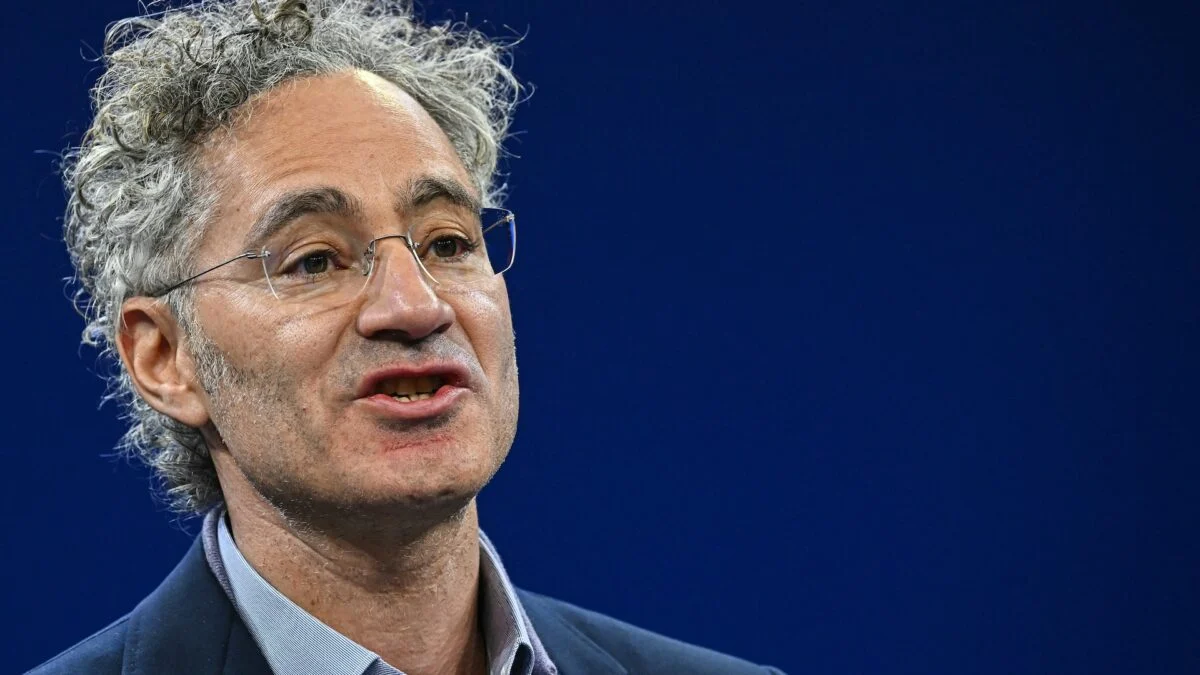
He exploded across the Squawk Box set with arms flailing and sentences cutting off midstream. I watched it and you probably saw the clip—his voice threading anger, confusion, and something almost performative. By the time Becky Quick said he sounded “pretty angry,” the room had already been remixed into a viral loop.
I want you to hold two things as we walk through this: the content of what Alex Karp said matters to companies wrestling with AI, and the way he said it tells us something about the conversation around tech power. I’ll point to the claims, the contradictions, and the unstated risks that enterprise leaders are whispering about in private.
The CNBC rant landed on live TV and the clip started circulating
Karp waved his arms and interrupted hosts while branding some frontier AI firms reckless. His target was a pricing model — tokenized access to models — that he argued leaves enterprise customers paying for “no value” while handing over intellectual property.
He named no single company repeatedly, but his grievances tracked against firms like Anthropic and their token-based offerings and, by implication, the broader wave of large language model products from outfits such as OpenAI. He warned enterprises that using those models could mean leaking sensitive IP and classified material.
CNBC host Rebecca Quick to a crazed-sounding, incoherent, ranting Palantir CEO Alex Karp: “You sound pretty angry” pic.twitter.com/lYSc2AjWDo
— Aaron Rupar (@atrupar) July 1, 2026
His words hit the morning show like a squall hitting a calm sea.
Did Alex Karp accuse AI companies of stealing IP?
He framed the problem as a systematic transfer of value: enterprises buy tokens, models consume their IP, and the model creators gain “weights and alpha” they can use to compete. Whether or not every AI vendor behaves that way, the concern is real: some firms offer APIs and fine-tuning paths that, without careful contracts, could expose proprietary workflows and data.
Mid-rant he confronted an old rumor about his onstage behavior
At one point Karp leaned into the caricature: “the neurodivergent crazy person that apparently is on drugs, the one thing I don’t do,” he said, then pivoted back to his AI critique.
That moment collapsed two tracks at once — an argument about technology and a personal performance that critics and late-night hosts have framed as unhinged. Semafor and others have tried to rationalize his peculiar appearances (sugary drinks, lighting, jet lag), but the gossip thread persists and now feeds the message.
If entertainment value keeps cable hosts employed, Karp showed he can be both tedious and magnetic — a carnival barker with a doctorate.
Why did people think Alex Karp was on drugs?
Observers pointed to a few viral appearances — notably a DealBook Summit clip — where his speech and demeanor looked out of sync with the room. Reporters offered mundane explanations: a sweet soda, exhaustion, eccentricity. Karp chose to own the trope on air rather than deflect it, which amplified the headlines.
He folded politics into the tirade and then hedged
At several points Karp declared public loyalty to Israel, called himself “the most publicly supportive CEO of Israel,” and then insisted he was its “most effective critic” because he is “fair.”
The exchange with Andrew Ross Sorkin ended with Karp saying he would discuss Israeli matters privately. That mix of rhetoric and private-off-the-record posture is familiar in Washington circles: public posture for optics, private conversations for operational reality.
What did Alex Karp say about Israel?
He defended Israel’s right to exist and framed his stance as both supportive and critical. When pressed about Iran and bilateral memorandums, Karp ducked into the private-versus-public line: he implied there are classified or sensitive details that would comfort people if made public, but said he would not air them on national television.
here is the entirety of Palantir CEO Alex Karp’s televised nervous breakdown this morning on CNBC pic.twitter.com/gzD8debrKB
— Aaron Rupar (@atrupar) July 1, 2026
Customers are unsettled, and policy proposals are bubbling up around that unease
Enterprise CIOs, I hear, are furious about paying for tokenized access to models that don’t deliver bespoke value and may siphon their competitive advantage.
Karp warned of a proposed “wealth tax” or AI tax — an idea floated in public discourse by firms like Anthropic as a hedge against job displacement — and argued such levies would not help those in need but instead punish business owners and investors.
He named plenty of players in the conversation: Palantir at the center of his grievances, Anthropic as an example of token economics, CNBC hosts Becky Quick and Andrew Ross Sorkin as the live forum, and Semafor as one outlet that tried to explain his previous behavior. Even Jim Cramer got a mention by implication: spectacle sells, whether it informs.
What matters beyond the viral clip is less Karp’s theatrics and more the structural questions he raised: who owns model weights, how will enterprises protect IP when using LLMs, and what policy responses are fair if automation displaces workers?
I’ll leave you with this: if you run a company that feeds data into third-party models, are you sure those APIs are protecting your crown jewels and not training your next competitor?