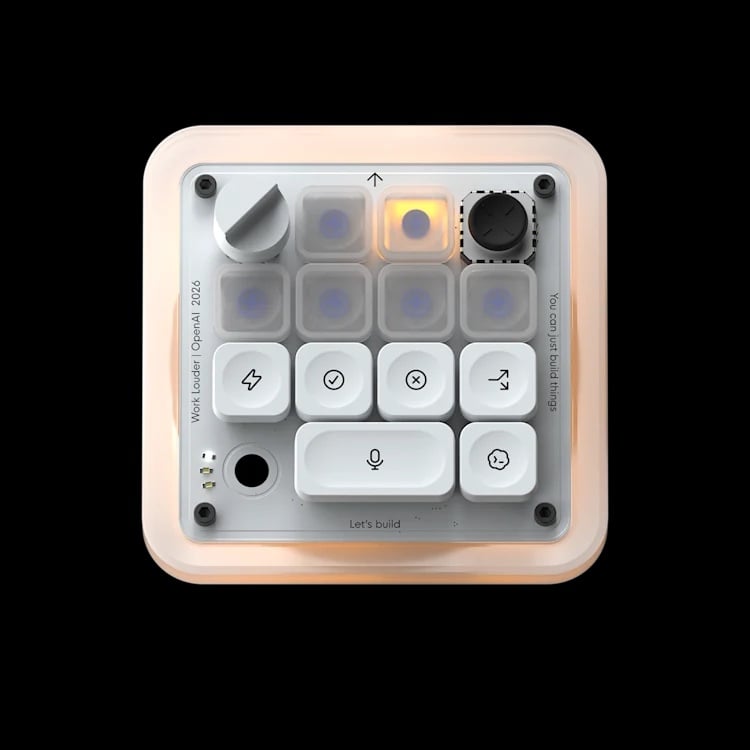
I was two commits deep when a small orange LED flicked and one of my agents paused. You could feel the room tighten — like a pause button pressed on a live orchestra. I stared at a compact square on my desk and realized OpenAI had just shipped its first piece of hardware.
I’m going to tell you what it is, why it matters, and how you can use it to boss around AI agents without flailing through menus. You can treat this as a short field guide from someone who’s already wired one into a live workflow.
At my cluttered desk I plugged in a 3-inch pad and it felt oddly decisive
The device is officially the kbd-1.0-codex-micro, but you’ll hear it called the Codex Micro. Priced at $230 (€212), it’s not a full keyboard. It’s a programmable macro pad made by Work Louder, built to work with OpenAI’s agent tooling — the company pitched it as a “command center for agentic work.”
Physically it’s small, square, and assertive. Six illuminated keys report agent status with color: green = unread, blue = thinking, orange = needs approval, red = error. There’s a joystick for launching workflows and a dial that adjusts how much reasoning Codex should apply to a task. If you use Codesx or ChatGPT agents, this device maps those conversations to literal buttons.
What is the Codex Micro keyboard?
It’s a programmable macro pad aimed at developers who run agent workflows. Think shortcuts, pinned chats, and one-touch control for debugging, refactoring, or approving suggestions from Codex. OpenAI and Work Louder built the hardware around Codesx’s workflow model, so the pad communicates status, triggers tasks, and gives you tactile control over AI activity.
At a team stand-up someone asked why you’d buy a tiny pad when your laptop has shortcuts
You buy it for reduced friction. When an agent raises a question you can approve it without switching windows. When an error pops, a single joystick movement can launch a targeted debugger. For people who run multiple agents at once, the Codex Micro is a way to move intent from your brain to the system in a single, deliberate motion.
OpenAI’s developer account tweeted a short demo: “Map the buttons and joystick to your workflow, and keep your pinned chats in view.” The product page calls it a command center — and functionally, that’s what it is. I’d add that for concentrated agent work it behaves like a tiny control tower for your agents.
How does the Codex Micro work with Codex or Codesx?
The pad maps button presses and joystick actions to agent operations inside Codesx (the AI coding agent) or similar agent platforms. Buttons light up with agent state, the joystick can invoke workflows like refactor or debug, and the dial tweaks the agent’s reasoning depth. For teams using ChatGPT or Codex-style agents, it reduces the cognitive load of context switching.
On a legal timeline a lawsuit landed on my feed the same week
OpenAI’s hardware plans are bigger than this $230 (€212) pad. Bloomberg reported a rumored screenless smart speaker that would move, act as a “humanlike AI companion,” and launch before 2027; OpenAI is reportedly also prototyping a mobile AI device. Those projects are tied to io Products, the hardware outfit founded by Jony Ive and acquired by OpenAI for $6.5 billion (€6.0 billion) last year.
That acquisition has already drawn legal fire: Apple sued OpenAI and two former Apple employees in California, alleging theft of manufacturing trade secrets and naming io Products as a defendant. For now, the Codex Micro is what’s on sale. The higher-stakes devices are still rumors, and a courtroom could change that roadmap fast.
At a coffee shop I watched someone map macros in five minutes
It’s aimed at people who want to move fast — developers, devops engineers, technical product managers. If you live in VS Code, GitHub, or the ChatGPT interface, the pad adds a physical layer to actions you already perform with keystrokes and clicks. Brands in the space include Work Louder, OpenAI, ChatGPT, Codesx, and tooling like VS Code and GitHub Copilot, all of which are likely touchpoints for how this pad gets used.
Will it become essential? That depends on whether agent-driven workflows take off in the way OpenAI expects. If agents are going to be a regular part of your stack, a tactile controller turns a passive observer into an active conductor.
OpenAI just shipped hardware that is small in footprint but loud in implication — are you ready to give a box of LEDs and a joystick the keys to your agent fleet?