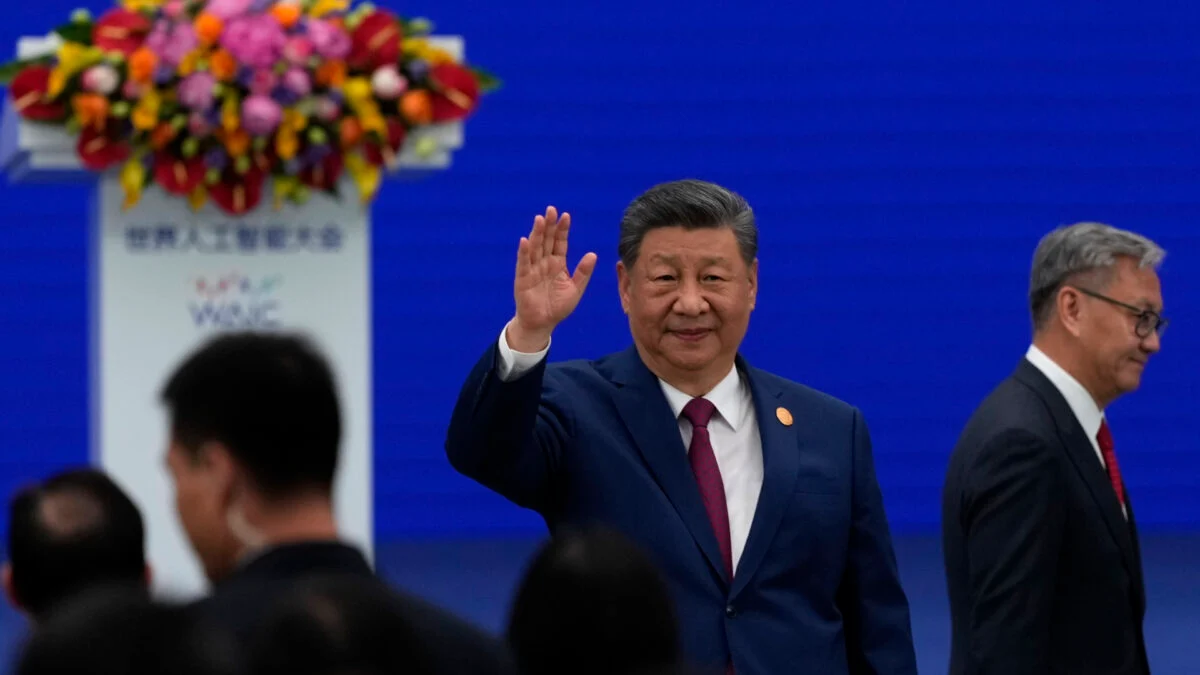
I was standing at the edge of a packed Shanghai ballroom when Xi Jinping took the podium and the room quieted like a stadium holding its breath. In three minutes he moved an industry strategy and a diplomatic play across one tight line. If you follow AI policy, you felt the world tilt—and you should have been paying attention.
I’ll walk you through what happened, why it matters to you, and where power is actually shifting. You don’t need a policy brief to see the stakes; you need a clear map of the moves.
Xi stepped onto Shanghai’s stage—He framed AI as a public good and called for broader sharing
“A single string cannot make music, and a single tree does not make a forest,” Xi told attendees, according to China Daily. That proverb was his opening card: cooperation, not closed national silos.
He pushed for more open-source work and cross-border research. Practically, that is a direct contrast with Washington’s posture under President Donald Trump, which has leaned toward export controls and model-sharing restrictions. The U.S. still leads in frontier labs like OpenAI and Anthropic and in GPU dominance through Nvidia, but China’s firms are shipping open models that can rival—or sometimes beat—protected offerings from Big Tech.
Jensen Huang, Nvidia’s CEO, has been warning U.S. policymakers that cutting China off could backfire by letting foreign software define the future AI stack. I’ve heard that argument at industry briefings and at Nvidia’s GTC event in Washington, D.C.—and it’s why chip policy matters as much as model policy.
What is the World Artificial Intelligence Cooperation Organization?
It’s the coalition Beijing announced at the conference, claiming 29 member states, including Brazil and Russia, to coordinate AI research, standards, and capacity building. Think of it as a rules-and-standards club built around Chinese priorities—training programs, shared labs, and governance templates aimed especially at the Global South.
A screen at the conference listed 29 flags—Beijing is selling a program of aid and training to developing countries
Xi pledged 5,000 AI training slots over five years and promised international application centers across Africa, Latin America, and Southeast Asia. China is laying tracks across the Global South like a railway map inked in red.
That strategy does two things at once: it accelerates China’s domestic AI ecosystem through partnerships, and it positions Beijing as the standard-setter in emerging markets where regulation and procurement are still forming. For a country that has been building digital infrastructure for a decade, this is the kind of long game governments and companies bet on.
At a back table, a Reuters reporter put a phone call through—Behind the public pitch, Chinese controls are tightening
Beijing’s public message of sharing masks a parallel pattern: meetings with local labs about limiting foreign access, pressure on foreign acquisitions, and an encouragement for domestic firms to buy from Chinese chip suppliers instead of Nvidia. Meta was reportedly forced to unwind a Manus deal worth $2 billion (€1.9 billion) and to pause data-sharing—an unmistakable signal that openness has strings attached.
You should read that as selective openness: China courts partners who will accept its terms while shrinking the windows of engagement to actors it views as strategically risky—most notably U.S. firms.
Will China’s AI coalition include the United States?
Not likely, unless U.S. policy shifts dramatically. Washington’s export controls and bans—such as the temporary restrictions on Anthropic’s Mythos model—are geared specifically at China when “national security” is cited. Even when the White House eased some limits, those relaxations didn’t make China a beneficiary.
A policymaker in Washington shrugged at the mention of tariffs—U.S. restrictions have hardened despite corporate pushback
Trump’s administration tightened model and chip rules after surprise performance gains from some Chinese models. That spurred public appeals from executives like Huang, who argues that global trade keeps American technology influential abroad. On the ground, however, Chinese labs are already switching to local silicon, and Beijing is nudging that behavior with procurement and incentives.
The result is two ecosystems starting to look increasingly independent: one centered on U.S. proprietary stacks and one built on Chinese open models plus local hardware.
How do open-source models change the AI race?
Open models lower the barrier to entry for states and companies with less cloud and compute muscle. They accelerate local adaptation—language, law, and regulation—and they diffuse capabilities faster than proprietary rollouts. That speed is exactly what scares policymakers who worry about dual-use and espionage, but it’s also the lever Beijing is using to win influence.
A staffer at an AI lab scrolled through a leaked slide—Both sides now talk safety, but with very different red lines
Xi called for laws, monitoring, early warning, and emergency response systems to keep AI under human control, and he warned against stretching “national security” into an excuse to shut out other countries. That’s a rhetorical rebuke to Washington’s recent moves and a policy posture aimed at rallying countries that prefer trade and development over tech containment.
Between America’s model export controls and China’s selective openness, you and I are watching governance split along geopolitical lines—rules, not just chips, are becoming the battleground.
Whatever you make of Xi’s speech and the new coalition, the practical consequence is this: norms, platforms, and training networks will shape who writes the playbook for applied AI in the next decade. Which side will set those rules, and who will be left following them?