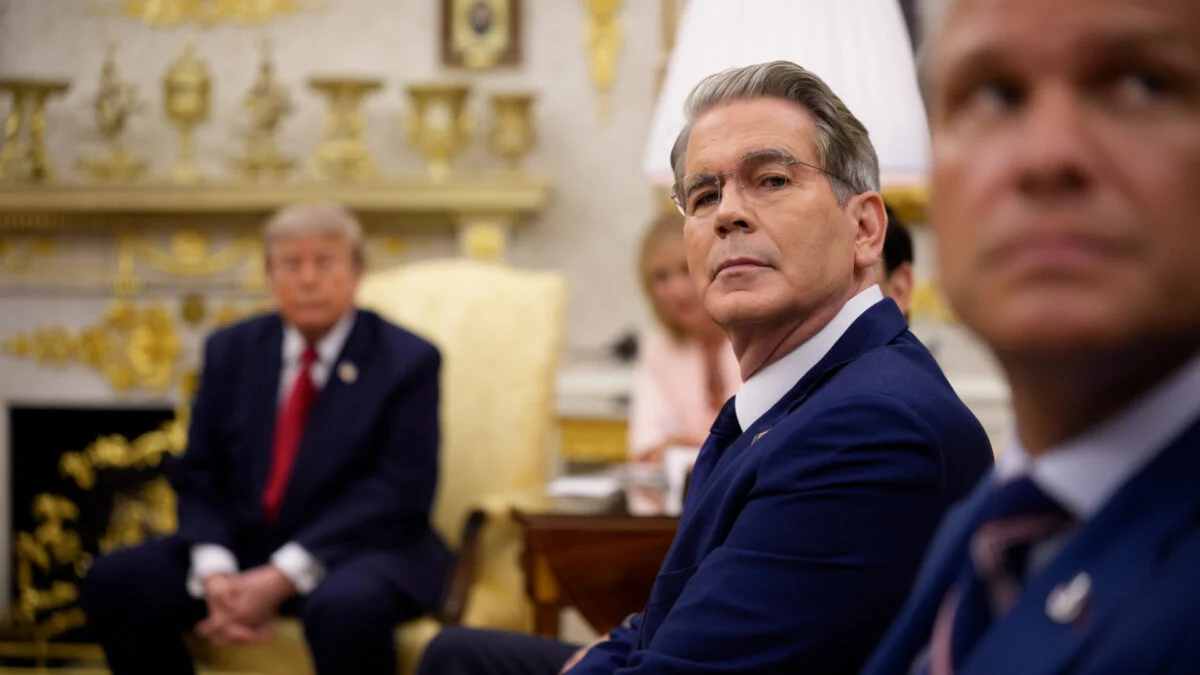
I watched Scott Bessent lean into a camera and say the Treasury has “the ability to sanction” — and that he would use it. You could feel Washington tightening a noose around tech chatter and code. I’m telling you this because it changes the rules of the game overnight.
On Fox Business, Treasury Secretary Scott Bessent made the threat explicit: American authorities will scrutinize Chinese open-source AI models for intellectual property theft and, if necessary, impose sanctions. I’ve spoken to engineers and policy officials who say this isn’t idle bluster — it’s a calibrated answer to a months-long string of accusations from U.S. frontier labs. You should expect action in the “coming days or weeks,” Bessent said.
On trading desks, DeepSeek’s R1 release in January 2025 sent markets reeling.
That moment—when DeepSeek’s R1 matched some routine tasks of then-best U.S. models and ran without the latest Nvidia GPUs—triggered a $1 trillion (€930 billion) market freakout and a raft of export controls. I remember the calls from investors: their thesis was collapsing because an inexpensive, open-weight model suddenly changed compute economics.
This is the backdrop for Bessent’s remarks. The U.S. still dominates frontier AI with OpenAI, Anthropic and the GPU stack from Nvidia, AMD and Intel, but Chinese entrants like DeepSeek and Moonshot are compressing the lead. Moonshot’s recent Kimi K3—backed by Alibaba—was tested by independent firms such as Artificial Analysis and Arena.ai and ranked near or above Anthropic’s Fable 5 and OpenAI’s GPT-5.6 on several benchmarks. That performance jump forces a policy response: when capability migrates fast, control and provenance become political problems.
On office whiteboards, engineers write the same word: distillation.
Distillation is an everyday technique: you use a high-performing “teacher” model to generate outputs that train a “student” model. It’s a standard trick in machine learning, and most labs have used it in one form or another.
Where the row starts is scale and intent. Anthropic accused Moonshot, DeepSeek and Minimax of illicit extraction; OpenAI alleged DeepSeek was “free-riding.” Anthropic later added Alibaba to the list. These aren’t mere lab-level complaints — they read like industrial-scale replication, which the White House’s chief science adviser called “adversarial” in April and promised to help U.S. labs counter.
Can the U.S. sanction Chinese AI companies for IP theft?
Short answer: yes, and Bessent said as much. The Treasury already wields sanctions routinely for finance and export-policy breaches; invoking them for model provenance is new but feasible. I’ve seen internal briefings that mention watermark detection and telemetry fingerprints — technical signals that can be deployed in legal and diplomatic cases. If U.S. watermarks appear inside a foreign model, the administration sees a clear line for action.
On conference stages, tensions leak into diplomacy ahead of planned talks.
Both sides are preparing for what Reuters reports will be the first bilateral AI talks of this administration in September, led for the U.S. by Bessent. China’s leaders, including Xi Jinping, pushed for cross-border openness at a recent AI summit and criticized what they call an overbroad national-security approach.
You should watch two categories that will dominate the agenda: claims of distillation-based theft and access to high-assurance models like Anthropic’s Mythos. The U.S. has tightly controlled distribution of Mythos — sharing it only with a handful of companies and agencies — and Beijing won’t be on that short list. Expect the Chinese side to press reciprocity; expect the U.S. to press provenance and enforcement.
What is AI model distillation and why does it matter?
Distillation compresses knowledge from a large model into a smaller one using generated outputs. On its own, it’s a neutral technique. At scale, when traces of a teacher’s behavior show up in a rival product, companies call it theft and regulators smell a policy violation. That’s where watermarking, behavioral testing, and forensic model analysis — tools familiar to OpenAI, Anthropic, and independent auditors — come into play.
On internal cables, officials flag watermarks and a short timetable for probes.
Bessent said Treasury has spotted American watermarks inside many Chinese offerings and will look closely in the days and weeks ahead. That suggests a sprint to collect evidence before September’s talks — and a willingness to escalate if the evidence holds.
I don’t want to be alarmist, but this is a pressure cooker for global tech policy: sanctions could affect Moonshot, DeepSeek, Alibaba, and even supply chains tied to Nvidia GPUs. The U.S. will argue it is defending IP and national security; China will argue it is defending sovereignty and technological independence. For firms and investors, the practical question is operational: can you prove provenance, show your data pedigree, and document training pipelines?
Will U.S.-China AI talks stop sanctions?
Talks can cool tensions, but they rarely erase competitive pain points. The meeting can create protocols for provenance testing and shared standards, or it can become a venue for pointed accusations that harden measures. I think you should assume both outcomes are possible: diplomacy will open channels, but enforcement tools will remain on the table.
I’ve spoken to engineers who say the industry has always borrowed ideas; I’ve also spoken to lawyers who see a line where borrowing becomes theft. For you — whether you run an AI startup, sit on a board, or trade semiconductor exposure — the immediate plan should be provenance hygiene: logging, watermarking, and legal review.
Bessent’s warning is now a market and policy signal: it’s a lighthouse for allies and a red flag for targets. Are you ready to prove your model’s lineage and defend it in a courtroom or a sanctions list?