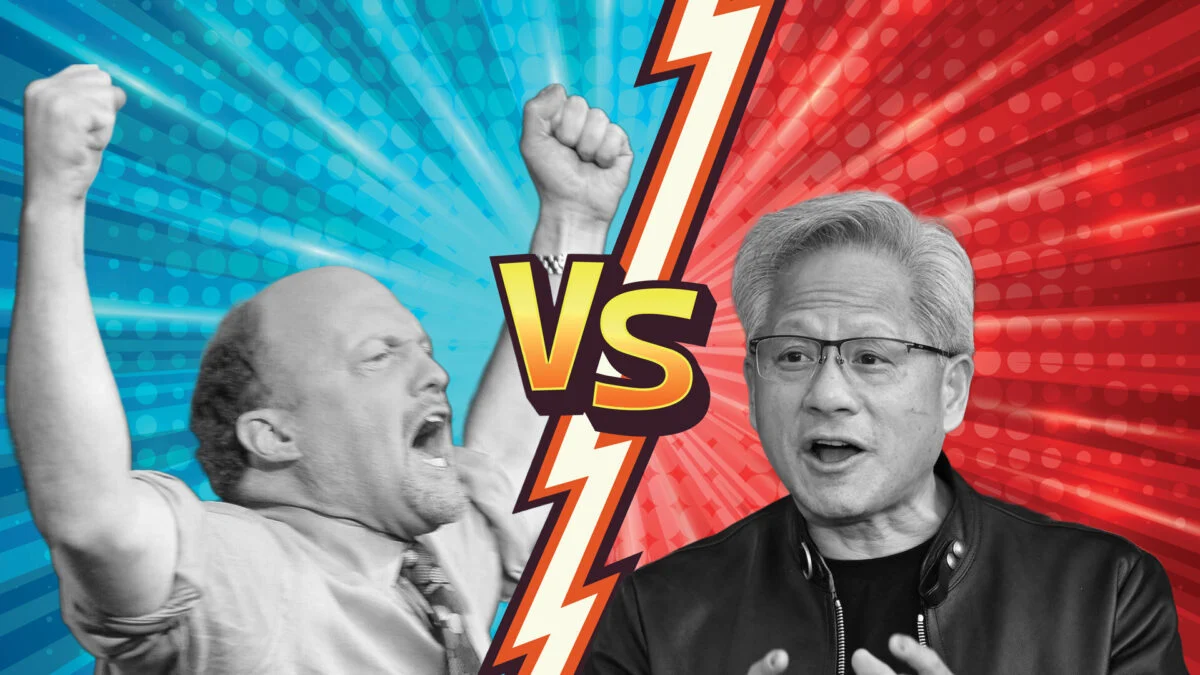
The TV volume spikes. One man shouts about national security; another shrugs and talks about utility. I watch the argument turn public and quick, with money, chips and reputation on the table.
On CNBC, Jim Cramer accused Chinese AI of being run by the PLA — and on Axios, Jensen Huang called Kimi K3 “excellent”
I’ve followed this beat long enough to know how these moments behave: they start as headlines and end up routing capital. You feel it in the tone—Cramer’s certainty vs. Huang’s dismissal—and that tension tells you which way the story will travel next.
Cramer’s take is loud: don’t touch Chinese models, they’re a national security risk. Huang’s reply is quiet but practical: if a model is good and open, use it. I agree with parts of both. You want safe systems; you also want efficient ones. The argument is less philosophical than commercial: cheap, performant models change where companies spend on chips and cloud services.
Are Chinese AI models safe?
Short answer: it depends, and open-source makes that easier to judge. Moonshot AI’s Kimi K3 and labs like DeepSeek have raised flags because of investor links and military-civil fusion concerns—CSET and members of Congress have pointed to those ties. But direct evidence of covert control is thin. Open-source models can be inspected on platforms like GitHub and Hugging Face, and companies can run them in locked-down deployments on AWS, Azure or Google Cloud so they don’t expose data.
If you care about auditability, open weights and model cards make verification faster. If you fear exfiltration, strict deployment controls, private clouds, and encryption make that risk manageable. The auditability is a strength; it’s easier to find a backdoor in an open model than in a proprietary black box.
At an Axios interview, Jensen Huang said open-source models should be used when they’re excellent — and he argued they help chips and data centers
Huang’s view is transactional: cheaper, efficient models increase compute demand overall. You might think that’s counterintuitive—why would cheaper AI mean more chips? Because lower cost of entry expands usage. Free or low-cost models drive experimentation and production runs, which consume GPU hours and data-center real estate.
He told Axios, “Free AI should be great for chips. Free AI should be great for data centers.” That’s a market logic: every new use case is fuel for servers. Cramer sees that logic and hears only threat—if firms save money by licensing Kimi, American incumbents could lose revenue. Huang pushes back: cheaper models don’t run U.S. labs off the road; they broaden demand instead.
Think of the market like a bustling bazaar: lower prices draw more buyers, and more buyers need more stalls and carts. If you’re the stall owner who also sells carts, that can still be good for you.
Should US companies use Chinese AI models?
Ask yourself what you value more—control or cost—and then build guardrails. If your product requires strict provenance and you have sensitive data, prefer vetted vendors and internal audits. If you’re experimenting or building broadly useful features, open models can accelerate development.
Operationally, you can mitigate risk by running models in private VPCs, applying differential privacy, and instrumenting every call for drift and exfiltration. Platforms like Hugging Face give model cards and licensing details; cloud vendors and MLOps tooling let you layer security and observability on top of any model you choose.
On trading floors and in boardrooms, the “foreign competitor” panic repeats — DeepSeek rattled markets once, Kimi stirred them again
I’ve watched investors run from cheap disruption before. The instinct is immediate: protect the incumbent, restrict the newcomer. That’s why you see calls to ban these models from American companies—protection as policy.
Cramer’s language—calling these firms effectively run by the PLA—raises the volume to a political pitch. It’s persuasive for some, alarmist for others. Regulators are already balancing export controls, CFIUS reviews, and procurement rules. The split is as much cultural as it is technical: one side prizes open access and velocity; the other prizes supply-chain control and geopolitical certainty.
Will cheap foreign models be kept off U.S. platforms? Some will, some won’t. You’ll see companies that prize cost and speed adopt open offerings; you’ll see defense contractors and certain regulated sectors lock to vetted vendors.
Will Chinese AI replace US AI companies?
Huang says “zero possibility” that China will run U.S. companies off the road. I’ll say this: outright replacement is unlikely in the near term because the market is fragmented—research labs, cloud providers, enterprise vendors, and regulated buyers all want different things. Chinese models increase competition, which can compress margins, but they also expand total demand for compute and services where U.S. firms excel.
There’s also a mirror image here: American labs have been courted by the Pentagon, and some U.S. firms have partnerships with defense units. The line between commercial AI and national security is blurry on both sides of the Pacific. If you worry about a single supply chain or country, remember multiple players already trade services with militaries and governments.
I’m not neutral—you should be skeptical of fear sold as certainty and skeptical of optimism sold as inevitability. Watch who benefits from bans and who benefits from open access. Evaluate models by auditability, deployment controls, and operational cost.
Markets will make the call unless lawmakers force one. Will you let price, performance, or politics decide which models power your next product?