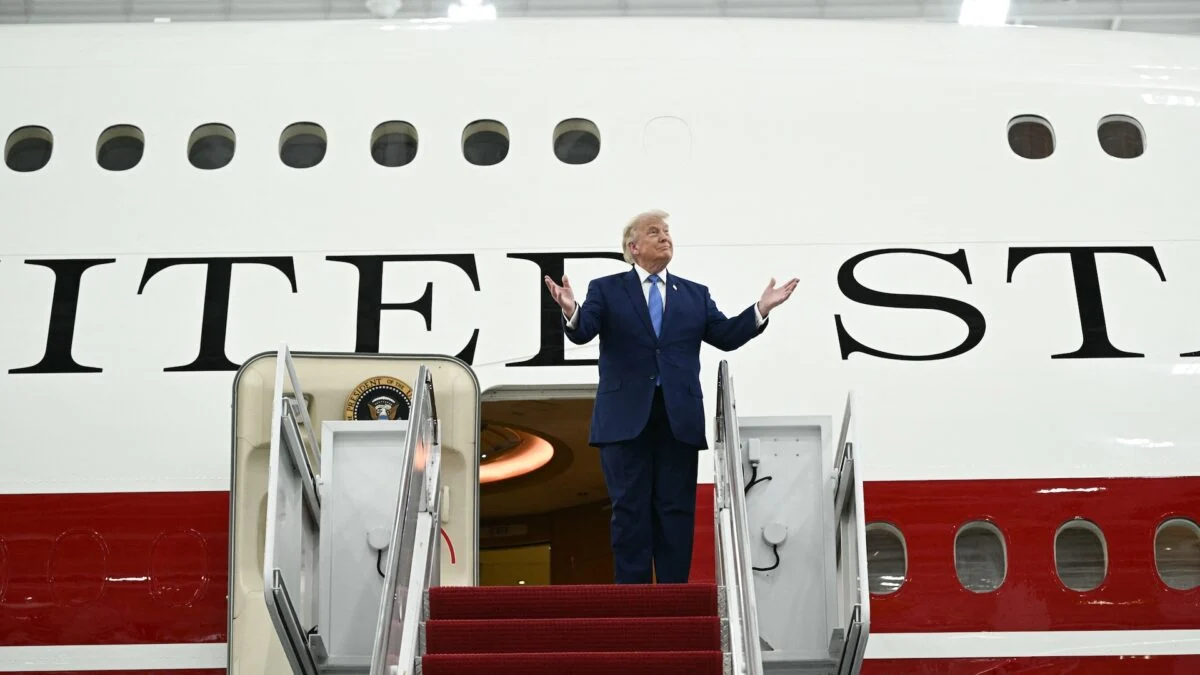
They photographed him walking down the stairs, grinning for cameras, and minutes later a catering container rolled away from the tarmac. I watched the footage and felt my skepticism snap into focus: the president, the press, and a box that bore the Do & Co logo. You and I have to agree this is not routine.
I’ve been reporting long enough to know when a public story is a cover and when it’s a performance; this felt like a magician’s misdirection. I’ll walk you through what the reporting says, what doesn’t add up, and the questions that should be shouted from the ramp.
A plane full of reporters taxied and took off, thinking the president was aboard.
That’s the first, simple fact that stretches credulity. According to the New York Times, staffers and journalists were on the older Air Force One and believed the president had boarded.
If those accounts are accurate, people were effectively left as live decoys. The BBC also reported that passengers were asked to keep window shades closed, which—if true—reads like a directive meant to keep intent and location murky.
So ask yourself this: would any sensible security team let a plane filled with unknowing people act as bait while a credible missile threat hangs overhead? The obvious answer is no, which makes whatever decision was made feel improvised at best and negligent at worst.
Did Trump actually leave Air Force One in a catering container?
The Washington Post first published the chain of events; the New York Times corroborated it. Video captured a Do & Co catering box being lowered onto a truck and loaded onto a military cargo plane. CBS News amplified the footage on social platforms.
I’ve examined the frames. The container had airline-style latches and the recognizable Do & Co branding; it was handled exactly as airline catering units are handled. According to the Do & Co site, those containers are standard equipment. That doesn’t make the story less bizarre — it makes it more concrete.
The administration staged photos of the president boarding an older plane, then flew him on a separate military aircraft.
That sequence was reported by multiple outlets: a staged departure, a stealth transfer into a cargo plane via a catering box, and then a flight to the U.K. where, later, Trump emerged on a different Air Force One.
Operationally, that’s a high-risk choreography with many moving parts: trucks, lifts, loadmasters, and small windows to slip a person in and out without being seen. If everything worked, it’s impressive for its precision; if it didn’t, it’s terrifying for its recklessness.
I asked myself why the new, Qatar-donated Air Force One would be treated as an asset you publicly parade yet privately avoid. Maybe the goal was deterrence—make adversaries think the president was on a plane believed to be more defensible. Or maybe the whole episode was a public-relations Trojan horse of PR, built to protect an image more than a person.
Were reporters and staffers knowingly used as decoys?
The Times described some passengers as “unknowing decoys.” That phrasing is not theatrical flourish; it’s a description of people put in harm’s way by misdirection. Steven Cheung, the White House communications director, later defended the action, saying the administration uses “distraction and misdirection” among its tools to address threats.
Whether that was sloppy transparency or sinister candor, it raises legal and ethical flags. If you were on that plane, would you accept that you were part of a security ploy without being told?
The administration’s official messaging about which plane carried the president was confused and inconsistent.
At the time, the story out of the White House was thin and shifting. Trump posted on Truth Social about bringing the new Air Force One to Mildenhall so service members could tour it; other statements framed his flying on an older plane as an homage “for old time’s sake.”
Those messages created a narrative problem: were they protecting classified defensive measures, or were they crafting a diversion? The answer matters, because the public’s right to accurate information about presidential safety is not optional.
Video shows the airport catering truck used in a secret operation to move President Trump from Air Force One to another U.S. government plane amid a credible Iranian threat last month.
The truck can be seen pulling away from Air Force One after the president had boarded the… pic.twitter.com/IwJTaWlmSb
— CBS News (@CBSNews) August 11, 2026
A scissor-lift lowered a catering unit marked Do & Co, then the container disappeared into a military cargo aircraft.
That sequence is visible on video published by the Times and amplified by other outlets. The images are plain: a catering box, straps, and handlers doing what handlers do.
The visuals have a forensic quality; they force you to reconcile official statements with what your eyes saw. Which brings us to the operational questions nobody has answered: chain of custody, personnel briefings, and risk assessments for having civilians present during a credible adversary threat.
Was there a credible Iranian threat at the time?
Multiple outlets reported the administration considered the Iran threat credible. The strikes Trump ordered while in Turkey for the NATO summit had heightened tensions, and senior defense officials later described the situation as serious enough to justify extraordinary precautions.
Still, credible threat assessments should produce clear, documented protocols. What we have instead is a series of opaque actions and public murk that invites more questions than it answers.
People on the ground at Mildenhall were told the new Air Force One would be there for tours.
That’s what Trump posted and what some U.S. posts suggested — that Mildenhall would host the new plane for personnel tours. It’s an odd choice given other large U.S. hubs in Europe, like Ramstein.
Who benefits from choosing that specific base for a reveal? My read is that the message was tailored for optics and loyalty: give a particular community a scoop while keeping the broader public guessing. That’s political theater, not crisis management.
I asked the White House and Pentagon for comment through Gizmodo; I didn’t get immediate answers. The press will keep pushing, and you should keep asking for clear, accountable explanations.
I’m not here to indulge rumor: I’m here to press on the discrepancies. Videos show a catering container being handled exactly as such containers are handled; multiple outlets corroborate the transfer. Yet the official story remains thin and puffed with PR claims on social platforms such as Truth Social, not concrete operational briefings from the Defense Department.
I’ll leave you with one last question: if the president can be moved through a service container and presented differently for cameras, who else should we expect will be shuffled for optics rather than safety?