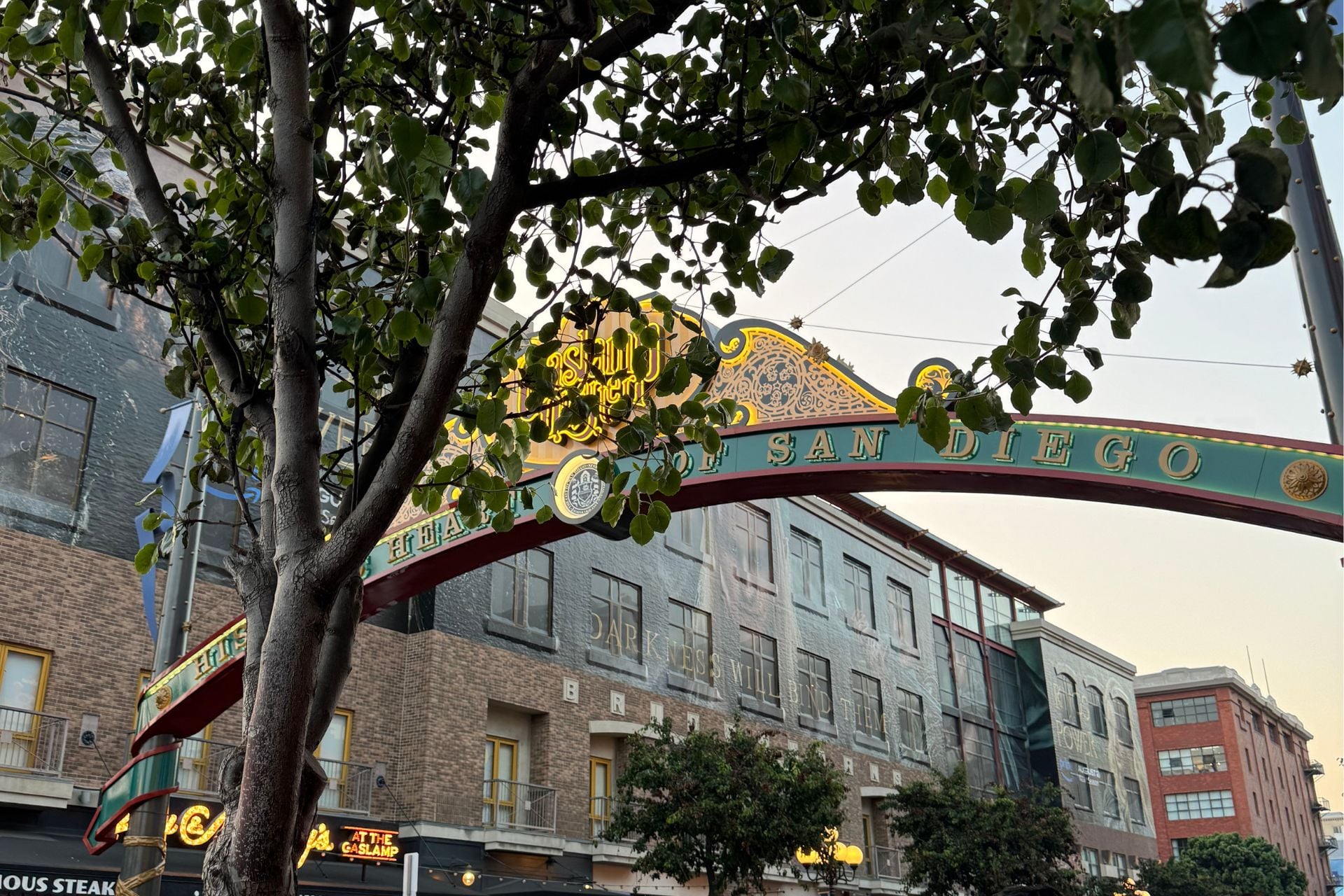
The Gaslamp arch disappeared under a giant advertising skin and a crowd stopped to take pictures. City officials warned the contractor for days and watched as the wrap went up anyway. Within a week, an iconic San Diego landmark had become a very public line-item in a Hollywood marketing budget.
I follow stunts like this because they reveal how studios balance risk against attention. You’ve seen the photo—Avengers: Doomsday stretched across the Gaslamp Quarter arch—and you probably wondered whether the spectacle was worth the fallout. I’ll walk you through what happened, who signed the tickets, and what the fine actually means for future Comic-Con campaigns.
A crowd slowed beneath the Gaslamp arch as photographers raised phones.
Marvel Studios was hit with a $160,000 (€147,200) fine after an Avengers: Doomsday wrap covered San Diego’s Gaslamp Quarter arch during Comic-Con. The wrap, created by Los Angeles firm Elevue Outdoor, was installed despite city warnings sent more than a week before the convention.
The San Diego Union-Tribune first reported the story; city spokesperson Richard Berg told the paper the contractor “knowingly created a safety risk and refused to address it.” io9 and other outlets have circulated the images nonstop. The stunt worked as attention-grabbing theater, but it wasn’t free.
How much was Marvel fined for covering the Gaslamp sign?
Short answer: $160,000 (€147,200). The penalty is actually a stack of daily fines imposed as city officials tried to force removal: $10,000 (€9,200) on Tuesday, another $10,000 (€9,200) on Wednesday, $20,000 (€18,400) on Thursday, $30,000 (€27,600) on Friday, $40,000 (€36,800) on Saturday, and $50,000 (€46,000) on Sunday. Those amounts add up quickly when enforcement becomes cumulative.
A line of city inspectors and staff escalated penalties as Comic-Con swelled.
San Diego has effectively banned outdoor advertising in the immediate Gaslamp area for decades, so the city treats wraps and banners during Comic-Con as illegal but tolerated—if companies accept the fines. This year the city issued $48,500 (€44,600) in advertising fines overall during the convention, more than double the 2025 total, according to the Union-Tribune.
Most advertisers treat the small fines as a predictable cost of doing business. What makes the Doomsday case exceptional is the scale and the public insistence on keeping the wrap up despite repeated orders to remove it. That escalation is why the single stunt transformed into a six-figure citation.
Why was Marvel fined at Comic-Con?
Because the wrap covered a protected landmark and, officials say, created a safety concern for the dense pedestrian flow during the city’s largest annual event. Elevue Outdoor told city staff about the installation in advance and was explicitly told not to proceed; the firm moved forward anyway. The enforcement language from San Diego framed the violations as both public-safety and code-violation issues.
An iconic sign was obscured while marketing teams watched the analytics spike.
If you’re marketing big-budget tentpoles, this is the calculus: a memorable image, guaranteed social traction, and a known fine schedule. Marvel and Elevue likely ran numbers on PR reach versus enforcement costs. The risk paid off in viral coverage—an expensive headline campaign rather than a traditional ad buy—so someone in the studio might mark the expense against the film’s gargantuan marketing spend.
The wrap was literally a curtain across a civic icon, and the stunt operated like a lightning rod for commentary from fans, officials, and local business owners. Either you admire the audacity, or you see a studio willing to flout local rules to generate buzz; both reactions will keep the story alive in feeds and boardrooms alike.
Do companies accept these fines as the cost of advertising during Comic-Con?
Yes—often. Hotel wraps and large street covers have become a predictable line item for some brands at Comic-Con, which is why the city’s prohibition persists in name but not always in effect. Still, the scale matters: minor fines are absorbed; a rollup to six figures makes the tactic much more visible and debatable.
Avengers: Doomsday opens December 18. No arrests were made in the reporting of this piece, but a landmark was temporarily silenced for marketing—who pays the reputational bill for that?