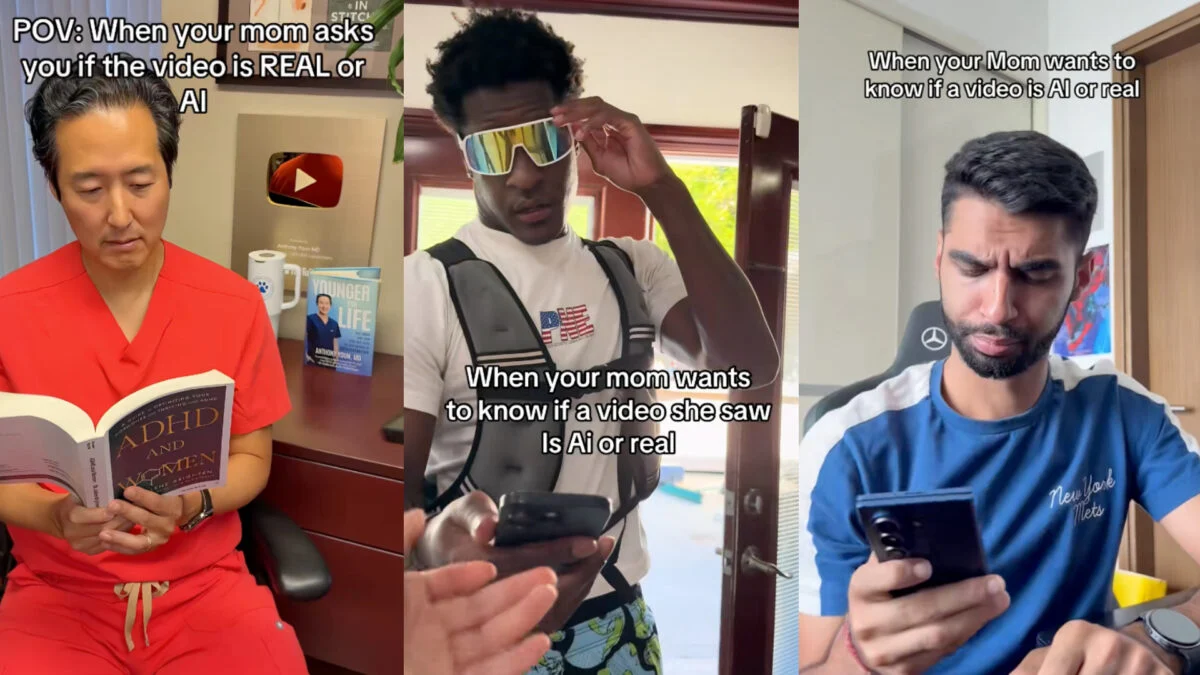
I got a message at 2 a.m.: “Mom says this elephant walked up stairs—real?” I opened the clip, and my chest tightened at how easy it was to believe. I braced, because you’ll be answering that same question from someone you love before long.
Who shared the elephant clip
A short, silly video labeled as a joke spread from a TikTok trend to X threads within hours.
I watched the version Angry Tom posted, captioned to mock older viewers, and I felt the social math at work: ridicule fuels sharing more fiercely than wonder. The clip shows a young man on an elephant as the animal achieves impossible movements; it earns traction because the punchline is generational. AI content here functions as social bait rather than art.
Boomers gonna be praising Jesus over this one. pic.twitter.com/zoxuo3Us9q
— Angry Tom (@AngryTomtweets) August 30, 2026
AI clips have become carnival mirrors—distorting the familiar into something grotesque. When the distortion is the point, attention follows different rules.
What the TikTok trend reveals
On TikTok, creators are stringing together the most absurd AI outputs and tagging them for shock value.
That trend turns AI garbage into a communal joke. People who want to feel clever share the over-the-top clips while pointing at a target: older viewers, gullible friends, the algorithm itself. The humor spreads, and the videos gain views not because anyone is impressed by the craft, but because the clip performs as a social signal.
The joke is sometimes on older adults, sometimes on AI itself. Most viewers would rather mock a bad fake than admire a convincing one with no story behind it.
How can I tell if a video is AI-generated?
Start by checking context: who posted it, when, and what else they post. Use reverse-frame search, inspect reflections and shadows, and watch for subtle motion errors—hands, water, clothing physics, and lip-sync are common giveaways. Tools such as Community Notes on X, reverse-frame search engines, and forensic services from platforms like Microsoft, Google, or initiatives in the verification community can help. If the account is new, the clip drops from an anonymous handle, or a Community Note flags manipulation, treat the clip with skepticism.
Why we stop caring about fakes
A thread that once boasted thousands of shares collapsed after someone added a Community Note identifying a clip as AI.
I watched the Townhall Media editor post a sentimental human-statue clip that tanked once verification arrived. Momentum is fragile: when a video gets tagged as manufactured, viewers abandon it. Emotions hinge on belief. A manufactured slice of wonder has no gravity unless you suspend disbelief and invest in a character or a story.
Life is beautiful. pic.twitter.com/MMEtN40jw5
— L A R R Y (@LarryOConnor) August 30, 2026
Spider-Man films work because they give us stakes and a person to care about. AI-generated stunts without story are empty dazzle; the effect vanishes when you know the trick.
Is a video worth watching if it’s made with AI?
It depends on what you want: spectacle, narrative, or proof. I find that footage meant to convince—proof of a strange event—loses value when declared synthetic. By contrast, deliberately crafted fiction that uses AI to tell a story can still grip you. Platforms such as Runway, Midjourney, and Stable Diffusion are tools; the deciding factor is whether the creator invited you into an emotional contract.
Who profits from the blur between real and fake
Big tech and attention markets are placing bets on your inability to tell the difference.
Elon Musk publicly predicts a future where AI creates most media, and many industry players are designing tools that make production cheap and ubiquitous. That creates two markets: creators who make persuasive, story-driven work, and opportunists who feed short bursts of novelty. The latter wins clicks at scale, and the incentive structure trains the feed to favor cheap surprise over durable meaning.
— Elon Musk (@elonmusk) August 13, 2026
The social feed is a rubber band, snapping attention between the real and the fake. If you want healthier viewing habits, teach the people around you simple verification moves: pause, search, check context, and ask who benefits from this clip spreading.
You can still enjoy crafted AI films and visual effects, but when the point is only to trick, the reward is hollow. The question is not whether AI will make more content, but what that content will ask of you—time, trust, or laughter—and which of those you are willing to give up?