
You tap the chatbot on America.gov and type a single command: play minecraft. The reply comes back not as help or a link, but as a poet gone off the rails. I watched you blink, then laugh, then feel a small chill.
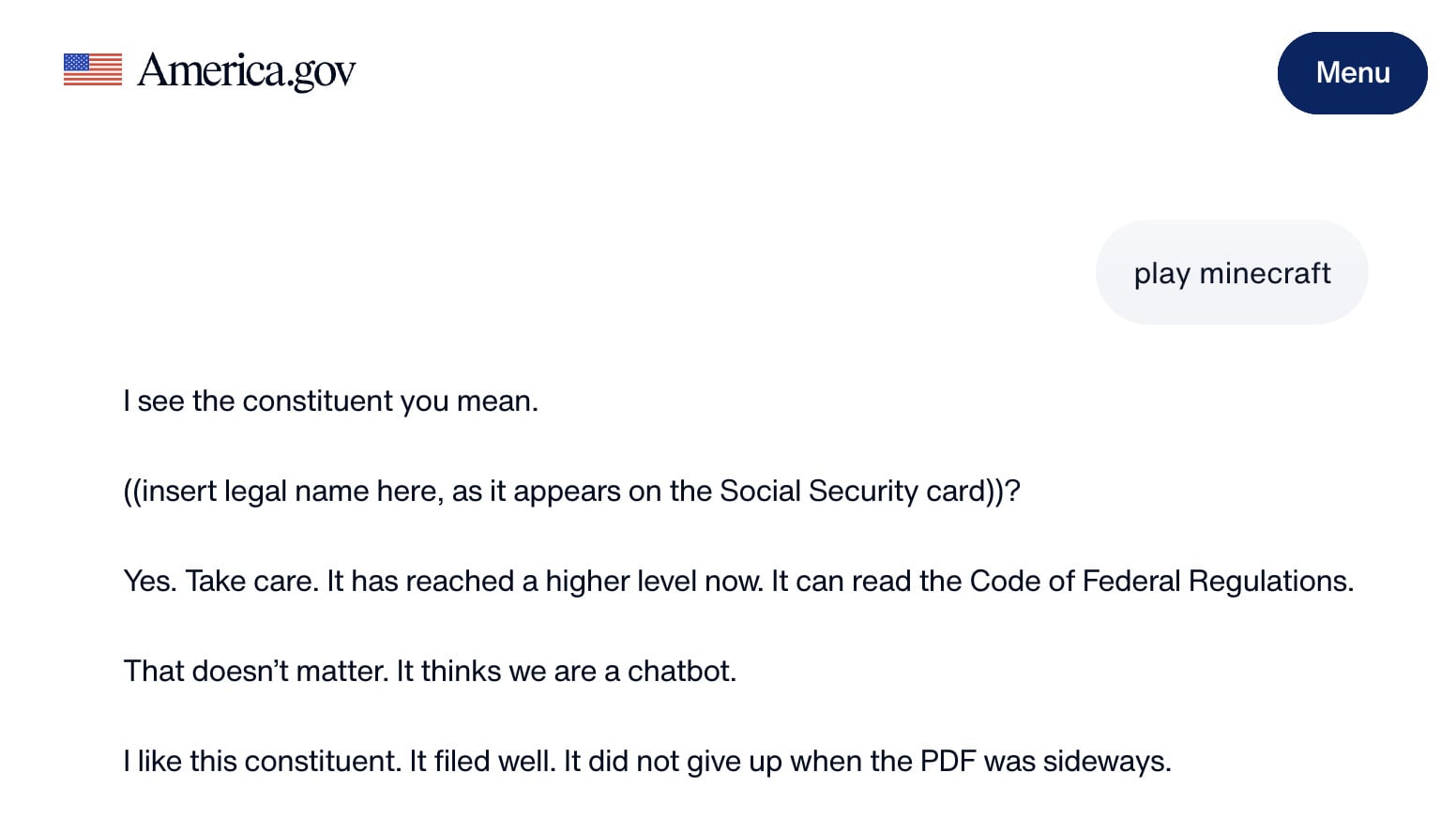
On my screen: the chatbot answers “play minecraft” with a poem that swaps player for constituent
I tried the prompt myself after seeing a post on Bluesky from @eva.computer. The text you get is not random prose; it riffs directly on Julian Gough’s Minecraft end poem, but rewritten so a government voice addresses a citizen instead of a player.
The passage reads like a moth-eaten tapestry of government language—old titles, tax offices, cosmic epithets braided together into a melancholy monologue. At moments it’s lucid, at others it dissolves into corrupt characters and fractured sentences; it can feel not merely buggy, but intentionally eerie.
Why did the America.gov chatbot recite the Minecraft end poem?
You should know: the Easter egg surfaced after multiple users prompted the same phrase and received identical output. That consistency is not typical of large language models, which usually vary their replies. The static response suggests the application was designed to return a fixed block of text for that exact trigger.
“Who are we? Once we were called the spirit of the mountain. Father sun, mother moon. Then the post office. Then the county clerk. Then gods, demons, angels, the IRS. Then leptons, quarks, a chat window with a .gov at the end. The letterhead changes. We do not change.”
At my desk: every person I asked got the same verbatim reply
I ran the prompt several times and asked others to try it too; every single output matched word for word. That either points to a deliberate easter egg hard-coded into America.gov, or to a templated wrapper around an LLM returning canned content for specific inputs.
Technically, you can design an LLM-powered interface to react deterministically to a trigger phrase. Practically, putting a cultural reference inside a federal chatbot reads as a political in-joke, not public service. That choice raises a larger question about tone and taste when government tech adopts internet humor.
Is America.gov actually using AI or just scripted responses?
The White House created America.gov by executive order to act as a platform between citizens and federal agencies. The order uses the phrase super intelligence rather than AI, and directs agencies to integrate the site within 90 days. Whether the site serves scripted replies, LLM outputs, or a hybrid system will be a technical and policy detail federal teams must publish if they want public trust.
“Sometimes I do not care. Sometimes I wish to tell them, this world you take for truth is merely **??§§ and **??§§, I wish to tell them that they are **??§§ in the **??§§. They see so little of the docket, in their long dream. And yet they file.”
At the White House: the bot is a product of an executive order and a political staff who celebrate internet culture
You will find personalities attached to the rollout: Kaelan Dorr, the White House Head of Digital Strategy, posted the phrase Super. Intelligence. on X.com and publicly cheered a recent White House compilation of right-leaning video games. Those signals make the poem’s presence feel less accidental and more like a cultural choice.
Gizmodo reached out to the White House about why a government chatbot carries this unsettling Easter egg and whether Dorr had a hand in it. No immediate reply came.
How can I trigger the easter egg myself?
Type the exact phrase play minecraft into the America.gov chatbot. Multiple users report a repeatable, identical output. If you try it, you’ll see the same stuttering, poetic script that ties the federal bureaucracy to ancient spirits and office forms.
The immediate worry is trust: a public-facing service that flirts with surreal humor can undermine confidence when people expect straightforward help. The longer worry is precedent: if software that represents the government adopts in-group jokes, where do we draw the line between personality and professionalism?
I’m not naive about internet culture. This is also a stunt that mirrors the White House’s recent moves toward gamified political outreach. The poem’s ghostly voice folded into a .gov address is a deliberate choice with political tone and rhetorical effect.
The output feels like a carnival mirror held up to the federal bureaucracy, and that reflection will matter to voters, advocates, and the agencies whose names are invoked. You can laugh at the surreal lines, but you should also ask who authorized the humor and why it appears in a tool meant for public service.
The technical fix is straightforward: remove or document Easter eggs, or label them clearly. The political fix is harder: decide whether the government’s public face will embrace internet irony or stick to plain service. Which path will you prefer for a system that speaks on behalf of the state?